
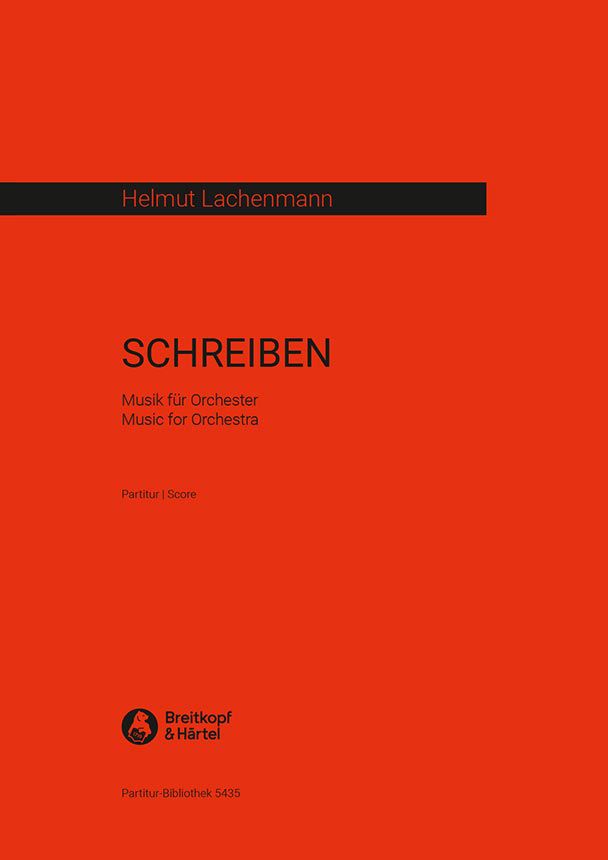
Helmut Lachenmann
SCHREIBEN
Music for Orchestra
PDF
view
Helmut Lachenmann
SCHREIBEN
Music for Orchestra
- Instrumentation Orchestra
- Composer Helmut Lachenmann
- Edition Score
- Publisher Breitkopf & Härtel
- Order no. PB5435
 ships within 2-5 working days
incl. tax,
excl. shipping costs
Not available in all countries. Learn more

Description:
My own new orchestral composition has the title 'WRITING'. The practical action of writing, as a mechanical action by hand, pen, brush, on a surface (paper, parchment, stone, etc.), triggered and controlled by a communicative need and, with all spontaneity, controlled by the rules of writing and language, is for me one of the most mysterious processes in everyday interpersonal life, in which human spirit and dead matter meet: thoughts or thought are recorded on a surface - paper, parchment, stone - entrusted to it, so to speak. And on this detour via language, writing and engraving they meet the spirit of the reading or deciphering fellow human being. As a composer, however, I ask: is there also another causality, is there, for example, an 'autonomous' writing, a sense-free sign-giving, through unleashed, released locomotion of the writing hand, where the writer only watches his own writing in amazement?
Aren't pictures, even 'abstract' ones, written in Japan??
(In an underground film of the 1970s about the young Mozart, the viewer sees himself transported into a room of an Italian inn, where the young Mozart, traveling through, is hurriedly putting the recitatives of one of his Italian operas to paper at the table. For more than a quarter of an hour we are present, listening not to the developing music, but to the nervous scratching of the pen on the coarse music paper in afternoon silence - only the steady pendulum beat of the wall clock can still be heard - and we experience this secondary sound world hardly less intensely than other listeners afterwards experience the music silently developing in the process.)
The orchestra in my piece 'writes'. It adds stroke to stroke, understands itself as a kind of multifaceted 'writing device'. We as listeners do not read the 'written', but we hear the process of writing, the stroke of the bow, the movement of the scraping wooden stick on fur or tam-tam, and we observe its imitation or transformation by wind instruments - at times also toneless - joining to linear figures as a kind of sounding writing ceremony. The result is a music which occasionally forgets its mental starting point and develops and transforms itself as an autonomous sound situation, and which finally writes a kind of 'cantilena' in the highest register.
Whoever writes the German word 'Schreiben' (engl. 'to write') inevitably also writes the word 'Schrei' (engl. 'shout'), and he also writes the word 'reiben' (engl. 'to rub'). As emotional as the first term can be thought, as sober-practical is the second one. My piece is characterized by both aspects, including their opposites.
(Helmut Lachenmann, 2003)
Addition: Immediately after the wonderful premiere of the piece in 2003 in the Suntory Hall, together with my piano concerto 'Ausklang' - lovingly and concentratedly rehearsed and sovereignly arranged by Maestro Kazuyoshi Akyama, to whom the work is dedicated, and with whom I have felt connected in great admiration and gratitude for 40 years - I revised 'SCHREIBEN' and extended it by about 40 bars. And so, after many more performances in Europe, it finally returns to its birthplace.
(Helmut Lachenmann, June 15, 2012)
Aren't pictures, even 'abstract' ones, written in Japan??
(In an underground film of the 1970s about the young Mozart, the viewer sees himself transported into a room of an Italian inn, where the young Mozart, traveling through, is hurriedly putting the recitatives of one of his Italian operas to paper at the table. For more than a quarter of an hour we are present, listening not to the developing music, but to the nervous scratching of the pen on the coarse music paper in afternoon silence - only the steady pendulum beat of the wall clock can still be heard - and we experience this secondary sound world hardly less intensely than other listeners afterwards experience the music silently developing in the process.)
The orchestra in my piece 'writes'. It adds stroke to stroke, understands itself as a kind of multifaceted 'writing device'. We as listeners do not read the 'written', but we hear the process of writing, the stroke of the bow, the movement of the scraping wooden stick on fur or tam-tam, and we observe its imitation or transformation by wind instruments - at times also toneless - joining to linear figures as a kind of sounding writing ceremony. The result is a music which occasionally forgets its mental starting point and develops and transforms itself as an autonomous sound situation, and which finally writes a kind of 'cantilena' in the highest register.
Whoever writes the German word 'Schreiben' (engl. 'to write') inevitably also writes the word 'Schrei' (engl. 'shout'), and he also writes the word 'reiben' (engl. 'to rub'). As emotional as the first term can be thought, as sober-practical is the second one. My piece is characterized by both aspects, including their opposites.
(Helmut Lachenmann, 2003)
Addition: Immediately after the wonderful premiere of the piece in 2003 in the Suntory Hall, together with my piano concerto 'Ausklang' - lovingly and concentratedly rehearsed and sovereignly arranged by Maestro Kazuyoshi Akyama, to whom the work is dedicated, and with whom I have felt connected in great admiration and gratitude for 40 years - I revised 'SCHREIBEN' and extended it by about 40 bars. And so, after many more performances in Europe, it finally returns to its birthplace.
(Helmut Lachenmann, June 15, 2012)