
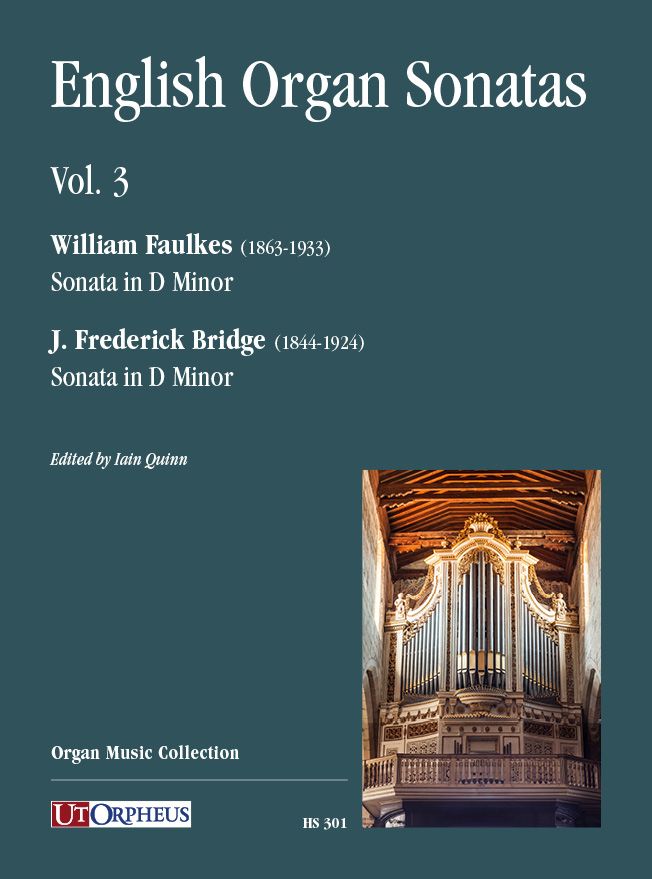
Frederick Bridge, William Faulkes
English Organ Sonatas 3
PDF
view
Frederick Bridge, William Faulkes
English Organ Sonatas 3
- Instrumentation Organ
- Composer Frederick Bridge William Faulkes
- Editor Iain Quinn
- Edition Sheet Music
- Publisher UT Orpheus Edizioni
- Order no. ORPH-HS301
 in stock
ships within 1-2 working days
incl. tax,
excl. shipping costs
Not available in all countries. Learn more
Description:
William Faulkes (1863-1933): Sonata in Re minore
J. Frederick Bridge (1844-1924): Sonata in Re minore
The organ sonatas of William Faulkes (1863-1933) and J. Frederick Bridge (1844-1924) are elegant examples of the style that many Victorian composers fostered in their writing for the developing symphonic organ in England. They are playable on both small and large instruments and allow for creativity in registration. They are also of limited technical difficulty and have an inimitable charm that could relate well to an audience and congregation alike.
As discussed in The Genesis and Development of an English Organ Sonata (2017), the English sonatas had an important pedagogical role jointly inherited from Mendelssohn’s very practical and popular approach to the instrument and the continued European legacy of the lesson-sonata tradition whereby in learning a piece you also learned the instrument and vice versa.
J. Frederick Bridge (1844-1924): Sonata in Re minore
The organ sonatas of William Faulkes (1863-1933) and J. Frederick Bridge (1844-1924) are elegant examples of the style that many Victorian composers fostered in their writing for the developing symphonic organ in England. They are playable on both small and large instruments and allow for creativity in registration. They are also of limited technical difficulty and have an inimitable charm that could relate well to an audience and congregation alike.
As discussed in The Genesis and Development of an English Organ Sonata (2017), the English sonatas had an important pedagogical role jointly inherited from Mendelssohn’s very practical and popular approach to the instrument and the continued European legacy of the lesson-sonata tradition whereby in learning a piece you also learned the instrument and vice versa.
-
Faulkes: Sonata D minor
-
Bridge: Sonata D minor
Customers rated this product:
Manufacturer Information:
Ut Orpheus Edizioni S.r.l.
Via Marsala 31/E
40126
Bologna
Italien
Related products:
- Organ
- Sheet Music
- UT Orpheus Edizioni
-
in stock
ships within 1-2 working days
- Organ
- Sheet Music
- UT Orpheus Edizioni
-
ships within 1-2 weeks

- Organ
- Sheet Music
- UT Orpheus Edizioni
-
ships within 2-4 working days

- Organ
- Sheet Music
- UT Orpheus Edizioni
-
in stock
ships within 1-2 working days

- Organ
- Sheet Music
- UT Orpheus Edizioni
-
ships within 1-2 weeks

- Organ
- Sheet Music
- UT Orpheus Edizioni
-
ships within 2-4 weeks

- Organ
- Sheet Music
- UT Orpheus Edizioni
-
ships within 1-2 weeks
- Organ
- Sheet Music
- UT Orpheus Edizioni
-
in stock
ships within 1-2 working days
- Organ
- Sheet Music
- UT Orpheus Edizioni
-
ships within 2-4 working days

- Organ
- Sheet Music
- UT Orpheus Edizioni
-
ships within 1-2 weeks

- Organ
- Sheet Music
- UT Orpheus Edizioni
-
ships within 1-2 weeks