
Paul Hindemith
Nobilissima Visione
Suite nach der Musik der Tanzlegende

Paul Hindemith
Nobilissima Visione
Suite nach der Musik der Tanzlegende
- Instrumentation Organ
- Edition Sheet Music
-
Difficulty Level
- Composer Paul Hindemith
- Publisher Schott Musik
- Editor Pier Damiano Peretti
- Order no. ED24075
incl. tax,
excl. shipping costs
 ships within 2-4 working days

Description:
Paul Hindemith’s orchestral work *Nobilissima Visione* was composed—as a "dance legend in six scenes"—in collaboration with the Russian-French choreographer Léonide Massine. Together, they had viewed Giotto di Bondone’s (1267–1337) fresco cycle *Storie di San Francesco* in Florence (Church of Santa Croce) in May 1937. Inspired by this experience, they developed the idea for a dance-based mystery play, which Massine later described as a "dramatic and choreographic depiction of the life of St. Francis" that sought "throughout to create and maintain an atmosphere of mystical exaltation." The final movement, a passacaglia, symbolizes the saint’s "Canticle of the Sun," which has been preserved only in written form.
The fifty-minute ballet was presented in London in July 1938; that same year, Hindemith compiled a selection of five movements from the original eleven, which premiered as an orchestral suite in Venice in September 1938. It is this version that has found its way into the orchestral repertoire; it also forms the basis for the present arrangement.
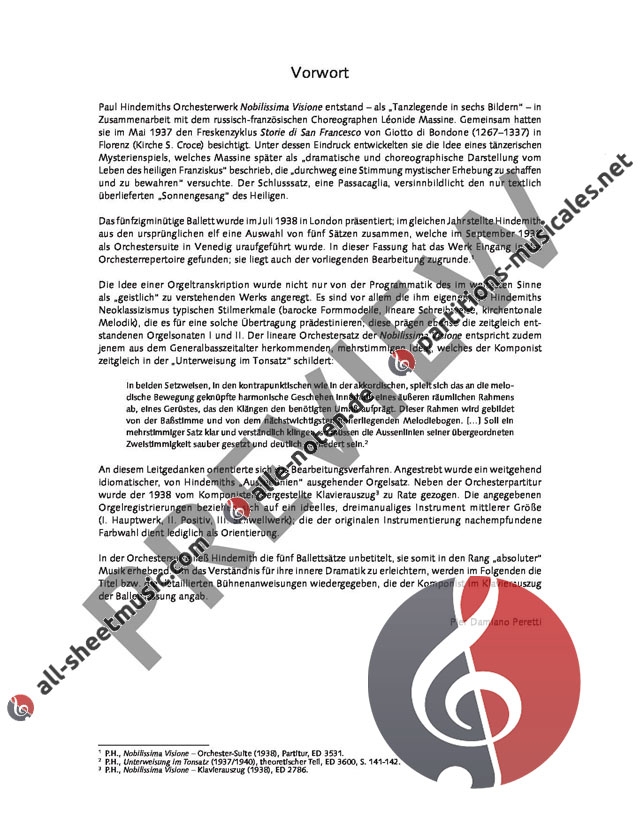
The idea for an organ transcription was inspired not only by the programmatic nature of the work, which can be understood as "spiritual" in the broadest sense. Above all, it is the stylistic characteristics unique to Hindemith’s neoclassicism (Baroque formal models, linear composition, church-modal melodies) that make it ideally suited for such a transcription; these characteristics also shape the Organ Sonatas I and II, composed at the same time. Furthermore, the linear orchestral texture of *Nobilissima Visione* corresponds to the polyphonic ideal originating from the era of the basso continuo, which the composer describes at the same time in his *Instruction in Composition*:
"In both styles of composition—contrapuntal and chordal—the harmonic development linked to the melodic movement takes place within an outer spatial framework, a structure that imparts the necessary outline to the sounds. This framework is formed by the bass voice and the next most important melodic line above it. […] If a polyphonic movement is to sound clear and intelligible, the outer lines of its overarching two-part structure must be clearly defined and distinctly articulated."
The arrangement process was guided by this central principle. The aim was to create an organ arrangement that was largely idiomatic and based on Hindemith’s "outer lines." In addition to the orchestral score, the piano reduction prepared by the composer in 1938 was consulted. The organ registrations indicated refer to an idealized, medium-sized three-manual instrument (I. Hauptwerk, II. Positiv, III. Schwellwerk); the choice of timbres, modeled after the original instrumentation, serves merely as a guide.
- Pier Damiano Peretti
Customers rated this product:
alle-noten.de: Sheet music shipping since 1969

Since 1969, over 500,000 customers have trusted us. With a huge selection of over 1,000,000 sheet music titles, we are one of the largest providers in Europe. Thanks to our large stock we can often ship sheet music within 24 hours. No matter what sheet music you are looking for: you are in the right place!
Yours, Stefanie Reichert
Head of Customer Service
Related products:


- Organ
- Sheet Music Download
- Pier Damiano Peretti
- Schott Musik
-
-
immediately available
|
Download immediately after ordering
- Instant download