
Johann Sebastian Bach
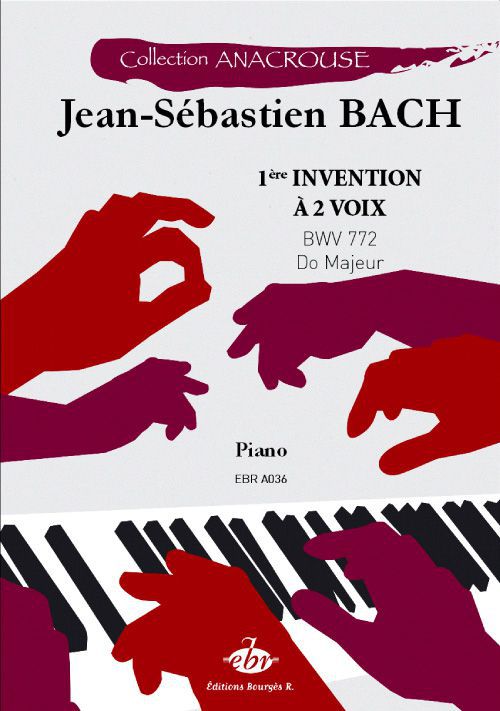
1ère Invention A 2 Voix Do Majeur BWV 772
Demo
listen
Johann Sebastian Bach
1ère Invention A 2 Voix Do Majeur BWV 772
- Instrumentation Piano
- Composer Johann Sebastian Bach
- Edition Sheet Music
- Publisher Editions Bourgès R.
- Order no. EBRA036
 ships within 2-4 weeks
Description:
The ANACROUSE collection offers novice and experienced pianists alike a wide choice of classical works, from the Renaissance to the modern era.
We have set ourselves the goal of offering both "must-haves" from the classical repertoire and pieces by sometimes forgotten composers, all of undeniable pedagogical value. Each piece, sold individually, has been the subject of careful editorial work, both in terms of the musical text and its engraving, in order to guarantee musicians the conditions essential to the pleasures derived from frequent trade in these works.
The scores are offered in traditional book form (paper sheets), and also available by download.
Jean Sebastien Bach wrote 15 Inventions for two voices (BWV 772-786) and 15 Inventions for three voices (BWV 787-801), which he called Sinfonias. He published them in Cöthen in 1723. They are didactic works. Bach's main aim with these thirty inventions was to instruct and establish a method for children. In the preface to one of the autograph manuscripts of the Inventions, he expresses his thoughts: "A sincere method intended for amateurs and apprentices, to teach them to play correctly with two parts, to proceed subsequently correctly and well with two or three obligatory parts, to have good inventions, to acquire a singing way of playing, as well as a foretaste of composition".
Thus the pieces are grouped according to the order of the semitones of the scale, and not according to the increasing complication of the keys. Each invention has a single thematic motif. This motif can be enlarged into a theme and then carried out in counterpoint with other smaller motifs, and the search for a rigorous balance in each invention is a great difficulty that may be beyond the comprehension of a novice pianist. In these pieces, Bach integrates a whole panoply of technical devices such as canon, counterpoint, the complexity of composition requiring the use of the harmonic pedal and the way to ornament a thematic motif.
We can glimpse in these Inventions a way of synthesizing his working method and an initiation to musical writing.
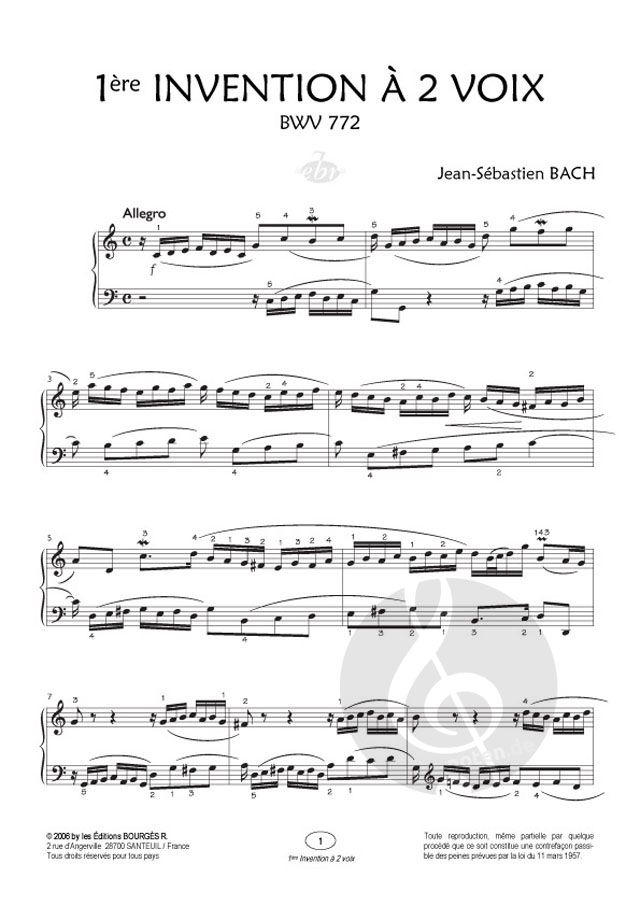
Consisting of a four-beat binary measure, the initial theme of Invention no. 1 is presented first to the right hand and concludes with an immediate response in the left hand. Both hands then contribute to its enrichment, developing until its recapitulation in the ninth bar, when it is revealed once again in its reverse in the dominant key. Composed of twenty-two bars, this theme and its inverse obnubilate the whole of this first invention, expressing delicate thoughts in a lilting way.
The fleeting sensation of feeling mixed with Bach's counterpoint demands dexterity from pianists in the search for the absolute.
We have set ourselves the goal of offering both "must-haves" from the classical repertoire and pieces by sometimes forgotten composers, all of undeniable pedagogical value. Each piece, sold individually, has been the subject of careful editorial work, both in terms of the musical text and its engraving, in order to guarantee musicians the conditions essential to the pleasures derived from frequent trade in these works.
The scores are offered in traditional book form (paper sheets), and also available by download.
Jean Sebastien Bach wrote 15 Inventions for two voices (BWV 772-786) and 15 Inventions for three voices (BWV 787-801), which he called Sinfonias. He published them in Cöthen in 1723. They are didactic works. Bach's main aim with these thirty inventions was to instruct and establish a method for children. In the preface to one of the autograph manuscripts of the Inventions, he expresses his thoughts: "A sincere method intended for amateurs and apprentices, to teach them to play correctly with two parts, to proceed subsequently correctly and well with two or three obligatory parts, to have good inventions, to acquire a singing way of playing, as well as a foretaste of composition".
Thus the pieces are grouped according to the order of the semitones of the scale, and not according to the increasing complication of the keys. Each invention has a single thematic motif. This motif can be enlarged into a theme and then carried out in counterpoint with other smaller motifs, and the search for a rigorous balance in each invention is a great difficulty that may be beyond the comprehension of a novice pianist. In these pieces, Bach integrates a whole panoply of technical devices such as canon, counterpoint, the complexity of composition requiring the use of the harmonic pedal and the way to ornament a thematic motif.
We can glimpse in these Inventions a way of synthesizing his working method and an initiation to musical writing.
Consisting of a four-beat binary measure, the initial theme of Invention no. 1 is presented first to the right hand and concludes with an immediate response in the left hand. Both hands then contribute to its enrichment, developing until its recapitulation in the ninth bar, when it is revealed once again in its reverse in the dominant key. Composed of twenty-two bars, this theme and its inverse obnubilate the whole of this first invention, expressing delicate thoughts in a lilting way.
The fleeting sensation of feeling mixed with Bach's counterpoint demands dexterity from pianists in the search for the absolute.