
Erik Satie
3 Gnossiennes
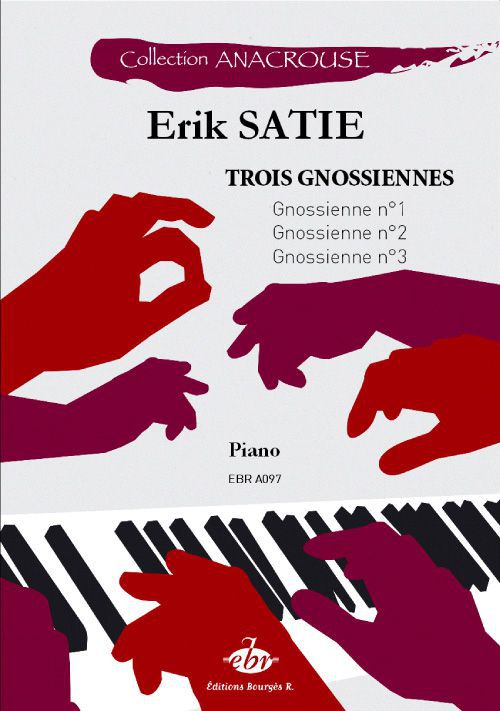
Erik Satie
3 Gnossiennes
- Instrumentation Piano
- Composer Erik Satie
- Editor Patrice Bourgès Sarah Fahy
- Edition Sheet Music
- Publisher Editions Bourgès R.
- Order no. EBRA097
 ships within 3-6 working days
incl. tax,
excl. shipping costs
Not available in all countries. Learn more
Description:
The ANACROUSE collection offers novice and experienced pianists alike a wide choice of classical works, from the Renaissance to the modern era.
We have set ourselves the goal of offering both "must-haves" from the classical repertoire and pieces by sometimes forgotten composers, all of undeniable pedagogical value. Each piece, sold individually, has been the subject of careful editorial work, both in terms of the musical text and its engraving, in order to guarantee musicians the conditions indispensable to the pleasures derived from frequent trade in these works.
The scores are offered in the form of traditional works (paper sheets), and also available by download.
Version revised in 2010 by Sarah Fahy and Patrice Bourgès.
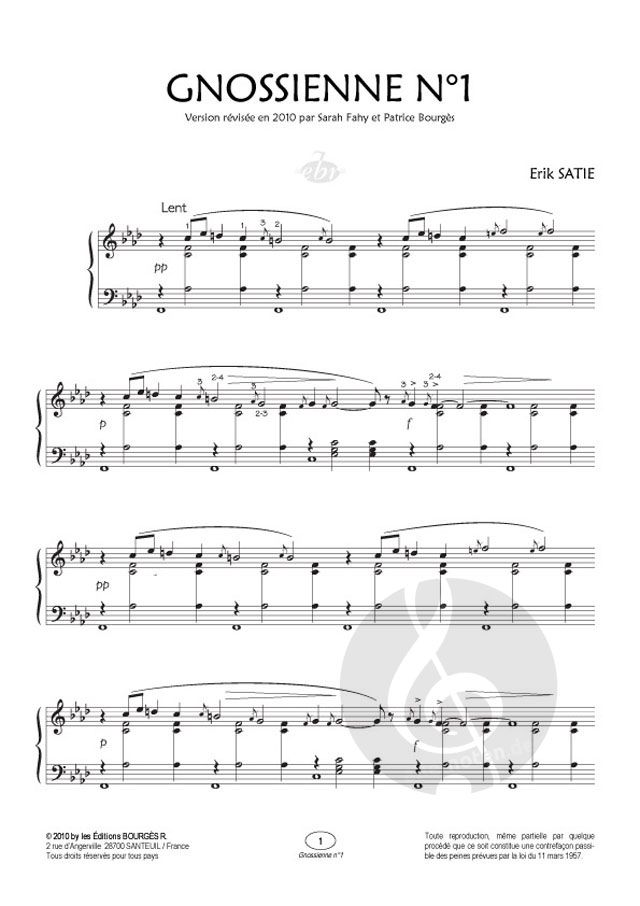
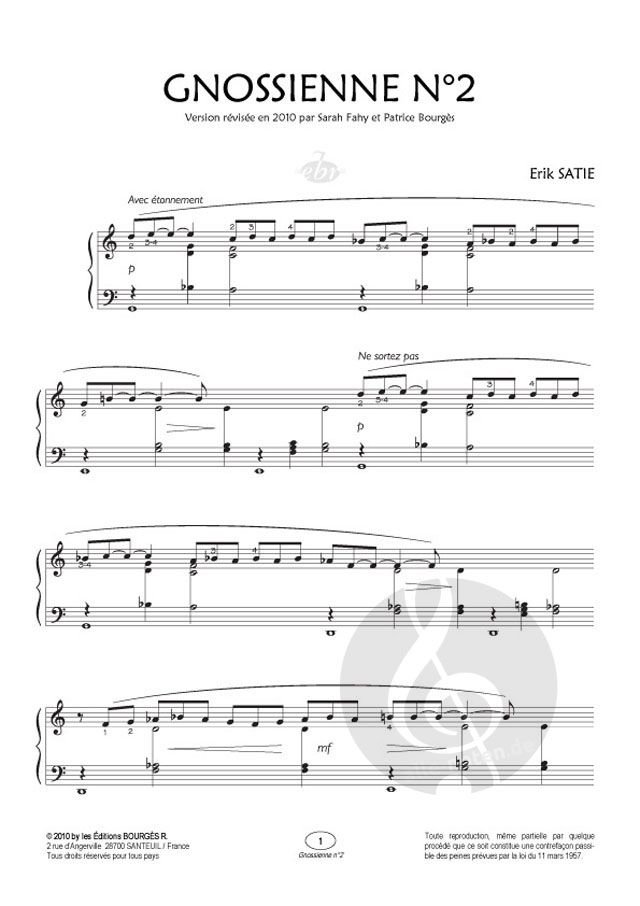
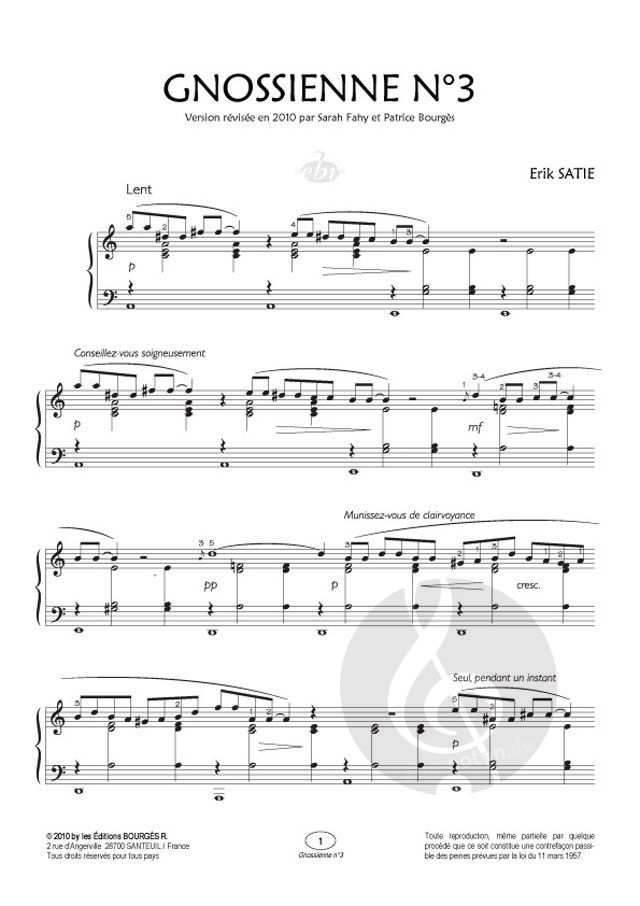
Composed between 1890, for the first and third, and 1893, for the second, the three Gnossiennes, published during the composer's lifetime, are almost as famous as their elder sisters the Gymnopédies.
There have been all kinds of interpretations of the word "Gnossienne", but it is identified above all with his music, enigmatic, haunting in its repetitions, rhythmic monotony, oriental melismas and silences.
In each of these three pieces, rhythm plays an essential role: the music, stripped of the bar line, unfolds over a syncopated bass that gives it great unity.
The great novelty of the Gnossiennes lies in the presence, for the first time, of fanciful annotations intended for the performer. For the most part, these are no more than musical directives: "postulate in yourself", "bury the sound", "in great goodness", suggest a state of mind, a sonority or a pace. But some add to the mystery of the music, such as the famous "open your head".
We have set ourselves the goal of offering both "must-haves" from the classical repertoire and pieces by sometimes forgotten composers, all of undeniable pedagogical value. Each piece, sold individually, has been the subject of careful editorial work, both in terms of the musical text and its engraving, in order to guarantee musicians the conditions indispensable to the pleasures derived from frequent trade in these works.
The scores are offered in the form of traditional works (paper sheets), and also available by download.
Version revised in 2010 by Sarah Fahy and Patrice Bourgès.
Composed between 1890, for the first and third, and 1893, for the second, the three Gnossiennes, published during the composer's lifetime, are almost as famous as their elder sisters the Gymnopédies.
There have been all kinds of interpretations of the word "Gnossienne", but it is identified above all with his music, enigmatic, haunting in its repetitions, rhythmic monotony, oriental melismas and silences.
In each of these three pieces, rhythm plays an essential role: the music, stripped of the bar line, unfolds over a syncopated bass that gives it great unity.
The great novelty of the Gnossiennes lies in the presence, for the first time, of fanciful annotations intended for the performer. For the most part, these are no more than musical directives: "postulate in yourself", "bury the sound", "in great goodness", suggest a state of mind, a sonority or a pace. But some add to the mystery of the music, such as the famous "open your head".