
Wolfgang Amadeus Mozart
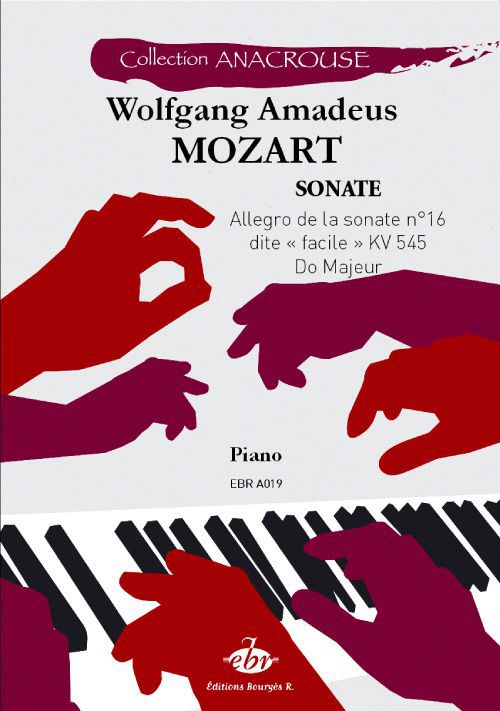
Allegro Sonate No. 16
Demo
listen
Wolfgang Amadeus Mozart
Allegro Sonate No. 16
- Instrumentation Piano
- Composer Wolfgang Amadeus Mozart
- Edition Sheet Music
- Publisher Editions Bourgès R.
- Order no. EBRA019
 ships within 2-4 weeks
Description:
The ANACROUSE collection offers novice and experienced pianists alike a wide choice of classical works, from the Renaissance to the modern era.
We have set ourselves the goal of offering both "must-haves" from the classical repertoire and pieces by sometimes forgotten composers, all of undeniable pedagogical value. Each piece, sold individually, has been the subject of careful editorial work, both in terms of the musical text and its engraving, in order to guarantee musicians the conditions indispensable to the pleasures derived from frequent trade in these works.
The scores are offered in the form of traditional works (paper sheets), and also available by download.
This so-called easy sonata or "sonata semplice" is Mozart's most famous. Its subtitle is misleading, for it is not as easy as one might think. In fact, Mozart's pianistic mastery and science fail to reveal the real difficulty of this sonata. It was first performed on June 26, 1788, a few years before the composer's death. The purpose of this creation is said to be half-pedagogical, half-commercial, hence its nickname.
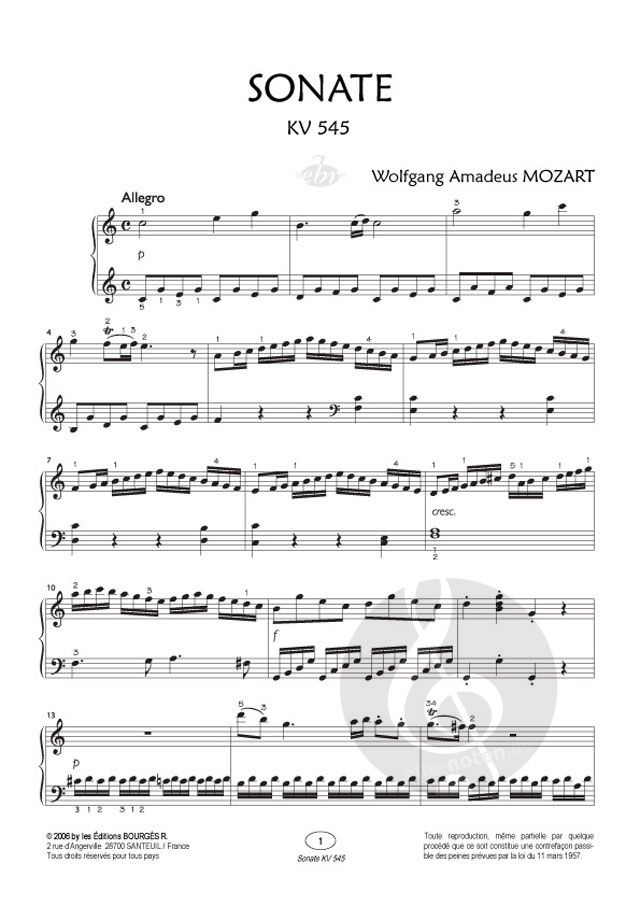
This piece has three movements: Allegro, Andante and Rondo-allegretto. It begins with an allegro at a fairly brisk tempo, with a bass called the Alberti bass in eighth-note rhythm, unfolding throughout the movement. The structure of the first movement is sonata form. The melody has two subjects on the tonic, and at the recapitulation the theme is presented on the subdominant. The dAlberti bass exposed in this first movement is developed in a rather extended, flowing manner in the second movement, the andante.
Only the allegro is represented in this score, and this well-known first movement bewitches many pianists of all levels thanks to the relative ease of its interpretation and the enchantment and frivolity it exudes.
We have set ourselves the goal of offering both "must-haves" from the classical repertoire and pieces by sometimes forgotten composers, all of undeniable pedagogical value. Each piece, sold individually, has been the subject of careful editorial work, both in terms of the musical text and its engraving, in order to guarantee musicians the conditions indispensable to the pleasures derived from frequent trade in these works.
The scores are offered in the form of traditional works (paper sheets), and also available by download.
This so-called easy sonata or "sonata semplice" is Mozart's most famous. Its subtitle is misleading, for it is not as easy as one might think. In fact, Mozart's pianistic mastery and science fail to reveal the real difficulty of this sonata. It was first performed on June 26, 1788, a few years before the composer's death. The purpose of this creation is said to be half-pedagogical, half-commercial, hence its nickname.
This piece has three movements: Allegro, Andante and Rondo-allegretto. It begins with an allegro at a fairly brisk tempo, with a bass called the Alberti bass in eighth-note rhythm, unfolding throughout the movement. The structure of the first movement is sonata form. The melody has two subjects on the tonic, and at the recapitulation the theme is presented on the subdominant. The dAlberti bass exposed in this first movement is developed in a rather extended, flowing manner in the second movement, the andante.
Only the allegro is represented in this score, and this well-known first movement bewitches many pianists of all levels thanks to the relative ease of its interpretation and the enchantment and frivolity it exudes.