
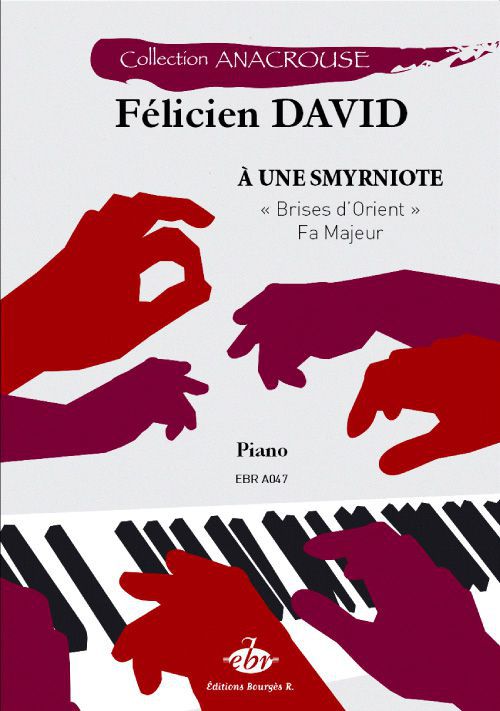
Félicien David
Brises D'orient'a Une Smyrniote' Fa Majeur
Demo
listen
Félicien David
Brises D'orient'a Une Smyrniote' Fa Majeur
- Instrumentation Piano
- Composer Félicien David
- Edition Sheet Music
- Publisher Editions Bourgès R.
- Order no. EBRA047
 ships within 2-4 weeks
Description:
The ANACROUSE collection offers novice and experienced pianists alike a wide choice of classical works, from the Renaissance to the modern era.
We have set ourselves the goal of offering both "must-haves" from the classical repertoire and pieces by sometimes forgotten composers, all of undeniable pedagogical value. Each piece, sold individually, has been the subject of careful editorial work, both in terms of the musical text and its engraving, in order to guarantee musicians the conditions essential to the pleasures derived from frequent trade in these works.
The scores are offered in the form of traditional works (paper sheets), and also available by download.
In 1836, the composer Félicien David published the "Mélodies orientales". They comprise a total of twenty-one pieces, eighteen of which were reissued in 1845 under the title "Brises d'Orient" and three others under the title "Les Minarets".
On their release, these melodies were not a great success. There are two reasons for this. Firstly, a fire destroyed part of the stock of printed scores. On the other hand, the public, which had enjoyed the poet Victor Hugo's "Orientales" and the painter Eugène Delacroix's "Pestiférés de Jaffa", did not seem to be attracted by musical orientalism.
Les brises d'Orient possesses the power of rather gentle oriental charms. The composer wonderfully translates the oriental atmosphere by marking the rhythms with astonishing basses.
More than traditional forms, what should be retained from these pieces is the fact that they tell beautiful stories, always with a very successful dynamic of slow passages and lively, fast passages.
Felicien David's writing is not lacking in color. However, he makes no attempt to apply the exoticism of the Middle East. The melodies sing naturally through his pieces.
Listening to "à une Smyrniote" as in the other pieces reveals an orientalism rather unoriental for us today. Originally, orientalism was an artistic movement, which means that it cannot be faithfully linked to the reproduction of reality.
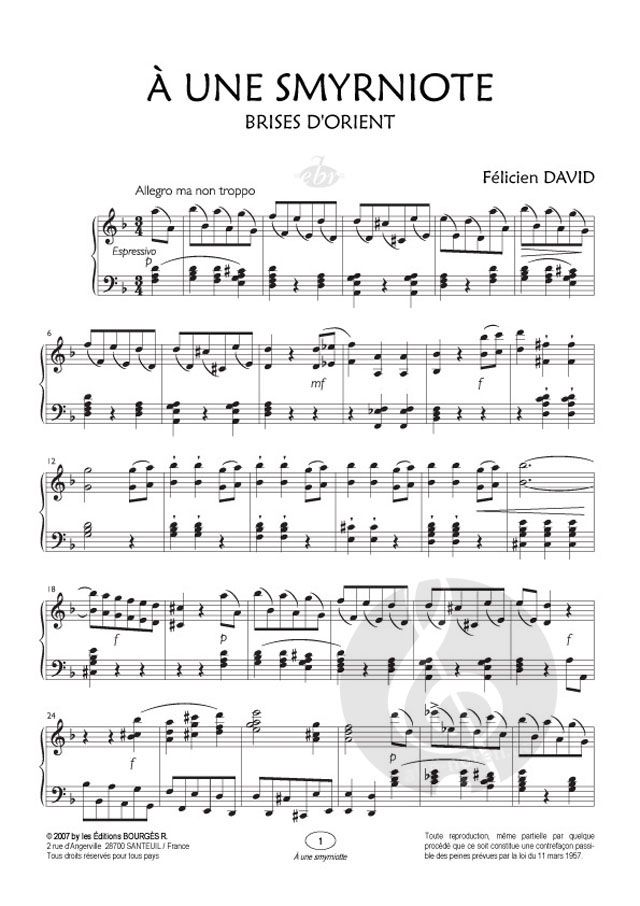
In this piece, the melody is undoubtedly linked to the harmonic bass, which is highly emphasized by rhythmic accentuations that form a solid foundation. Repeats of musical passages in the sequence of the work reveal completely different atmospheres, suggesting a new thread in the pianist's interpretation.
We have set ourselves the goal of offering both "must-haves" from the classical repertoire and pieces by sometimes forgotten composers, all of undeniable pedagogical value. Each piece, sold individually, has been the subject of careful editorial work, both in terms of the musical text and its engraving, in order to guarantee musicians the conditions essential to the pleasures derived from frequent trade in these works.
The scores are offered in the form of traditional works (paper sheets), and also available by download.
In 1836, the composer Félicien David published the "Mélodies orientales". They comprise a total of twenty-one pieces, eighteen of which were reissued in 1845 under the title "Brises d'Orient" and three others under the title "Les Minarets".
On their release, these melodies were not a great success. There are two reasons for this. Firstly, a fire destroyed part of the stock of printed scores. On the other hand, the public, which had enjoyed the poet Victor Hugo's "Orientales" and the painter Eugène Delacroix's "Pestiférés de Jaffa", did not seem to be attracted by musical orientalism.
Les brises d'Orient possesses the power of rather gentle oriental charms. The composer wonderfully translates the oriental atmosphere by marking the rhythms with astonishing basses.
More than traditional forms, what should be retained from these pieces is the fact that they tell beautiful stories, always with a very successful dynamic of slow passages and lively, fast passages.
Felicien David's writing is not lacking in color. However, he makes no attempt to apply the exoticism of the Middle East. The melodies sing naturally through his pieces.
Listening to "à une Smyrniote" as in the other pieces reveals an orientalism rather unoriental for us today. Originally, orientalism was an artistic movement, which means that it cannot be faithfully linked to the reproduction of reality.
In this piece, the melody is undoubtedly linked to the harmonic bass, which is highly emphasized by rhythmic accentuations that form a solid foundation. Repeats of musical passages in the sequence of the work reveal completely different atmospheres, suggesting a new thread in the pianist's interpretation.