
Richard Wagner
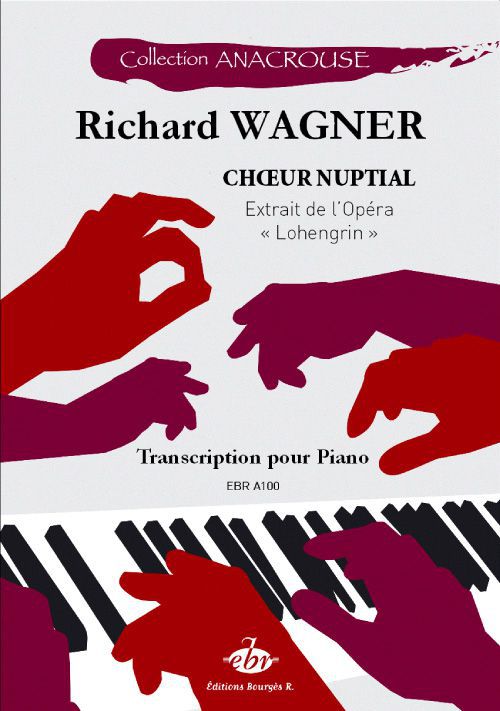
Choeur Nuptial
Demo
listen
Richard Wagner
Choeur Nuptial
- Instrumentation Piano
- Composer Richard Wagner
- Edition Sheet Music
- Publisher Editions Bourgès R.
- Order no. EBRA100
 ships within 2-4 weeks

Description:
The ANACROUSE collection offers novice and experienced pianists alike a wide choice of classical works, from the Renaissance to the modern era.
We have set ourselves the goal of offering both "must-haves" from the classical repertoire and pieces by sometimes forgotten composers, all of undeniable pedagogical value. Each piece, sold individually, has been the subject of careful editorial work, both in terms of the musical text and its engraving, in order to guarantee musicians the conditions indispensable to the pleasures derived from frequent trade in these works.
The scores are offered in the form of traditional works (paper sheets), and also available by download.
Lohengrin is the sixth opera Richard Wagner composed. Written between 1845 and 1848, and premiered in 1850, it is based on the story of the "Swan Knight" from medieval German literature.
Lohengrin was an immediate success, and of great importance in the composer's musical career. In a letter to Liszt dated 1853, Richard Wagner wrote: "I realize that in Lohengrin I have forgotten an indication of movement, an omission that I only noticed when I conducted it. It's in the nuptial chorus in D major, after the second solo of the eight women, the last eight bars before the first movement: here, the movement must be slowed down considerably, more than in the first entry in D major; it must be done quietly, solemnly, otherwise the intention is missed."
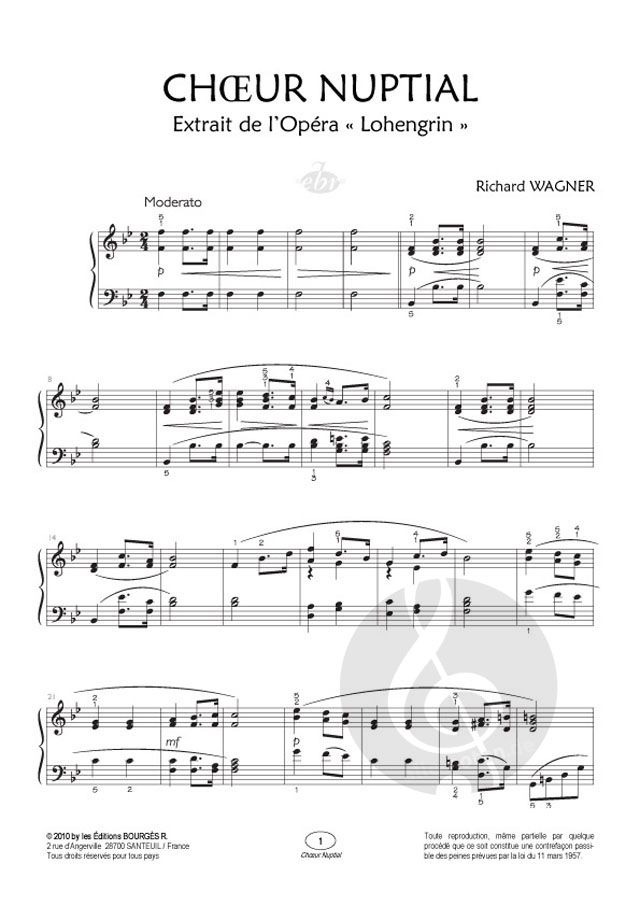
The nuptial chorus Richard Wagner mentions marks the beginning of the opera's third act, when Elsa and her husband enter the bridal chamber, where they declare their love for each other: `Let the sounds of the feast die away, let your hearts grow drunk! Today, this wedding march traditionally accompanies the bride and groom as they enter or leave the church in the West. It is traditionally played on the organ, but can also be played by an orchestra. It is sometimes called the "engagement march".
We have set ourselves the goal of offering both "must-haves" from the classical repertoire and pieces by sometimes forgotten composers, all of undeniable pedagogical value. Each piece, sold individually, has been the subject of careful editorial work, both in terms of the musical text and its engraving, in order to guarantee musicians the conditions indispensable to the pleasures derived from frequent trade in these works.
The scores are offered in the form of traditional works (paper sheets), and also available by download.
Lohengrin is the sixth opera Richard Wagner composed. Written between 1845 and 1848, and premiered in 1850, it is based on the story of the "Swan Knight" from medieval German literature.
Lohengrin was an immediate success, and of great importance in the composer's musical career. In a letter to Liszt dated 1853, Richard Wagner wrote: "I realize that in Lohengrin I have forgotten an indication of movement, an omission that I only noticed when I conducted it. It's in the nuptial chorus in D major, after the second solo of the eight women, the last eight bars before the first movement: here, the movement must be slowed down considerably, more than in the first entry in D major; it must be done quietly, solemnly, otherwise the intention is missed."
The nuptial chorus Richard Wagner mentions marks the beginning of the opera's third act, when Elsa and her husband enter the bridal chamber, where they declare their love for each other: `Let the sounds of the feast die away, let your hearts grow drunk! Today, this wedding march traditionally accompanies the bride and groom as they enter or leave the church in the West. It is traditionally played on the organ, but can also be played by an orchestra. It is sometimes called the "engagement march".