
Johannes Brahms
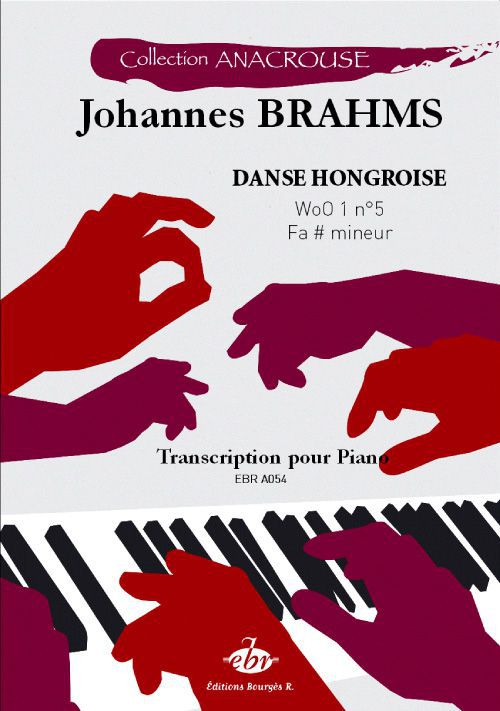
Danse Hongroise No. 5 Fa Diese
Demo
listen
Johannes Brahms
Danse Hongroise No. 5 Fa Diese
- Instrumentation Piano
- Composer Johannes Brahms
- Edition Sheet Music
- Publisher Editions Bourgès R.
- Order no. EBRA054
 ships within 2-4 weeks

Description:
The ANACROUSE collection offers novice and experienced pianists alike a wide choice of classical works, from the Renaissance to the modern era.
We have set ourselves the goal of offering both "must-haves" from the classical repertoire and pieces by sometimes forgotten composers, all of undeniable pedagogical value. Each piece, sold individually, has been the subject of careful editorial work, both in terms of the musical text and its engraving, in order to guarantee musicians the conditions essential to the pleasures derived from frequent trade in these works.
The scores are offered in traditional book form (paper sheets), and also available by download.
The 21 Hungarian Dances by Johannes Brahms were published by Simrock under the title Hungarian Dances, arranged for piano by Johannes Brahms. He did not consider these works to be original creations, but merely adaptations of traditional music, so he did not give them an opus number. In 1869, the first two books were published, and in 1880, the other two.
These dances were initially written for four hands. He created a two-hand version of the first two quires, then an orchestral version from no. 3 to no. 10.
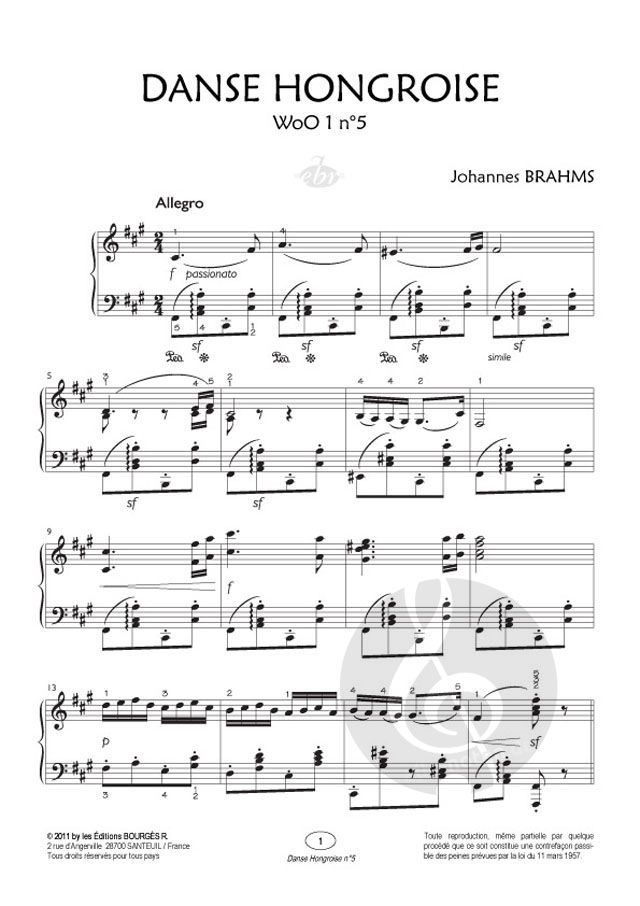
The fifth Hungarian dance in F # minor is one of his most famous dances. This piece is borrowed from Kéler Bela's Souvenir de Bartfai.
Brahms introduces elements of the Hungarian Verbunkos, principally the csardas. It is characterized here by changes from slow to fast tempi. Slowing down or speeding up is typical of Hungarian folk music. No monotony ensues. These tunes are transfigured by Brahms, where the folk colors flicker frenetically through the various musical changes.
We have set ourselves the goal of offering both "must-haves" from the classical repertoire and pieces by sometimes forgotten composers, all of undeniable pedagogical value. Each piece, sold individually, has been the subject of careful editorial work, both in terms of the musical text and its engraving, in order to guarantee musicians the conditions essential to the pleasures derived from frequent trade in these works.
The scores are offered in traditional book form (paper sheets), and also available by download.
The 21 Hungarian Dances by Johannes Brahms were published by Simrock under the title Hungarian Dances, arranged for piano by Johannes Brahms. He did not consider these works to be original creations, but merely adaptations of traditional music, so he did not give them an opus number. In 1869, the first two books were published, and in 1880, the other two.
These dances were initially written for four hands. He created a two-hand version of the first two quires, then an orchestral version from no. 3 to no. 10.
The fifth Hungarian dance in F # minor is one of his most famous dances. This piece is borrowed from Kéler Bela's Souvenir de Bartfai.
Brahms introduces elements of the Hungarian Verbunkos, principally the csardas. It is characterized here by changes from slow to fast tempi. Slowing down or speeding up is typical of Hungarian folk music. No monotony ensues. These tunes are transfigured by Brahms, where the folk colors flicker frenetically through the various musical changes.