
Jacques Offenbach
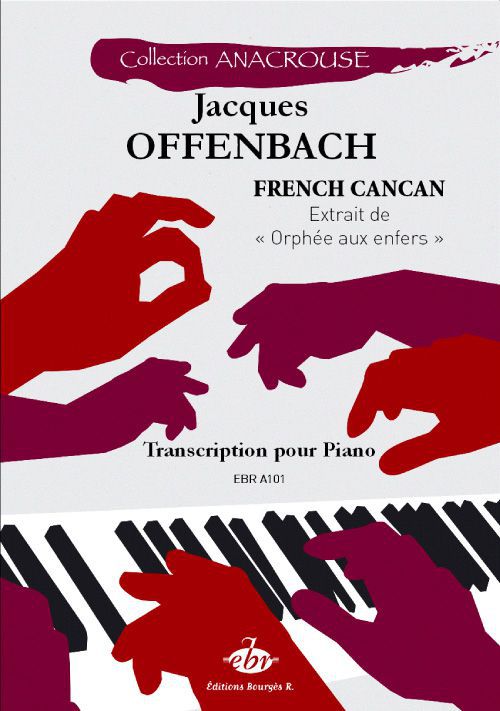
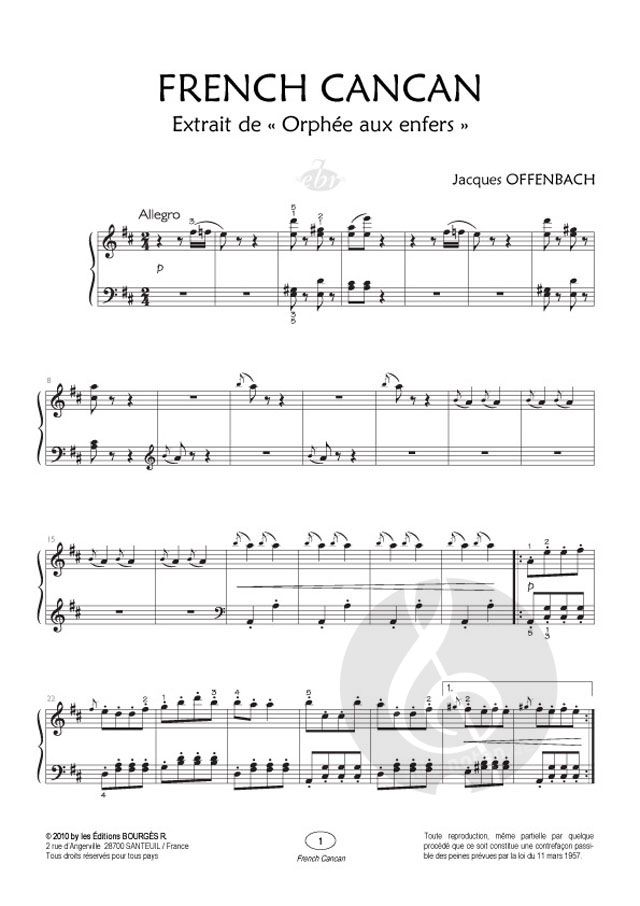
French Cancan
Demo
listen
Jacques Offenbach
French Cancan
- Instrumentation Piano
- Composer Jacques Offenbach
- Edition Sheet Music
- Publisher Editions Bourgès R.
- Order no. EBRA101
 ships within 3-6 working days
incl. tax,
excl. shipping costs
Not available in all countries. Learn more

Description:
The ANACROUSE collection offers novice and experienced pianists alike a wide choice of classical works, from the Renaissance to the modern era.
We have set ourselves the goal of offering both "must-haves" from the classical repertoire and pieces by sometimes forgotten composers, all of undeniable pedagogical value. Each piece, sold individually, has been the subject of careful editorial work, both in terms of the musical text and its engraving, in order to guarantee musicians the conditions indispensable to the pleasures derived from the frequent trade in these works.
The scores are offered in the form of traditional works (paper sheets), and also available by download.
The gossip, often attributed to Jacques Offenbach, is in reality nothing more than a misappropriation of his compositions. The most famous case is the galop infernal (the name of a dance step) from Orphée aux enfers (1858), which is often renamed French Cancan. This transformation is a misnomer, as the name French Cancan did not exist when Jacques Offenbach was composing.
The cancan is a popular dance invented in the early 19th century. It was originally performed in couples at balls and cabarets, and was one of the dances most frowned upon by socialite families. The name Cancan, apparently originally given because the dancers imitated the gait and cry of the goose, later became French Cancan through a tourist transformation of English origin (coincoin/cancan).
This dance gives the image of frivolous Parisian society, close to that caricaturally described in La vie parisienne. Women were soon the only dancers, lined up to face the audience, and the many paws-in-the-air steps often revealed the refined undergarments of the time...which the painter Toulouse-Lautrec enjoyed illustrating.
We have set ourselves the goal of offering both "must-haves" from the classical repertoire and pieces by sometimes forgotten composers, all of undeniable pedagogical value. Each piece, sold individually, has been the subject of careful editorial work, both in terms of the musical text and its engraving, in order to guarantee musicians the conditions indispensable to the pleasures derived from the frequent trade in these works.
The scores are offered in the form of traditional works (paper sheets), and also available by download.
The gossip, often attributed to Jacques Offenbach, is in reality nothing more than a misappropriation of his compositions. The most famous case is the galop infernal (the name of a dance step) from Orphée aux enfers (1858), which is often renamed French Cancan. This transformation is a misnomer, as the name French Cancan did not exist when Jacques Offenbach was composing.
The cancan is a popular dance invented in the early 19th century. It was originally performed in couples at balls and cabarets, and was one of the dances most frowned upon by socialite families. The name Cancan, apparently originally given because the dancers imitated the gait and cry of the goose, later became French Cancan through a tourist transformation of English origin (coincoin/cancan).
This dance gives the image of frivolous Parisian society, close to that caricaturally described in La vie parisienne. Women were soon the only dancers, lined up to face the audience, and the many paws-in-the-air steps often revealed the refined undergarments of the time...which the painter Toulouse-Lautrec enjoyed illustrating.