
Johann Strauss (Sohn)
Le Beau Danube Bleu
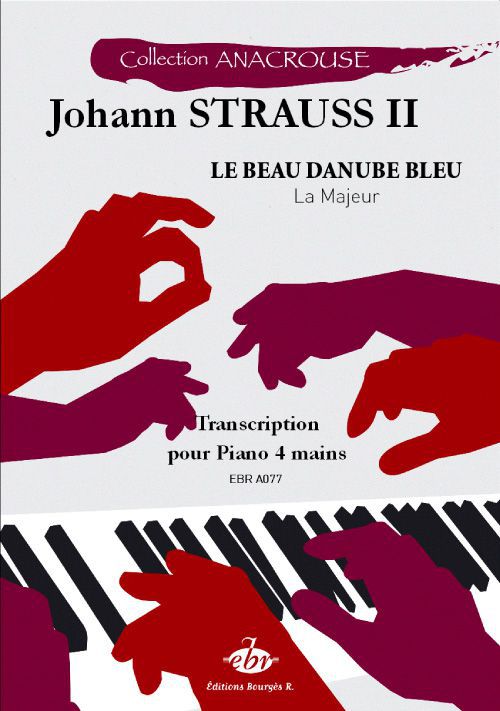
Johann Strauss (Sohn)
Le Beau Danube Bleu
- Instrumentation Piano 4 Hands
- Composer Johann Strauss (Sohn)
- Edition Sheet Music
- Publisher Editions Bourgès R.
- Order no. EBRA077
 ships within 2-4 weeks
Description:
The ANACROUSE collection offers novice and experienced pianists alike a wide choice of classical works, from the Renaissance to the modern era.
We have set ourselves the goal of offering both "must-haves" from the classical repertoire and pieces by sometimes forgotten composers, all of undeniable pedagogical value. Each piece, sold individually, has been the subject of careful editorial work, both in terms of the musical text and its engraving, in order to guarantee musicians the conditions indispensable to the pleasures derived from frequent trade in these works.
The scores are offered in the form of traditional works (paper sheets), and also available by download.
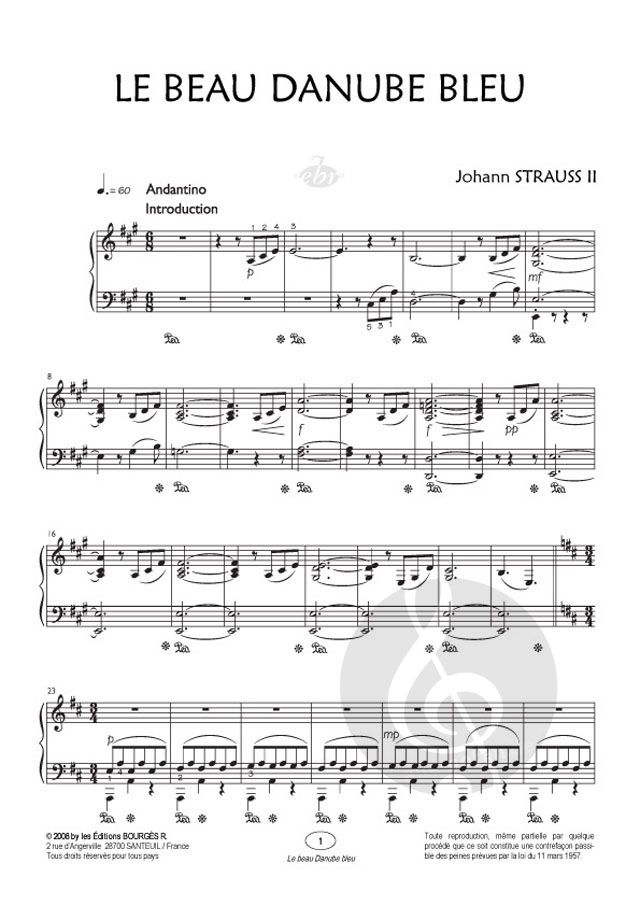
The opening bars of Le Beau Danube bleu are among the most famous of all waltz themes. The orchestral version premiered at the Paris World's Fair in 1867, and was such a triumph that audiences abandoned balls that didn't play it.
The piece is the quintessential Viennese work, with its generous melodic developments and rich, sweeping coda finale. At the time, over a million copies of this score were sold abroad.
We have set ourselves the goal of offering both "must-haves" from the classical repertoire and pieces by sometimes forgotten composers, all of undeniable pedagogical value. Each piece, sold individually, has been the subject of careful editorial work, both in terms of the musical text and its engraving, in order to guarantee musicians the conditions indispensable to the pleasures derived from frequent trade in these works.
The scores are offered in the form of traditional works (paper sheets), and also available by download.
The opening bars of Le Beau Danube bleu are among the most famous of all waltz themes. The orchestral version premiered at the Paris World's Fair in 1867, and was such a triumph that audiences abandoned balls that didn't play it.
The piece is the quintessential Viennese work, with its generous melodic developments and rich, sweeping coda finale. At the time, over a million copies of this score were sold abroad.