
Camillo Schumann
Marche Militaire op. 62 No. 2
Camillo Schumann
Marche Militaire op. 62 No. 2
- Instrumentation Piano
- Composer Camillo Schumann
- Edition Sheet Music
- Publisher Editions Bourgès R.
- Order no. EBRA022
 ships within 2-4 weeks
Description:
The ANACROUSE collection offers novice and experienced pianists alike a wide choice of classical works, from the Renaissance to the modern era.
We have set ourselves the goal of offering both "must-haves" from the classical repertoire and pieces by sometimes forgotten composers, all of undeniable pedagogical value. Each piece, sold individually, has been the subject of careful editorial work, both in terms of the musical text and its engraving, in order to guarantee musicians the conditions indispensable to the pleasures derived from frequent trade in these works.
The scores are offered in the form of traditional works (paper sheets), and also available by download.
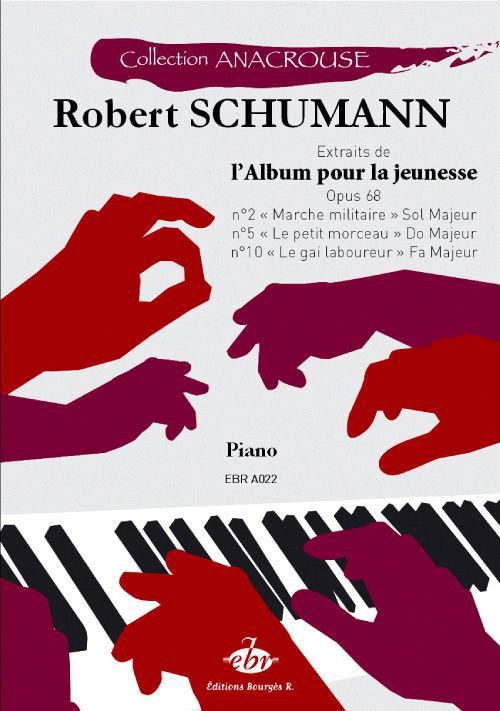
In 1848, Schumann wrote a few piècettes for his daughter Marie's seventh birthday. Over the course of a few weeks, he gradually began to compose other short pieces. Eventually, he assembled an eclectic group of easy pieces, which he later supplemented with more elementary pieces for the novice fingers of novice pianists.
Schumann compiled all these works in a collection called L'album pour la jeunesse, or Weihnachtsalbum in German. In all, forty-three pieces were published as Opus 68 in 1848. The first issue was published with a cover by the well-known fairy-tale illustrator Ludwig Richter. The collection quickly became popular with young readers, as it contained a universal children's macrocosm. Its success awakened thousands of children to music around the world.
Each piece bears an attractive title, but conceals a minor technical problem. Schumann approaches this exercise with a pure eye and a certain freshness very much suited to these young recipients.
The album is divided into two divisions. The first half, for the little ones, is made up of the first nineteen pieces. The second half, "for the older ones", comprises slightly longer, shaped pieces.
Schumann strives for simplicity in his works by using the most frequent keys, up to a maximum of four sharps, with E major, and by the brevity of the pieces, the shortest being four lines and the longest three pages.
We have selected three pieces addressed to the little ones.
They are of different styles and present varied and accessible technical difficulties.
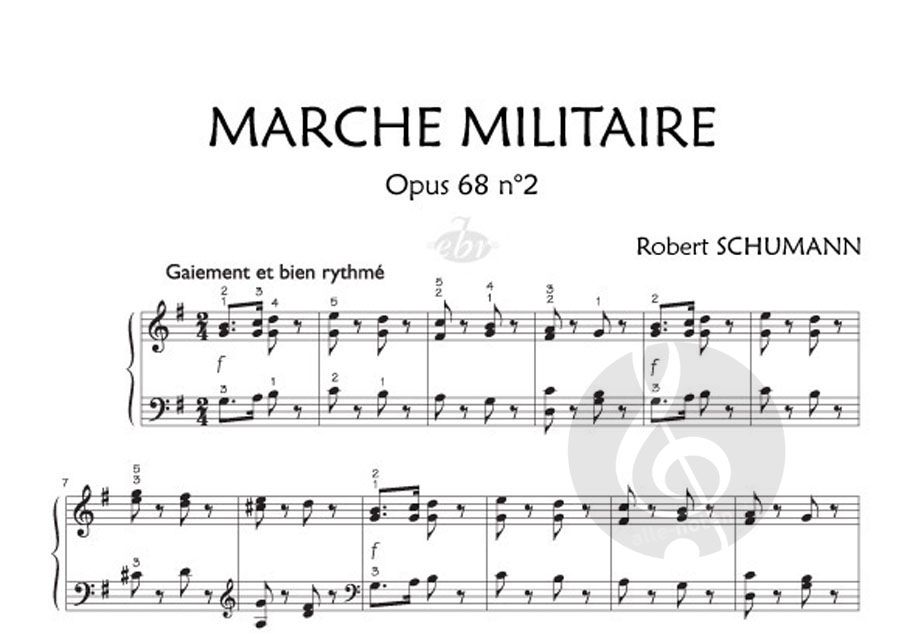
No. 2 Marche militaire is of a joyful nature, in a dynamic tempo embellished with staccato. It borrows, in a different rhythm, the melodic curve of the Scherzo from Beethoven's sonata for violin and piano Op. 24, nicknamed the Spring Sonata.
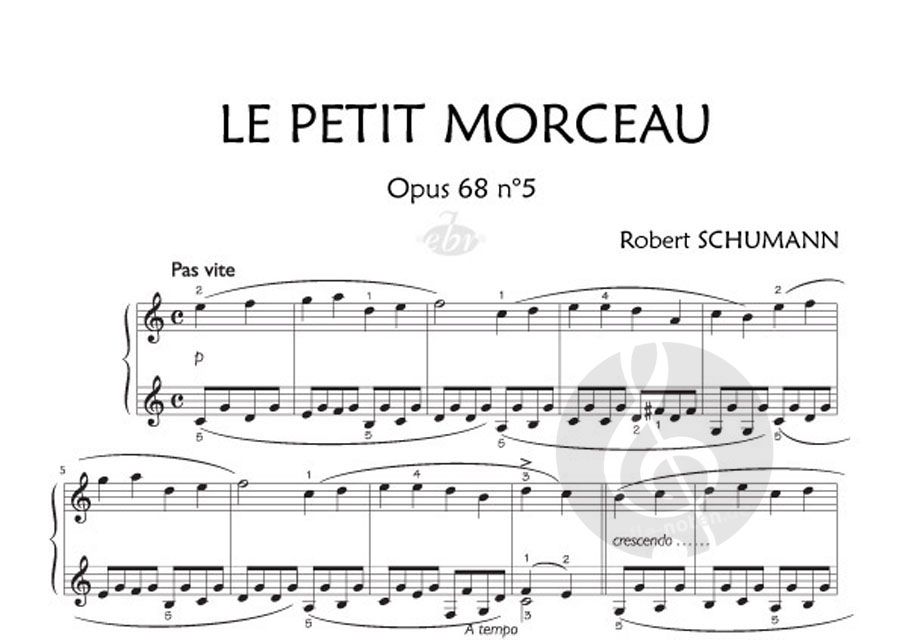
No. 5, entitled Le petit morceau, is similar to No. 1, Mélodie, in its melodic and harmonic treatment. This piece features an accompanied melody in the key of C major.
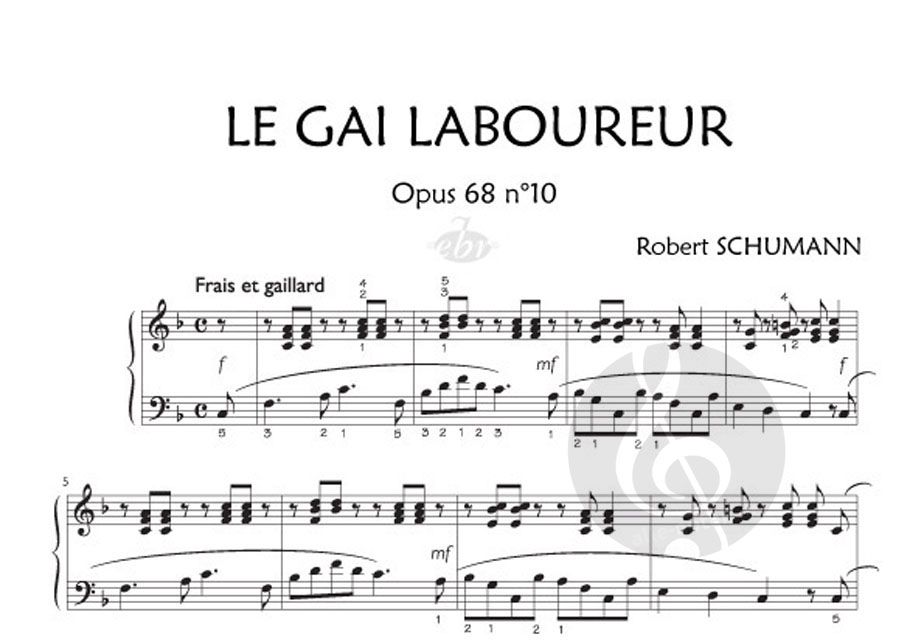
No. 10, entitled Le gai laboureur, is the best-known piece in the collection. It became extremely popular after its publication. Its melody in F major, sung by the left hand in the low register of the piano, has a freshness that speaks for itself.
Schumann's children's album is not just for the little ones, but can evoke youthful feelings and childlike pleasures in the minds of adults.
We have set ourselves the goal of offering both "must-haves" from the classical repertoire and pieces by sometimes forgotten composers, all of undeniable pedagogical value. Each piece, sold individually, has been the subject of careful editorial work, both in terms of the musical text and its engraving, in order to guarantee musicians the conditions indispensable to the pleasures derived from frequent trade in these works.
The scores are offered in the form of traditional works (paper sheets), and also available by download.
In 1848, Schumann wrote a few piècettes for his daughter Marie's seventh birthday. Over the course of a few weeks, he gradually began to compose other short pieces. Eventually, he assembled an eclectic group of easy pieces, which he later supplemented with more elementary pieces for the novice fingers of novice pianists.
Schumann compiled all these works in a collection called L'album pour la jeunesse, or Weihnachtsalbum in German. In all, forty-three pieces were published as Opus 68 in 1848. The first issue was published with a cover by the well-known fairy-tale illustrator Ludwig Richter. The collection quickly became popular with young readers, as it contained a universal children's macrocosm. Its success awakened thousands of children to music around the world.
Each piece bears an attractive title, but conceals a minor technical problem. Schumann approaches this exercise with a pure eye and a certain freshness very much suited to these young recipients.
The album is divided into two divisions. The first half, for the little ones, is made up of the first nineteen pieces. The second half, "for the older ones", comprises slightly longer, shaped pieces.
Schumann strives for simplicity in his works by using the most frequent keys, up to a maximum of four sharps, with E major, and by the brevity of the pieces, the shortest being four lines and the longest three pages.
We have selected three pieces addressed to the little ones.
They are of different styles and present varied and accessible technical difficulties.
No. 2 Marche militaire is of a joyful nature, in a dynamic tempo embellished with staccato. It borrows, in a different rhythm, the melodic curve of the Scherzo from Beethoven's sonata for violin and piano Op. 24, nicknamed the Spring Sonata.
No. 5, entitled Le petit morceau, is similar to No. 1, Mélodie, in its melodic and harmonic treatment. This piece features an accompanied melody in the key of C major.
No. 10, entitled Le gai laboureur, is the best-known piece in the collection. It became extremely popular after its publication. Its melody in F major, sung by the left hand in the low register of the piano, has a freshness that speaks for itself.
Schumann's children's album is not just for the little ones, but can evoke youthful feelings and childlike pleasures in the minds of adults.