
Franz Schubert
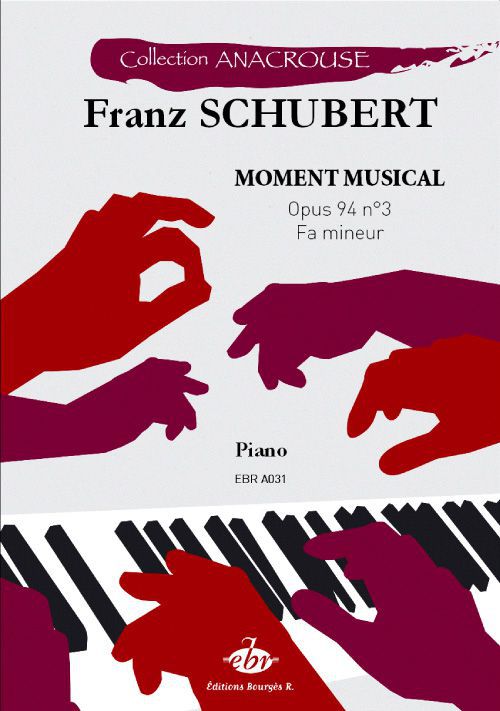
Moment Musical op.94 No. 3
Demo
listen
Franz Schubert
Moment Musical op.94 No. 3
- Instrumentation Piano
- Composer Franz Schubert
- Edition Sheet Music
- Publisher Editions Bourgès R.
- Order no. EBRA031
 ships within 2-4 weeks

Description:
The ANACROUSE collection offers novice and experienced pianists alike a wide choice of classical works, from the Renaissance to the modern era.
We have set ourselves the goal of offering both "must-haves" from the classical repertoire and pieces by sometimes forgotten composers, all of undeniable pedagogical value. Each piece, sold individually, has been the subject of careful editorial work, both in terms of the musical text and its engraving, in order to guarantee musicians the conditions indispensable to the pleasures derived from frequent trade in these works.
The scores are offered in the form of traditional works (paper sheets), and also available by download.
Schubert's creative involvement in the writing of the lied led him to interact with other compositional forms. It's in this spirit that short piano pieces such as Impromptus, Kavierstücke and Moments musicaux appear. Historically speaking, Schubert was not the first to compose in this genre, but he did give it its earliest and finest pages.
Schubert's six musical moments are short pieces for piano, requiring approximately less than thirty minutes to perform. The development of these pieces contains many enigmatic points, but we know that they were created between 1823 - when the "allegro moderato" appeared - and 1827 - when these six musical moments were published.
This work consists of : Moderato n°1 in C minor, Andantino n°2 in F minor, Allegro moderato n°3 in F minor, Moderato n°4 in C sharp minor, Allegro Vivace n°5 in F minor, Plainte d'un troubadour n°6 in A flat major. The latter was also published separately in 1824.
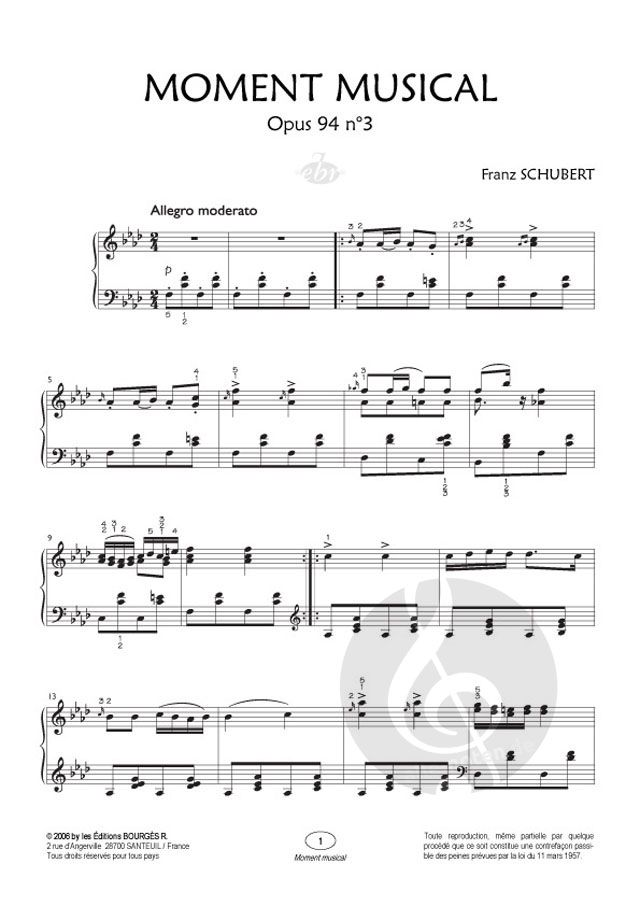
The allegro moderato, commonly known as the "Russian air", is the most famous of the six little pieces. Although its plan is quite distinct and formal, its conception no longer respects a rigorous architecture, which contributes to giving free rein to the musician's harmonic and melodic imagination. This little piece is charged with expressing psychological moments through the alternation of highly contrasting lively and rhythmic moments, which ultimately compels formal flexibility.
Schubert invites pianists to share this musical moment through great psychological concentration in an atmospheric setting that is constantly in motion.
We have set ourselves the goal of offering both "must-haves" from the classical repertoire and pieces by sometimes forgotten composers, all of undeniable pedagogical value. Each piece, sold individually, has been the subject of careful editorial work, both in terms of the musical text and its engraving, in order to guarantee musicians the conditions indispensable to the pleasures derived from frequent trade in these works.
The scores are offered in the form of traditional works (paper sheets), and also available by download.
Schubert's creative involvement in the writing of the lied led him to interact with other compositional forms. It's in this spirit that short piano pieces such as Impromptus, Kavierstücke and Moments musicaux appear. Historically speaking, Schubert was not the first to compose in this genre, but he did give it its earliest and finest pages.
Schubert's six musical moments are short pieces for piano, requiring approximately less than thirty minutes to perform. The development of these pieces contains many enigmatic points, but we know that they were created between 1823 - when the "allegro moderato" appeared - and 1827 - when these six musical moments were published.
This work consists of : Moderato n°1 in C minor, Andantino n°2 in F minor, Allegro moderato n°3 in F minor, Moderato n°4 in C sharp minor, Allegro Vivace n°5 in F minor, Plainte d'un troubadour n°6 in A flat major. The latter was also published separately in 1824.
The allegro moderato, commonly known as the "Russian air", is the most famous of the six little pieces. Although its plan is quite distinct and formal, its conception no longer respects a rigorous architecture, which contributes to giving free rein to the musician's harmonic and melodic imagination. This little piece is charged with expressing psychological moments through the alternation of highly contrasting lively and rhythmic moments, which ultimately compels formal flexibility.
Schubert invites pianists to share this musical moment through great psychological concentration in an atmospheric setting that is constantly in motion.