
Camillo Schumann
Pays Lointain
Demo
listen
Camillo Schumann
Pays Lointain
- Instrumentation Piano
- Composer Camillo Schumann
- Edition Sheet Music
- Publisher Editions Bourgès R.
- Order no. EBRA021
 ships within 2-4 weeks
Description:
The ANACROUSE collection offers novice and experienced pianists alike a wide choice of classical works, from the Renaissance to the modern era.
We have set ourselves the goal of offering both "must-haves" from the classical repertoire and pieces by sometimes forgotten composers, all of undeniable pedagogical value. Each piece, sold individually, has been the subject of careful editorial work, both in terms of the musical text and its engraving, in order to guarantee musicians the conditions essential to the pleasures derived from frequent trade in these works.
The scores are offered in traditional book form (paper sheets), and also available by download.
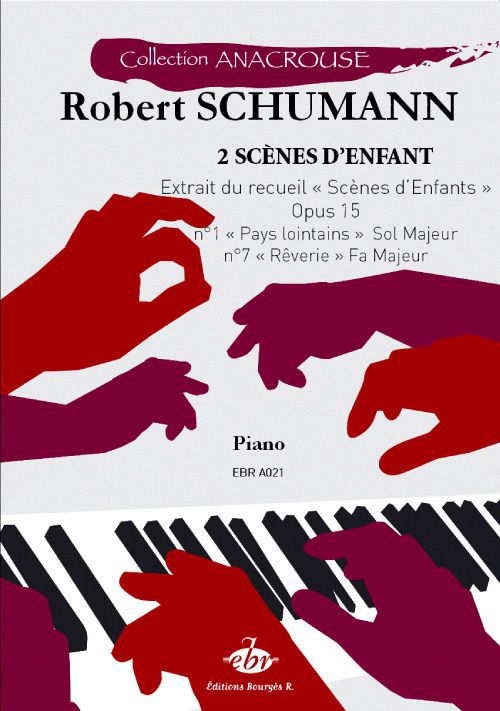
The children's scenes consist of 13 marvelous miniatures where dream, fear and reality mingle.
Robert Schumann was the first poet in music to take an interest in the mystery of childhood. Adapting to the childlike universe, he perfectly fulfills the genre of the monothematic instrumental miniature, previously attempted by Beethoven in the Bagatelles, followed by Schubert in the Musical Moments.
These little pieces, contrary to what the title would suggest, are not intended for childlike hands. In Schumann's own words, these "thirteen little tricks were concocted by a grown-up child as a souvenir for people who have grown up".
These thirteen miniatures, each no longer than two pages, are content with a formal structure of great simplicity. Expressive and distinct from one another, each is a pearl of pure music.
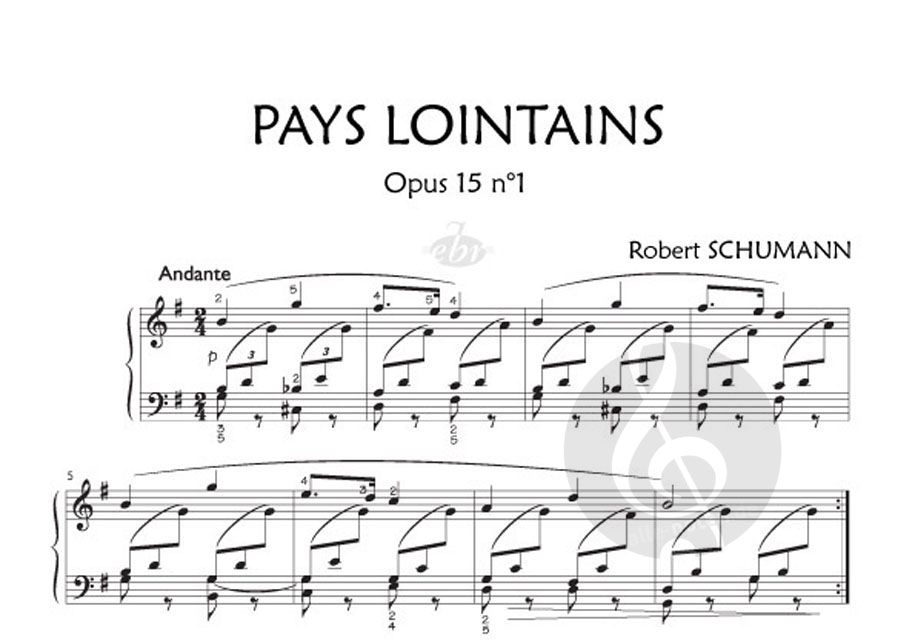
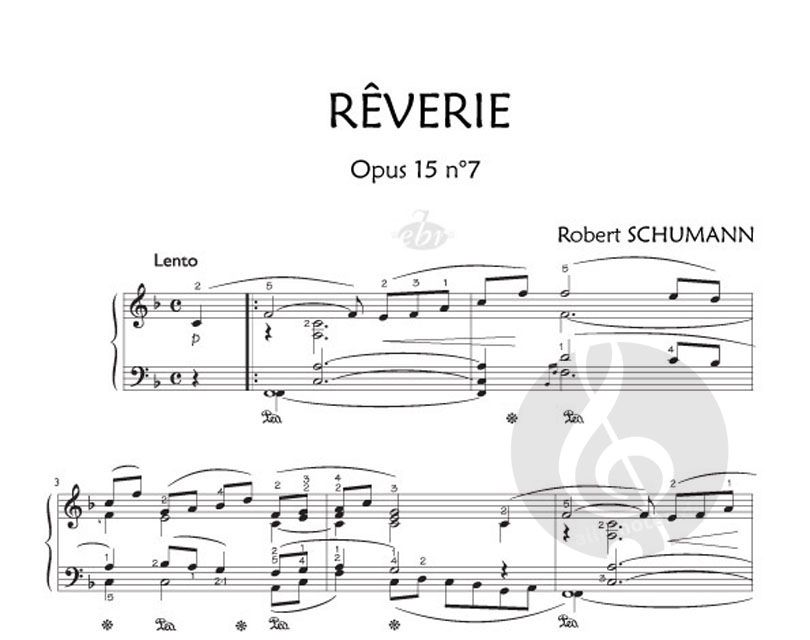
The cycle opens with the dreamy, delicate piece Pays Lointains (No.1), crowned with a touch of melancholy. The opening bars reveal a melody that aspires to escape, with an ascending sixth, a gentle oscillation of triplets in the central voice, simple harmonies of diminished and dominant seventh, and a return to the tonic G major. The famous central page, Rêverie n°7 (Traumerei), shifts the cycle to the flats with its F major, before returning to the sharps to finish on the initial G major. In the first pieces, Schumann's melodic profile focuses on the interval of the ascending sixth, followed by its melodic disinence. As the central piece begins, Schumann exposes his Eusebian face centered on a fourth, while installing sweetness with Reverie to the end of the collection.
Reverie was the subject of controversy in 1920, when Alban Berg brilliantly demonstrated to Hans Pfitzner that this small, simple piece could contain an immensely rich teaching for any musician.
The Children's Scenes have an important place among the most beloved and performed scores by pianists.
We have set ourselves the goal of offering both "must-haves" from the classical repertoire and pieces by sometimes forgotten composers, all of undeniable pedagogical value. Each piece, sold individually, has been the subject of careful editorial work, both in terms of the musical text and its engraving, in order to guarantee musicians the conditions essential to the pleasures derived from frequent trade in these works.
The scores are offered in traditional book form (paper sheets), and also available by download.
The children's scenes consist of 13 marvelous miniatures where dream, fear and reality mingle.
Robert Schumann was the first poet in music to take an interest in the mystery of childhood. Adapting to the childlike universe, he perfectly fulfills the genre of the monothematic instrumental miniature, previously attempted by Beethoven in the Bagatelles, followed by Schubert in the Musical Moments.
These little pieces, contrary to what the title would suggest, are not intended for childlike hands. In Schumann's own words, these "thirteen little tricks were concocted by a grown-up child as a souvenir for people who have grown up".
These thirteen miniatures, each no longer than two pages, are content with a formal structure of great simplicity. Expressive and distinct from one another, each is a pearl of pure music.
The cycle opens with the dreamy, delicate piece Pays Lointains (No.1), crowned with a touch of melancholy. The opening bars reveal a melody that aspires to escape, with an ascending sixth, a gentle oscillation of triplets in the central voice, simple harmonies of diminished and dominant seventh, and a return to the tonic G major. The famous central page, Rêverie n°7 (Traumerei), shifts the cycle to the flats with its F major, before returning to the sharps to finish on the initial G major. In the first pieces, Schumann's melodic profile focuses on the interval of the ascending sixth, followed by its melodic disinence. As the central piece begins, Schumann exposes his Eusebian face centered on a fourth, while installing sweetness with Reverie to the end of the collection.
Reverie was the subject of controversy in 1920, when Alban Berg brilliantly demonstrated to Hans Pfitzner that this small, simple piece could contain an immensely rich teaching for any musician.
The Children's Scenes have an important place among the most beloved and performed scores by pianists.