
Wolfgang Amadeus Mozart
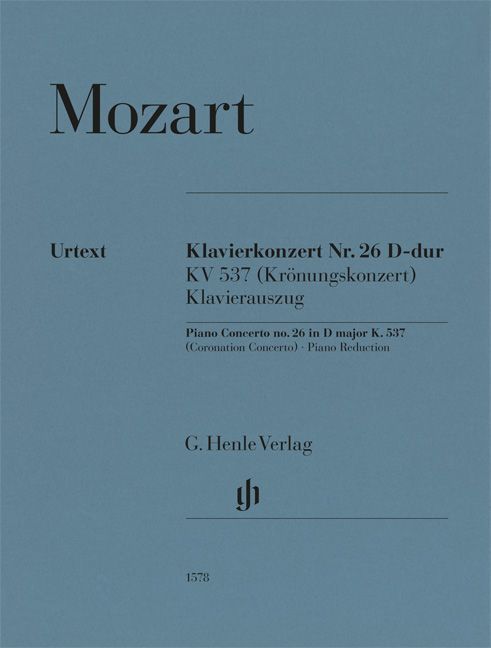
Piano Concerto no. 26 in D major K. 537
Coronation Concerto
Wolfgang Amadeus Mozart
Piano Concerto no. 26 in D major K. 537
Coronation Concerto
- Instrumentation Piano and Orchestra
- Composer Wolfgang Amadeus Mozart
- Editor Heiko Stralendorff Andreas Staier
- Editor Andreas Friesenhagen
-
Difficulty Level
- Edition Piano Reduction (Urtext)
- Publisher G. Henle Verlag
- Order no. HN1578
 in stock
ships within 1-2 working days
incl. tax,
excl. shipping costs
Not available in all countries. Learn more

Description:
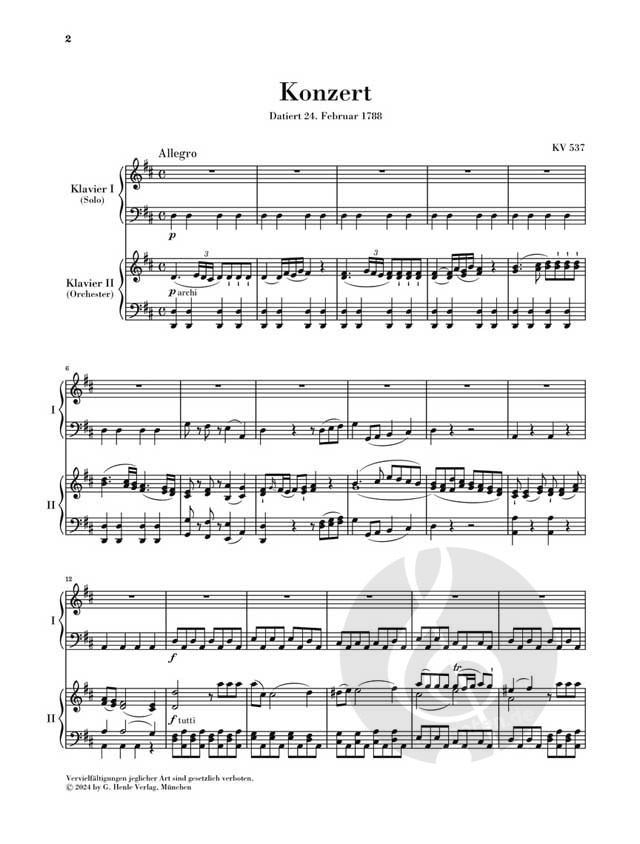
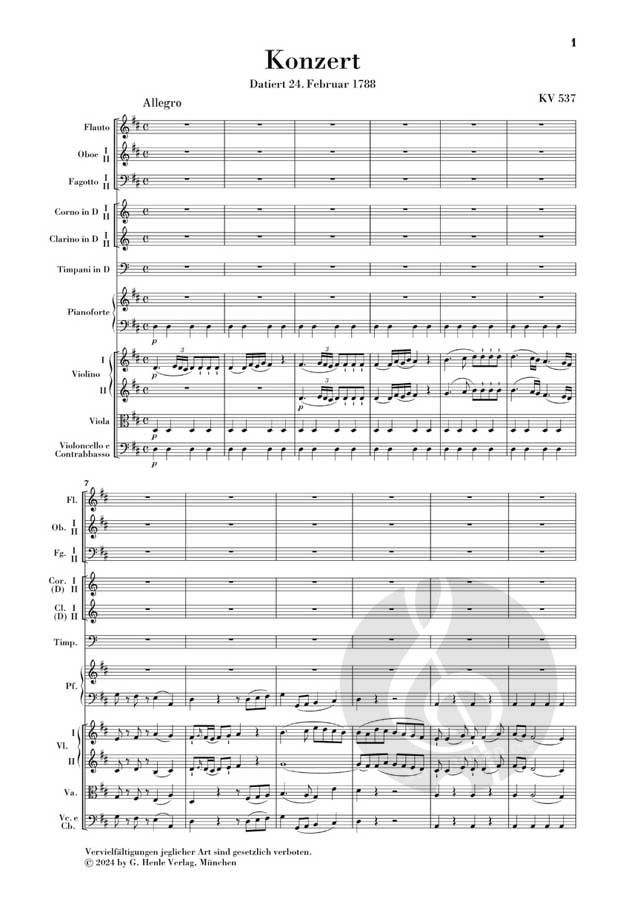
Although Mozart’s penultimate piano concerto was completed on 24 February 1788, it was not premiered until 1789 in Dresden. A further performance in autumn 1790, as part of the celebrations in honour of Leopold II’s coronation as Emperor, led to the concerto’s now popular nickname.
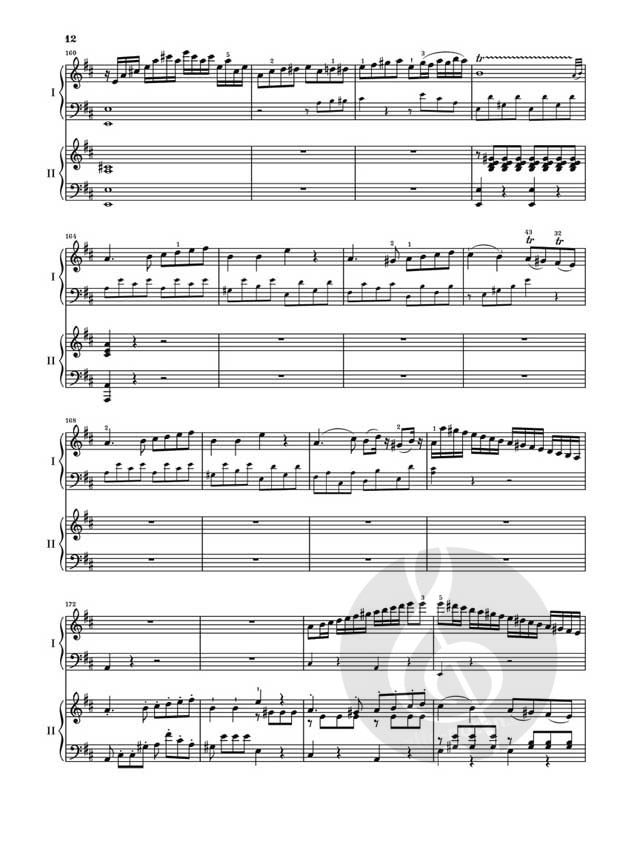
In comparison to the series of large piano concertos from 1784–86, K. 537, with its numerous rapid scale passages and embellishments, looks more conventional at first glance, although it is precisely this more flexible structure that points ahead to forms of the early romantic period. In any case, it today numbers among Mozart’s most frequently played concertos.
Mozart specialist Andreas Staier has supplemented this Urtext edition with numerous practical performance suggestions (rendered as an ossia or in small print): he provides not only elegant entries, cadenzas, embellishments and fingerings, but also completes the sections of the solo part only fragmentarily preserved in the autograph. Henle thus offers a welcome alternative to the previously known version of the solo part, which contains additions made by the publisher Johann André in the posthumous first edition of 1794.
In comparison to the series of large piano concertos from 1784–86, K. 537, with its numerous rapid scale passages and embellishments, looks more conventional at first glance, although it is precisely this more flexible structure that points ahead to forms of the early romantic period. In any case, it today numbers among Mozart’s most frequently played concertos.
Mozart specialist Andreas Staier has supplemented this Urtext edition with numerous practical performance suggestions (rendered as an ossia or in small print): he provides not only elegant entries, cadenzas, embellishments and fingerings, but also completes the sections of the solo part only fragmentarily preserved in the autograph. Henle thus offers a welcome alternative to the previously known version of the solo part, which contains additions made by the publisher Johann André in the posthumous first edition of 1794.
Customers rated this product:
Manufacturer Information:
G. Henle Verlag e.K.
Forstenrieder Allee 122
81476
München
Deutschland
Related products:
- Piano and Orchestra
- Study Score (Urtext)
- G. Henle Verlag
-
in stock
ships within 1-2 working days
Other customers also bought:
Maurice Ravel
- Piano
- Sheet Music (Urtext)
-
in stock
ships within 1-2 working days
- Piano and Orchestra
- Piano Reduction (Urtext)
-
in stock
ships within 1-2 working days
- Piano
- Sheet Music (Urtext)
-
in stock
ships within 1-2 working days
Maurice Ravel
- Piano
- Sheet Music (Urtext)
-
in stock
ships within 1-2 working days
- Piano and Orchestra
- Piano Reduction (Urtext)
- Mitsuko Uchida
-
in stock
ships within 1-2 working days


Maurice Ravel
- Piano and Orchestra
- Piano Reduction (Urtext)
- Pascal Rogé
-
in stock
ships within 1-2 working days