
Franz Schubert
Piano Sonata in a minor Opus post. 164 D 537
Revised edition of HN697

Franz Schubert
Piano Sonata in a minor Opus post. 164 D 537
Revised edition of HN697
- Instrumentation Piano
- Edition Sheet Music (Urtext)
-
Difficulty Level
- Composer Franz Schubert
- Editor Martin Helmchen
- Publisher G. Henle Verlag
- Editor Dominik Rahmer
- Order no. HN1556
incl. tax,
excl. shipping costs
 in stock
|
ships within 1-2 working days
in stock
|
ships within 1-2 working days
Description:
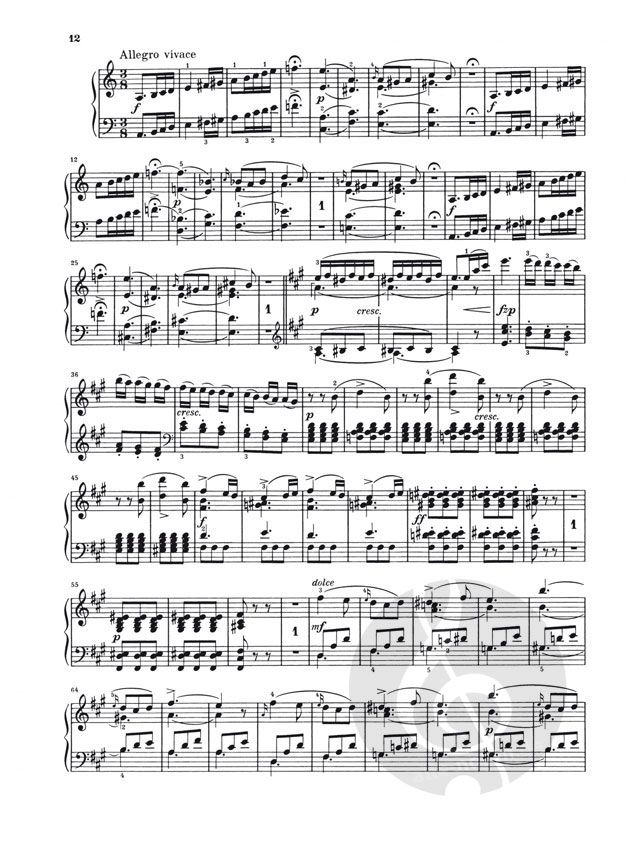
Franz Schubert seems to have been particularly attracted to a-minor. Not just one but three of his piano sonatas are in this key. The earliest of them, D 537, was composed in March 1817 and was simultaneously his first completed piano sonata ever. It is characterised by concise brevity. The three-movement form dispenses with the usual scherzo. It is far removed from the drama of its a-minor sibling works; meandering modulations often lead to distant harmonic regions and lighten the mood to major - significantly, the sonata also ends in A major.
Henle’s Urtext edition is based on the autograph, which is preserved in the Bibliothèque nationale in Paris; a contemporary manuscript copy and the posthumous first edition were only used for comparison purposes. The preface by Schubert expert Andrea Lindmayr-Brandl and the detailed comment section provide information about the work’s genesis and about open questions concerning the musical text. The fingerings by renowned Schubert interpreter Martin Helmchen are a further plus point of this new edition.
Henle’s Urtext edition is based on the autograph, which is preserved in the Bibliothèque nationale in Paris; a contemporary manuscript copy and the posthumous first edition were only used for comparison purposes. The preface by Schubert expert Andrea Lindmayr-Brandl and the detailed comment section provide information about the work’s genesis and about open questions concerning the musical text. The fingerings by renowned Schubert interpreter Martin Helmchen are a further plus point of this new edition.
Customers rated this product:
alle-noten.de: Sheet music shipping since 1969

Since 1969, over 500,000 customers have trusted us. With a huge selection of over 1,000,000 sheet music titles, we are one of the largest providers in Europe. Thanks to our large stock we can often ship sheet music within 24 hours. No matter what sheet music you are looking for: you are in the right place!
Yours, Stefanie Reichert
Head of Customer Service
Related products:

- Piano
- Sheet Music (Urtext)
- G. Henle Verlag
-
-
in stock
|
ships within 1-2 working days