
Frédéric Chopin
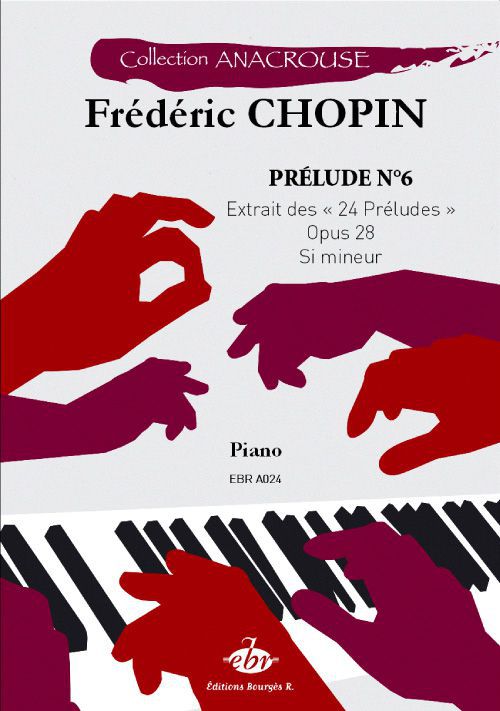
Prelude No. 6 Extrait Des 24 Preludes
Demo
listen
Frédéric Chopin
Prelude No. 6 Extrait Des 24 Preludes
- Instrumentation Piano
- Composer Frédéric Chopin
- Edition Sheet Music
- Publisher Editions Bourgès R.
- Order no. EBRA024
 ships within 2-4 weeks
Description:
The ANACROUSE collection offers novice and experienced pianists alike a wide choice of classical works, from the Renaissance to the modern era.
We have set ourselves the goal of offering both "must-haves" from the classical repertoire and pieces by sometimes forgotten composers, all of undeniable pedagogical value. Each piece, sold individually, has been the subject of careful editorial work, both in terms of the musical text and its engraving, in order to guarantee musicians the conditions essential to the pleasures derived from frequent trade in these works.
The scores are offered in traditional book form (paper sheets), and are also available for download.
The works grouped together in Opus 28 comprise 24 preludes composed between 1837 and 1839 by Frédérick Chopin. The bulk of these pieces were written before and during the stay of star-crossed lovers Chopin and Georges Sand in Majorca.
The composer has created a kind of cohesion in the succession of the 24 preludes, on the one hand through the sequencing by neighboring tones, and on the other through the alternation of major and minor keys that make them effectively inseparable. The first prelude starts from C major, which corresponds to no alteration. Each piece then climbs the sharps one by one. At the end of the ascending sharps scale, we move on to the enharmonic key of E-flat, which corresponds to prelude 14 with 6 flats. Chopin then brings the flat scale down to the key of D minor in prelude 14, equivalent to a single flat.
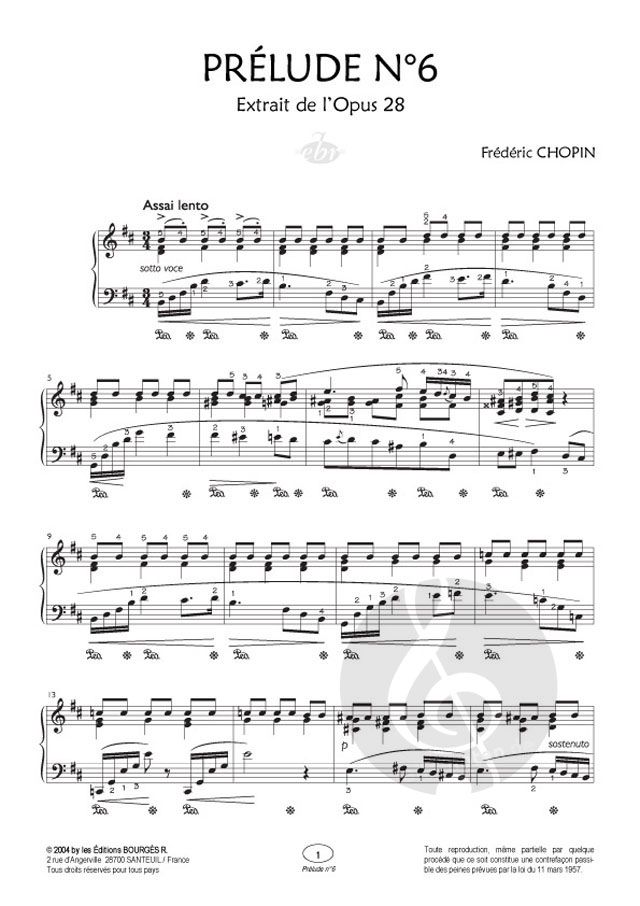
Prelude no. 6 is one of the pieces he wrote to overcome his anxieties during his stay at the Chartreuse de Majorque in the company of Georges Sand. In this prelude, Chopin introduces the melody of a pensive, plaintive theme. The theme is barely supported by the sober accompaniment of the right hand, but the stubborn repetition of one note accentuates the melancholy aspect - this prelude was played at Chopin's funeral.
This great expressivity, sombre with a shadow of hope, arouses a certain introspection, seeking out what is deepest in us, which will certainly enrich the pianist's musical interpretation.
We have set ourselves the goal of offering both "must-haves" from the classical repertoire and pieces by sometimes forgotten composers, all of undeniable pedagogical value. Each piece, sold individually, has been the subject of careful editorial work, both in terms of the musical text and its engraving, in order to guarantee musicians the conditions essential to the pleasures derived from frequent trade in these works.
The scores are offered in traditional book form (paper sheets), and are also available for download.
The works grouped together in Opus 28 comprise 24 preludes composed between 1837 and 1839 by Frédérick Chopin. The bulk of these pieces were written before and during the stay of star-crossed lovers Chopin and Georges Sand in Majorca.
The composer has created a kind of cohesion in the succession of the 24 preludes, on the one hand through the sequencing by neighboring tones, and on the other through the alternation of major and minor keys that make them effectively inseparable. The first prelude starts from C major, which corresponds to no alteration. Each piece then climbs the sharps one by one. At the end of the ascending sharps scale, we move on to the enharmonic key of E-flat, which corresponds to prelude 14 with 6 flats. Chopin then brings the flat scale down to the key of D minor in prelude 14, equivalent to a single flat.
Prelude no. 6 is one of the pieces he wrote to overcome his anxieties during his stay at the Chartreuse de Majorque in the company of Georges Sand. In this prelude, Chopin introduces the melody of a pensive, plaintive theme. The theme is barely supported by the sober accompaniment of the right hand, but the stubborn repetition of one note accentuates the melancholy aspect - this prelude was played at Chopin's funeral.
This great expressivity, sombre with a shadow of hope, arouses a certain introspection, seeking out what is deepest in us, which will certainly enrich the pianist's musical interpretation.