
Richard Lane
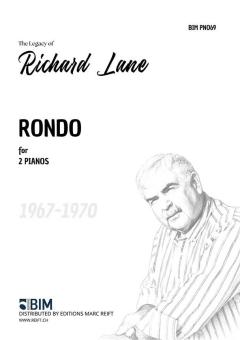
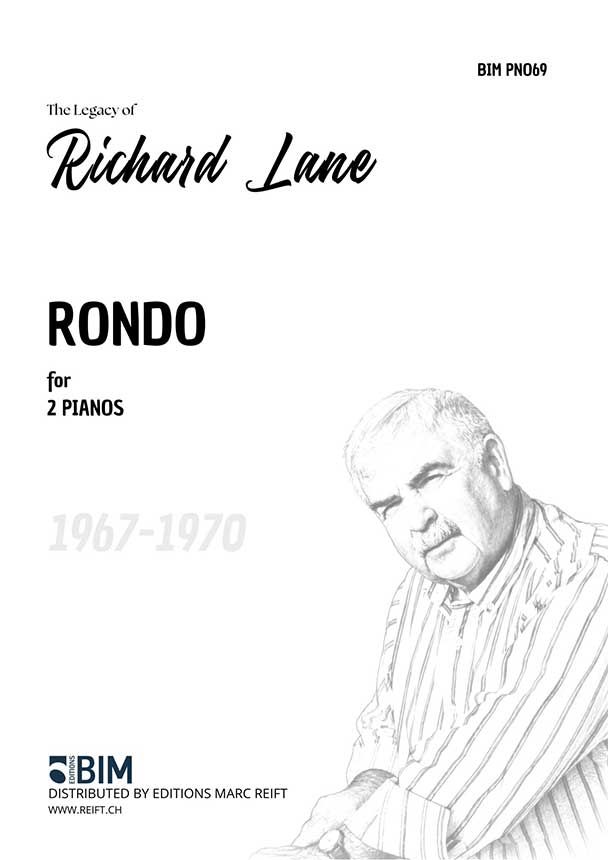
Rondo
for 2 Pianos
NEW
Demo
listen
PDF
view
Richard Lane
Rondo
for 2 Pianos
- Instrumentation 2 Pianos
- Composer Richard Lane
-
Difficulty Level
- Edition Sheet Music
- Publisher Editions Bim
- Order no. BIM-PNO69

Description:
Composed between 1967 and 1970, Richard Lane’s Rondo for Two Pianos was written for the pianists Paul Van Ness and Joseph Werner, both of whom were close to the composer and to whom he dedicated several of his works. Marked "Allegro molto e giocoso," the Rondo immediately establishes the lively, playful character that pervades much of the work. Lane treats the two instruments as equal partners and creates a lively dialogue in which thematic ideas, rapid figurations, and harmonic gestures constantly shift back and forth between the players, who seem to respond to, interrupt, or propel one another. Short, incisive rhythmic ideas alternate with longer lyrical lines, while chromatic harmonies, unexpected accents, and sharply differentiated articulations add wit and vitality. The writing is distinctly pianistic and often virtuosic, drawing on the combined range and timbre of two pianos while demanding considerable precision and coordination. True to its title, the work is characterized by the return of recognizable material between contrasting episodes, yet Lane avoids any sense of predictability: Familiar ideas reappear in altered harmonic, timbral, and textural contexts, lending the music both coherence and a sense of constant discovery. Rapid lines are exchanged or layered between the instruments, alongside sweeping gestures and glissandi, while lyrical passages and sudden shifts in texture and dynamics provide contrast, humor, and surprise. Toward the end, increasingly lively figurations and strong dynamic contrasts drive the music toward a brilliant and emphatic conclusion. The rondo exemplifies Lane’s ability to combine an established form with a language firmly rooted in the 20th century: Its formal clarity recalls the classical rondo tradition, while its chromaticism, rhythmic vitality, lyricism, and playful unpredictability are unmistakably part of his own eclectic vocabulary. The result is a compact yet substantial concert piece in which technical brilliance serves a fundamentally communicative purpose—a lively conversation marked by energy, lyricism, wit, and the joy two pianists take in making music together.
Customers rated this product:
Manufacturer Information:
Editions Bim
Route d'Echallens 51
1674
Vuarmarens
Schweiz
Related products:

- 2 Pianos
- Sheet Music Download
- Editions Bim
-
-
 immediately available
Download immediately after ordering - Instant download