
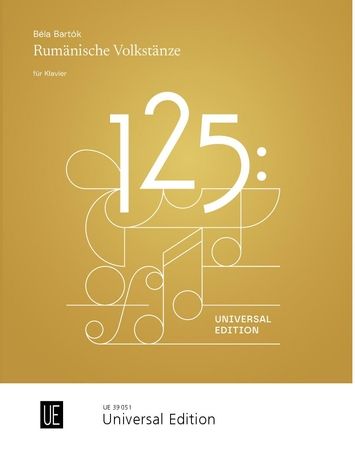
Béla Bartók
Rumänische Volkstänze
for Piano
PDF
view
Béla Bartók
Rumänische Volkstänze
for Piano
- Instrumentation Piano
- Composer Béla Bartók
- Editor Péter Bartók
-
Difficulty Level
- Edition Score
- Publisher Universal Edition
- Order no. UE39051
 in stock
ships within 1-2 working days
incl. tax,
excl. shipping costs
Not available in all countries. Learn more

Description:
From a letter from Béla Bartók during the First World War: "I consider it my life's goal to continue and complete my studies of Romanian folk music, at least in Transylvania..." For the time being, however, the war prevented the publication of the collection from Máramaros county, which was planned for 1914/15. The work was published in 1967. Among the 1115 instrumental melodies are the seven that Bartók put together to form a cycle under the title Romanian Folk Dances from Hungary. Bartók places the seven melodies in one and the same category: all have a fixed, closed, usually four-line form. The seven wise men are six different dances that come from four different areas of Transylvania. Bartók selected the pieces from a larger area and also changed the order according to his own conception. First there is "The Dance with the Staff", which a young lad performs alone, embellishes with complicated steps and finally – as Bartók notes – performs such a leap that he can kick the low ceiling. The second piece is a round dance, called "Brâul", which Bartók played by a 30-year-old man on the shepherd's flute. Bartók probably learned the third dance from the same flute player. The name "The Stomper" refers to the choreography: it is danced by a couple on the spot, trapping. The fourth dance (Dance of the Buchumers) comes from the Romanian town of Bucium (Buchum). Bartók heard the wonderfully beautiful, swinging Andante theme played by a gypsy on the violin. The series of final dances begins with the Romanian "Polka" (Poarga romancasca, Allegro), which is the most rhythmically interesting piece of the cycle due to the constant alternation of 2/4 and 3/4 time. The cycle is concluded by two fast dances, so-called Mărunțel. Only those who have become acquainted with and enjoyed the Romanian folk dances in Transylvania can really appreciate Bartók's arrangement; all the richness, the colourful diversity of village life comes alive in the concert hall. From: (c) Universal Edition and György Kroó, Bartók Handbook
-
Der Tanz mit dem Stabe/Joc cu bâta
-
Brâul
-
Der Stampfer/Pe loc
-
Tanz aus Butschum/Buciumeana
-
Rumänische Polka/Poarga româneasca
-
Schnell-Tanz/Maruntel
Customers rated this product:
Other customers also bought:
- Piano
- Sheet Music
-
ships within 1-2 weeks
21 of the best themes from the biggest films specially arranged for intermediate piano solo
- Piano
- Sheet Music
-
in stock
ships within 1-2 working days