
Felix Mendelssohn Bartholdy
Songe D'une Nuit D'ete Do Majeur
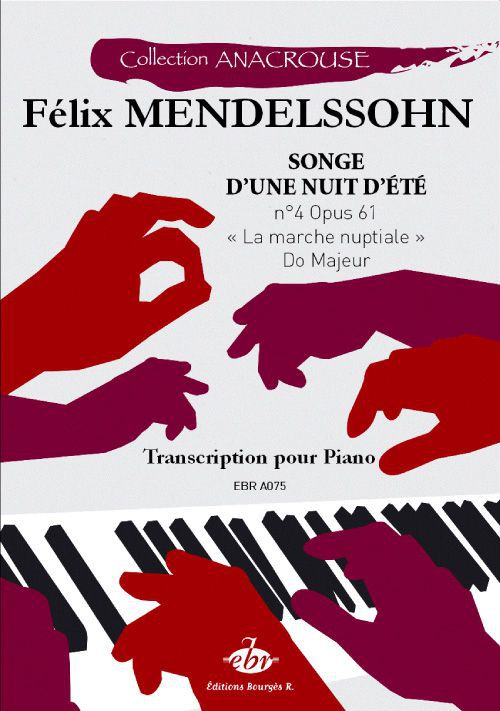
Felix Mendelssohn Bartholdy
Songe D'une Nuit D'ete Do Majeur
- Instrumentation Piano
- Composer Felix Mendelssohn Bartholdy
- Edition Sheet Music
- Publisher Editions Bourgès R.
- Order no. EBRA075
 ships within 2-4 weeks
Description:
The ANACROUSE collection offers novice and experienced pianists alike a wide choice of classical works, from the Renaissance to the modern era.
We have set ourselves the goal of offering both "must-haves" from the classical repertoire and pieces by sometimes forgotten composers, all of undeniable pedagogical value. Each piece, sold individually, has been the subject of careful editorial work, both in terms of the musical text and its engraving, in order to guarantee musicians the conditions indispensable to the pleasures derived from frequent trade in these works.
The scores are offered in the form of traditional works (paper sheets), and also available by download.
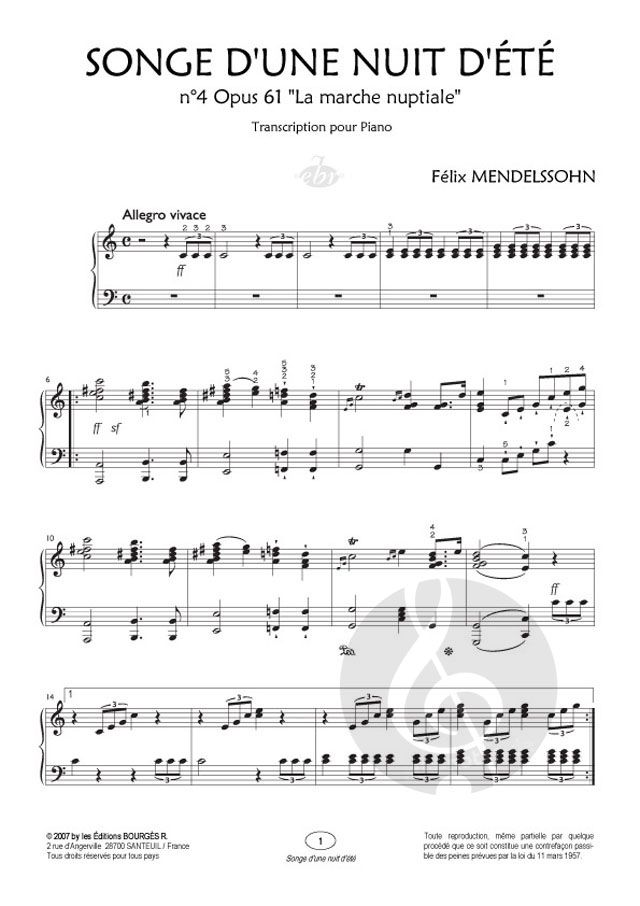
Félix Mendelssohn first wrote the overture to A Midsummer Night's Dream in 1826. He began composing incidental music to the dream again in 1842, at the request of the King of Prussia. His inspiration came from Shakespeare's comedies. Originally, this work was performed with an orchestra, two sopranos and a women's choir. Today, it is performed as a concert suite, some parts of which are no longer performed. The Wedding March precedes the grand finale of this stage music. A very famous piece, it has been detached from the concert suite to be performed in unexpected situations, such as at the end of a wedding, in its transcription for organ, or for piano. Originally, it accompanied the rather comical wedding escort of Titiana and the donkey-eared Bottom. The main theme characterizes the entrance of the actors and comes from the intermezzo, the second piece. This very particular motif has enabled many couples to pleasantly mystify this walk through this symbolic wedding venue.
We have set ourselves the goal of offering both "must-haves" from the classical repertoire and pieces by sometimes forgotten composers, all of undeniable pedagogical value. Each piece, sold individually, has been the subject of careful editorial work, both in terms of the musical text and its engraving, in order to guarantee musicians the conditions indispensable to the pleasures derived from frequent trade in these works.
The scores are offered in the form of traditional works (paper sheets), and also available by download.
Félix Mendelssohn first wrote the overture to A Midsummer Night's Dream in 1826. He began composing incidental music to the dream again in 1842, at the request of the King of Prussia. His inspiration came from Shakespeare's comedies. Originally, this work was performed with an orchestra, two sopranos and a women's choir. Today, it is performed as a concert suite, some parts of which are no longer performed. The Wedding March precedes the grand finale of this stage music. A very famous piece, it has been detached from the concert suite to be performed in unexpected situations, such as at the end of a wedding, in its transcription for organ, or for piano. Originally, it accompanied the rather comical wedding escort of Titiana and the donkey-eared Bottom. The main theme characterizes the entrance of the actors and comes from the intermezzo, the second piece. This very particular motif has enabled many couples to pleasantly mystify this walk through this symbolic wedding venue.