
Johannes Brahms
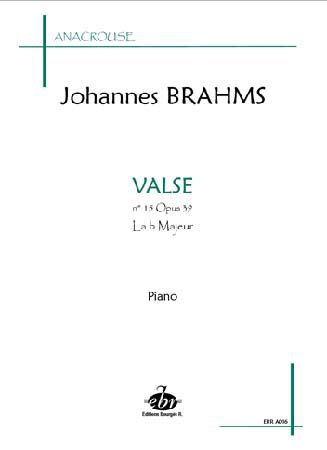
Valse No. 15 op. 39 La Majeur
Demo
listen
Johannes Brahms
Valse No. 15 op. 39 La Majeur
- Instrumentation Piano
- Composer Johannes Brahms
- Edition Sheet Music
- Publisher Editions Bourgès R.
- Order no. EBRA016
 ships within 2-4 weeks
Description:
The ANACROUSE collection offers novice and experienced pianists alike a wide choice of classical works, from the Renaissance to the modern era.
We have set ourselves the goal of offering both "must-haves" from the classical repertoire and pieces by sometimes forgotten composers, all of undeniable pedagogical value. Each piece, sold individually, has been the subject of careful editorial work, both in terms of the musical text and its engraving, in order to guarantee musicians the conditions indispensable to the pleasures derived from frequent trade in these works.
The scores are offered in the form of traditional works (paper sheets), and also available by download.
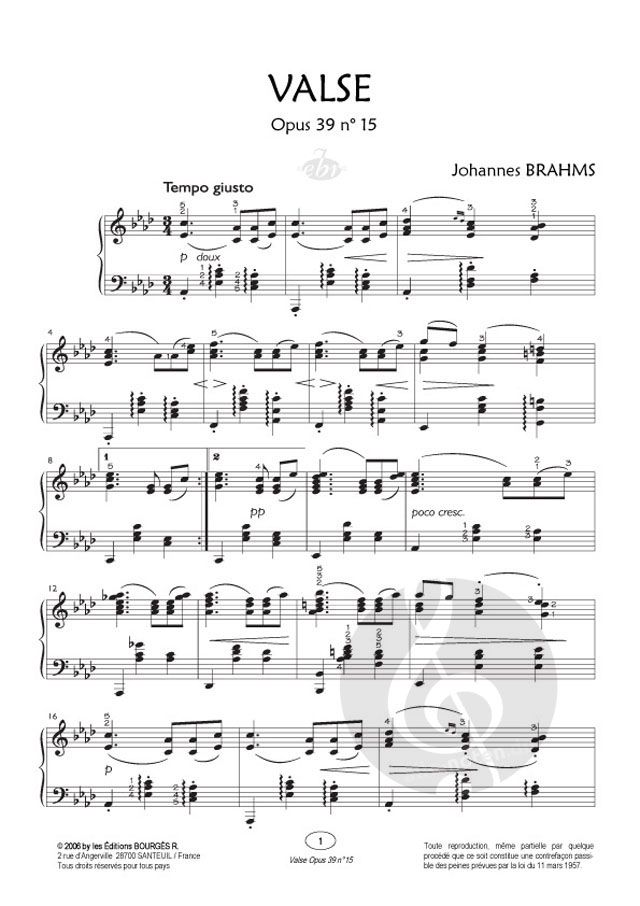
Brahms published Opus 39 in 1865. It consists of sixteen waltzes written for four hands. This was followed by a simplified version for two hands in 1867. His magnificent waltzes represent one of the few unique collections of Brahms's Viennese legacy. Waltz no. 15 in A flat major is the most famous. Its ternary rhythm matches the swaying melody, which gradually develops, giving free rein to the dance; so much so that it was used for a solo ballet danced by Malkovsky in 1923, entitled pensée constante in homage to Isadora Duncan.
Pianists who love Johannes Strauch's waltzes will be charmed by the lively melody Brahms offers in this delightful composition.
We have set ourselves the goal of offering both "must-haves" from the classical repertoire and pieces by sometimes forgotten composers, all of undeniable pedagogical value. Each piece, sold individually, has been the subject of careful editorial work, both in terms of the musical text and its engraving, in order to guarantee musicians the conditions indispensable to the pleasures derived from frequent trade in these works.
The scores are offered in the form of traditional works (paper sheets), and also available by download.
Brahms published Opus 39 in 1865. It consists of sixteen waltzes written for four hands. This was followed by a simplified version for two hands in 1867. His magnificent waltzes represent one of the few unique collections of Brahms's Viennese legacy. Waltz no. 15 in A flat major is the most famous. Its ternary rhythm matches the swaying melody, which gradually develops, giving free rein to the dance; so much so that it was used for a solo ballet danced by Malkovsky in 1923, entitled pensée constante in homage to Isadora Duncan.
Pianists who love Johannes Strauch's waltzes will be charmed by the lively melody Brahms offers in this delightful composition.