
Frédéric Chopin
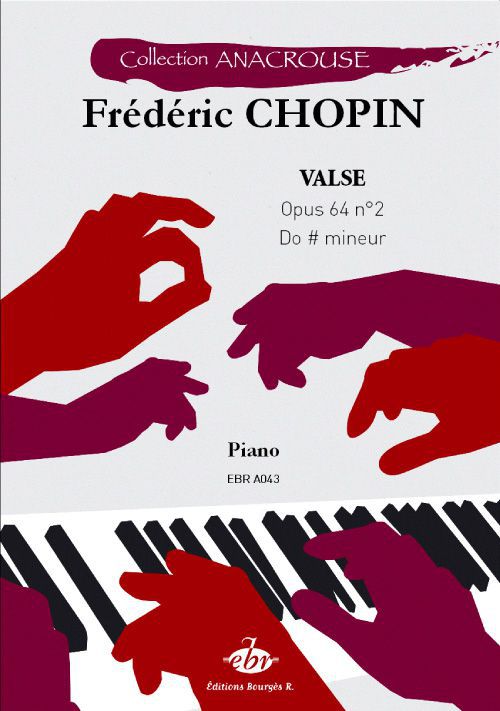
Valse op. 64 No. 2 Do Diese Mineur
Demo
listen
Frédéric Chopin
Valse op. 64 No. 2 Do Diese Mineur
- Instrumentation Piano
- Composer Frédéric Chopin
- Edition Sheet Music
- Publisher Editions Bourgès R.
- Order no. EBRA043
 ships within 2-4 weeks
Description:
The ANACROUSE collection offers novice and experienced pianists alike a wide choice of classical works, from the Renaissance to the modern era.
We have set ourselves the goal of offering both "must-haves" from the classical repertoire and pieces by sometimes forgotten composers, all of undeniable pedagogical value. Each piece, sold individually, has been the subject of careful editorial work, both in terms of the musical text and its engraving, in order to guarantee musicians the conditions indispensable to the pleasures derived from frequent trade in these works.
The scores are offered in the form of traditional works (paper sheets), and also available by download.
Chopin's Waltzes differ completely from the Viennese Waltzes written by Strauss for dancing. Chopin's Waltzes are closer to a sung poem. As he once confided: "I don't have anything I need for Viennese waltzes. Each of his waltzes reveals flights of spontaneity and infinite lyricism.
Chopin composed nineteen waltzes at all periods of his life, fourteen of which are world-famous and catalogued by all pianists.
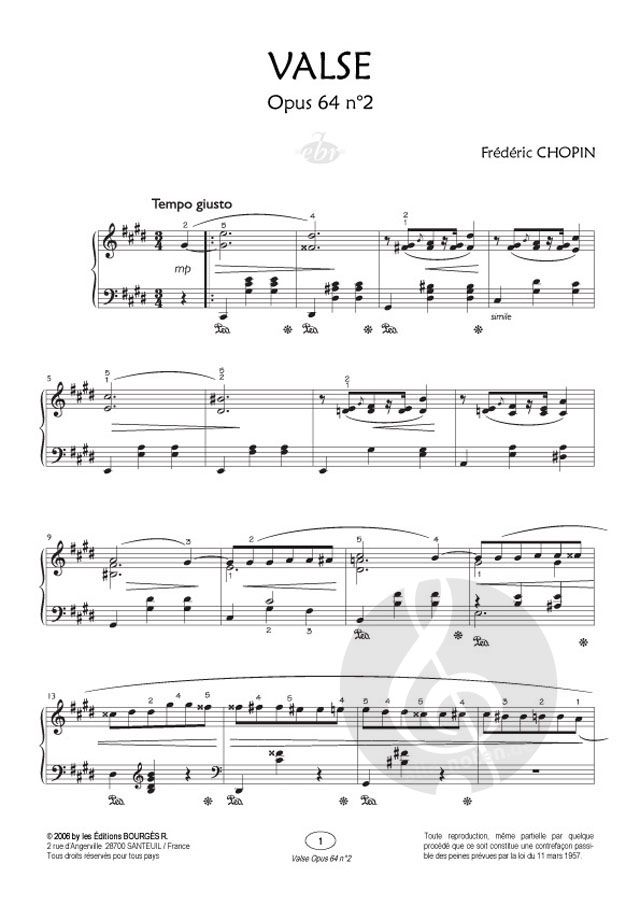
Opus 64 is one of eight opuses published during Chopin's lifetime. Dedicated to Baroness Nathaniel de Rothschild, waltz no. 2 sways throughout the piece at different tempi, transient or successive, as indicated on the score: giusto piu mosso (bar 38), piu lento (bar 65), piu mosso (bar 97) tempo I (bar 129), piu mosso (bar 161). The central section develops a delectable melody of great velocity in the key of D-flat major, all in a burst of spontaneity.
This intimate, playful waltz recalls the spirit of the salons where Chopin usually played. The performer will be captivated by the whimsical, expressive and spirited whirl of this waltz. He'll escape into unexplored corners of his imagination, which will bring him great pleasure in interpretation.
We have set ourselves the goal of offering both "must-haves" from the classical repertoire and pieces by sometimes forgotten composers, all of undeniable pedagogical value. Each piece, sold individually, has been the subject of careful editorial work, both in terms of the musical text and its engraving, in order to guarantee musicians the conditions indispensable to the pleasures derived from frequent trade in these works.
The scores are offered in the form of traditional works (paper sheets), and also available by download.
Chopin's Waltzes differ completely from the Viennese Waltzes written by Strauss for dancing. Chopin's Waltzes are closer to a sung poem. As he once confided: "I don't have anything I need for Viennese waltzes. Each of his waltzes reveals flights of spontaneity and infinite lyricism.
Chopin composed nineteen waltzes at all periods of his life, fourteen of which are world-famous and catalogued by all pianists.
Opus 64 is one of eight opuses published during Chopin's lifetime. Dedicated to Baroness Nathaniel de Rothschild, waltz no. 2 sways throughout the piece at different tempi, transient or successive, as indicated on the score: giusto piu mosso (bar 38), piu lento (bar 65), piu mosso (bar 97) tempo I (bar 129), piu mosso (bar 161). The central section develops a delectable melody of great velocity in the key of D-flat major, all in a burst of spontaneity.
This intimate, playful waltz recalls the spirit of the salons where Chopin usually played. The performer will be captivated by the whimsical, expressive and spirited whirl of this waltz. He'll escape into unexplored corners of his imagination, which will bring him great pleasure in interpretation.