
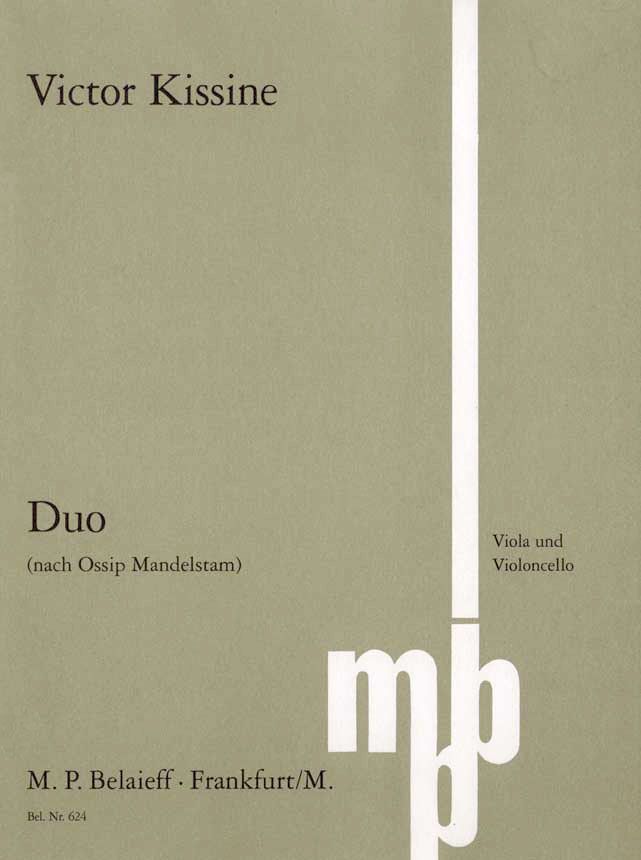
Victor Kissine
Duo für Viola und Violoncello
(after Ossip Mandelstam)
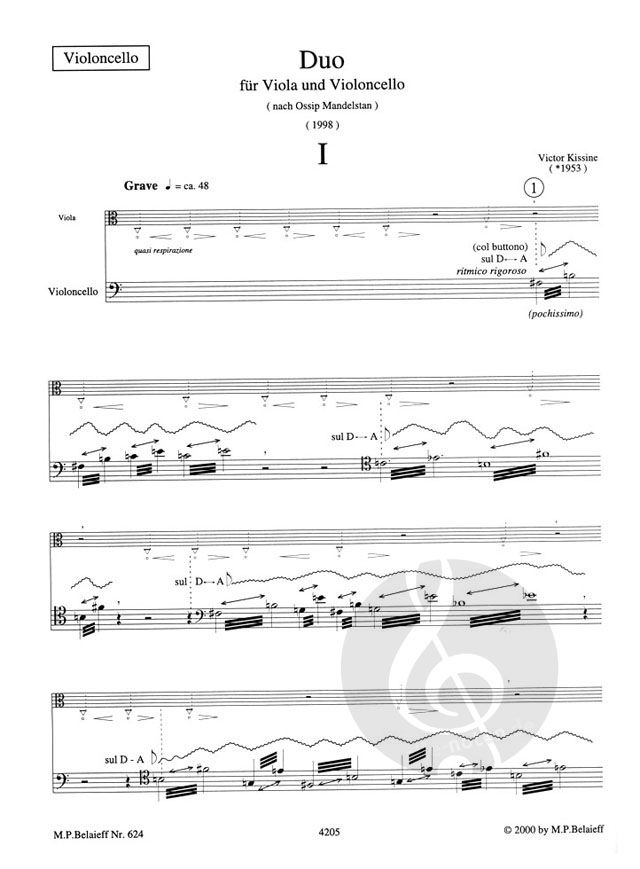
Victor Kissine
Duo für Viola und Violoncello
(after Ossip Mandelstam)
- Instrumentation String Duet (Cello and Viola)
- Composer Victor Kissine
- Edition Score and Parts
- Publisher M.P. Belaieff
- Order no. BEL624
 in stock
ships within 1-2 working days
incl. tax,
excl. shipping costs
Not available in all countries. Learn more

Description:
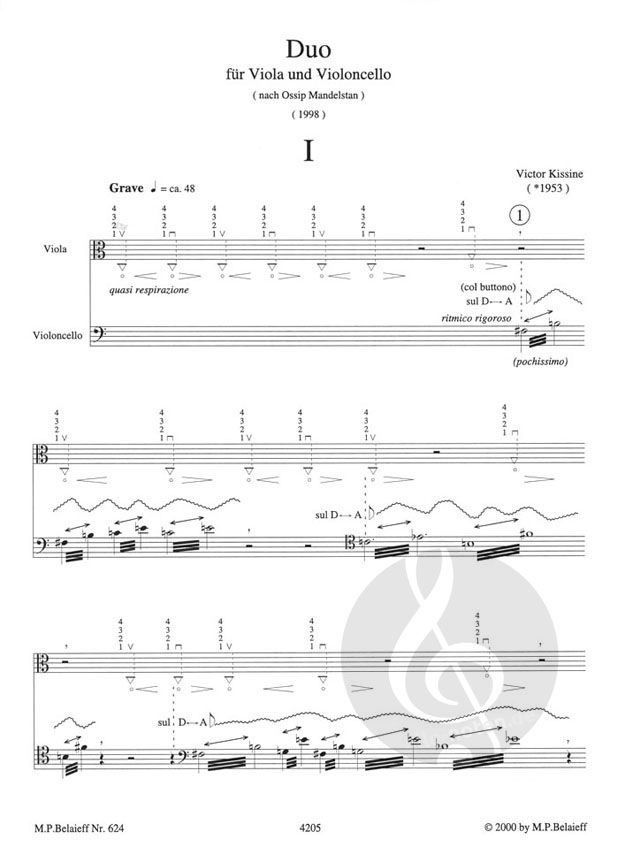
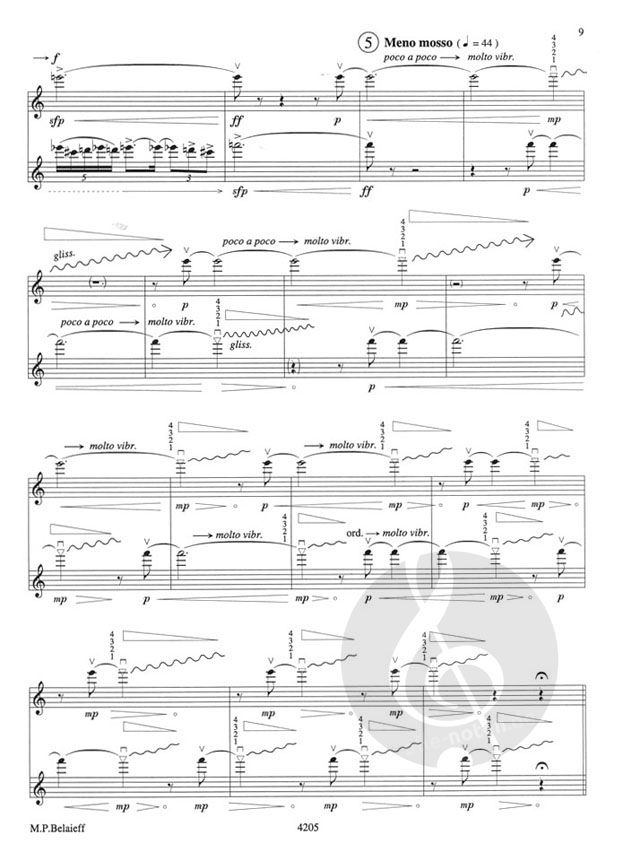
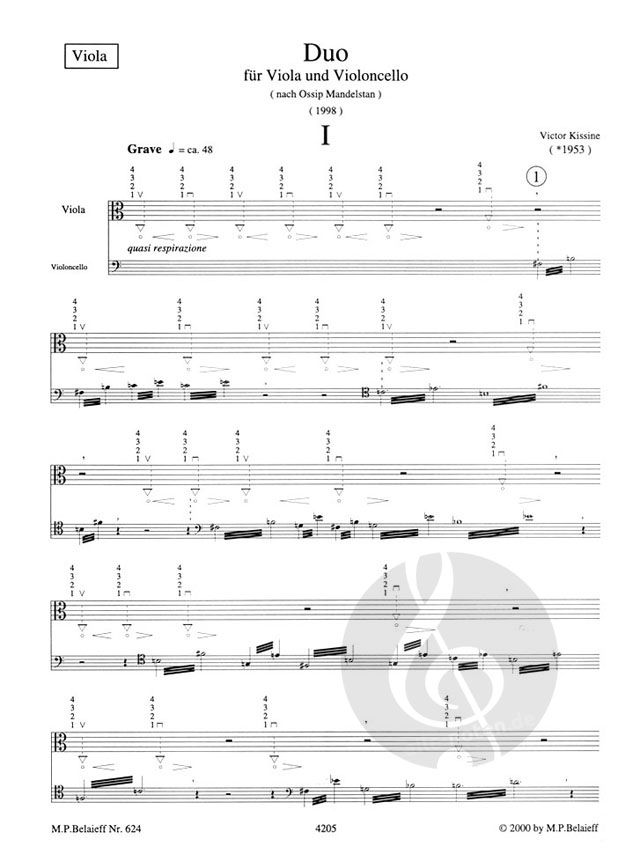
Although the first version of the Duo was composed in 1998, I rewrote it completely for Giedre Dirvanauskaite and Daniel Grishin who premiered it at Lockenhaus festival 2011. The sub-title, 'After Ossip Mandelstam', refers to a short poem from his 1910 collection Kamen' (Stone), which underlies my piece: not only is this poem my epigraph, it is also quoted all along within the instrumental context. Here are a few lines from the English and German translations:Ears stretch sensitive sails,dilated eyes lose fire,over the silence swimsthe night-birds' soundless choir.Das Ohr - ein feingespanntes Segel,der Blick taucht fragend-leer empor,der Stille mitternächtge Vögelziehn durch die Luft als stummer Chor.But obviously no translation can transmit the breath of this poetry, its respiration. It is exactly what I attempted to do through a musical reading that starts and ends with this breath. In the first movement, it is initiated by the Viola, which follows the 'choir', played by the Cello with a vertically positioned bow. So, the emergence, at the end of this movement, of the real sound marks the entrance into metaphorical spectrum.The second movement has a concentric form where the voiceless choir of the first movement is developed in the central section.The final movement, Adagietto, adjusts the respiration, like a regular pace - a reference to J. S. Bach. The coda, finally, goes back to the initial breath. Victor Kissine
-
I Grave
-
II Con moto
-
III Adagietto
Customers rated this product:
Manufacturer Information:
M.P. Belaieff
Weihergarten 5
55116
Mainz
Deutschland
Other customers also bought:
- String Duet (Cello and Viola)
- Sheet Music
-
ships within 2-4 weeks
Ernst-Lothar von Knorr
- String Duet (Cello and Viola)
- Sheet Music
-
ships within 4-8 working days
- String Duet (Cello and Viola)
- Sheet Music
-
ships within 4-8 working days
Georg Abraham Schneider
- String Duet (Cello and Viola)
- Sheet Music
-
ships within 4-8 working days
Caspar Diethelm
- String Duet (Cello and Viola)
- Sheet Music
-
ships within 4-8 working days

- String Duet (Cello and Viola)
- Sheet Music
-
ships within 2-4 weeks

- String Duet (Cello and Viola)
- Sheet Music
-
ships within 2-4 weeks