
Yves Balmer
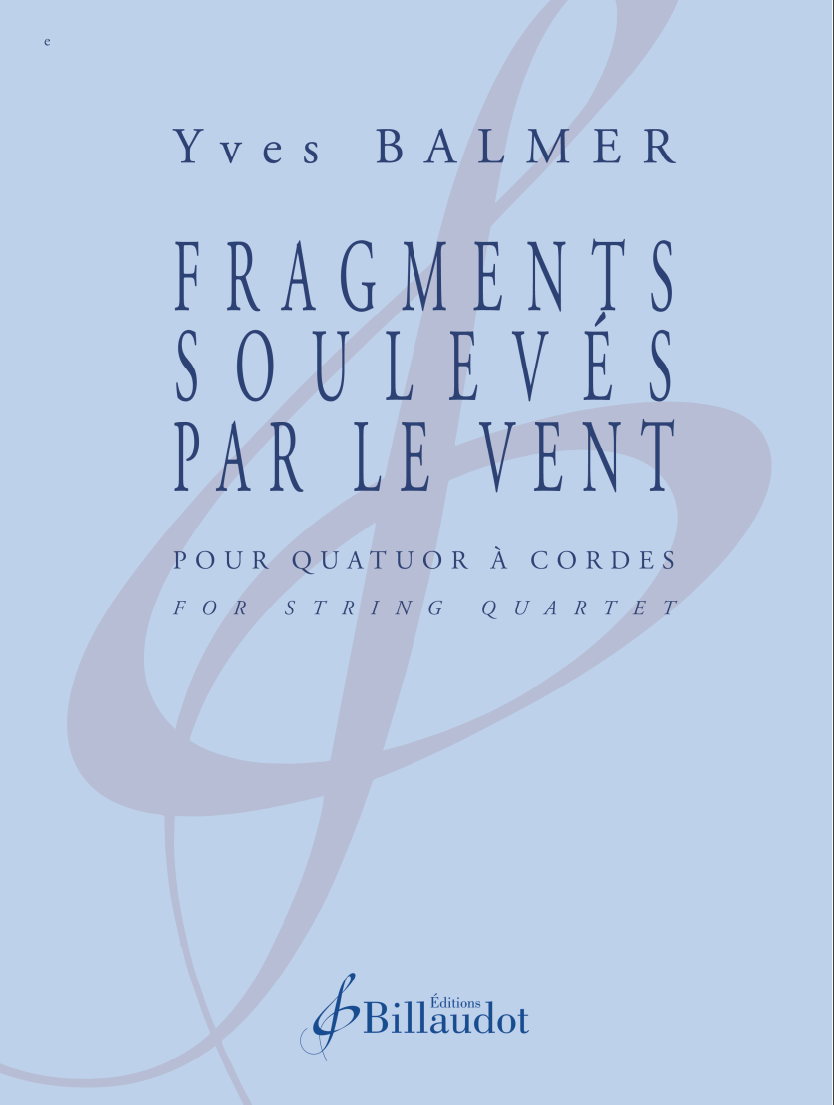
Fragments soulevés par le Vent
for string quartet
PDF
view
Yves Balmer
Fragments soulevés par le Vent
for string quartet
- Instrumentation String Quartet
- Composer Yves Balmer
- Edition Score and Parts
- Publisher Gerard Billaudot
- Order no. BILL10419
 in stock
ships within 1-2 working days
incl. tax,
excl. shipping costs
Not available in all countries. Learn more

Description:
Placed under the guardianship of a title by the poet Philippe Jaccottet (1925-2021) - Fragments soulevés par le vent - the three movements of this work are permeated by instability and almost continuous changes of state, expressing the wondering simplicity of a sensitive and poetic relationship with nature. In the age of climate change, reviving the eminently Debussian model of the wind - recall the Dialogue du vent et de la mer or Ce qu'a vu le vent d'Ouest - requires us to reflect critically on how we perceive and listen to this natural phenomenon, and how to approach it as a living musician in the 21st century. It is also a way of wagering on a possible shift, made necessary today: from the retranscription of an idealised impression to a utopian listening to the world.
One of the pieces of advice given by Monsieur Croche (the pen name of the critic Claude Debussy) came back to Yves Balmer's mind when he responded to the Voce quartet's commission to write a quartet "in echo" of Debussy's: "Listen to no one's advice, except the wind as it passes and tells us the story of the world." The link forged with Debussy in this creation, which is in no way a pastiche, is that of a relationship with the natural elements and a fascination with timbre. Like Debussy, who learnt from the wind and water, he sought to capture some of the volatile sensations of the wind's breath, its fluidity and fragility.
One of the pieces of advice given by Monsieur Croche (the pen name of the critic Claude Debussy) came back to Yves Balmer's mind when he responded to the Voce quartet's commission to write a quartet "in echo" of Debussy's: "Listen to no one's advice, except the wind as it passes and tells us the story of the world." The link forged with Debussy in this creation, which is in no way a pastiche, is that of a relationship with the natural elements and a fascination with timbre. Like Debussy, who learnt from the wind and water, he sought to capture some of the volatile sensations of the wind's breath, its fluidity and fragility.