
Ludwig van Beethoven
Quintett in Es-Dur
Video
view
Ludwig van Beethoven
Quintett in Es-Dur
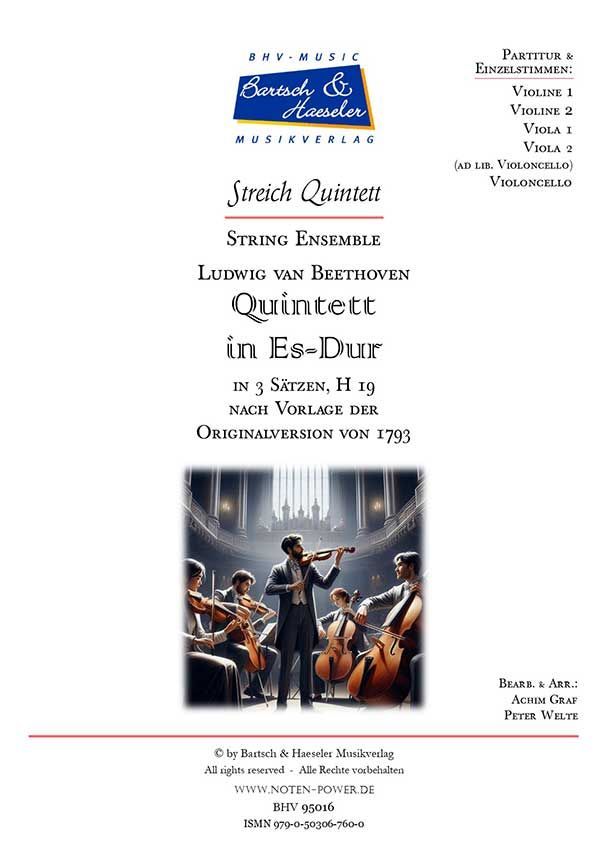
- Instrumentation String Quintet (2 Violins, 2 Violas and Cello)
- Composer Ludwig van Beethoven
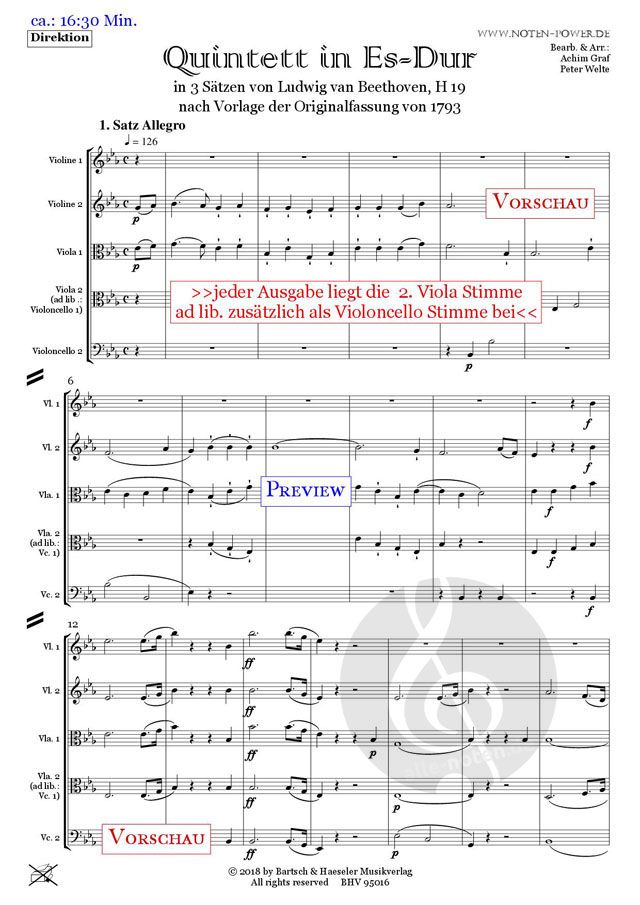
- Edition Director's Score and Parts
- Publisher Bartsch & Haeseler Musikverlag
- Order no. BHV95016
 in stock
ships within 1-2 working days
incl. tax,
excl. shipping costs
Not available in all countries. Learn more

Description:
after the original version of 1793 in 3 movements:
1st Allegro, 2nd Adagio Maestoso, 3rd Minuetto Allegro
Contents: Director's Score and Parts
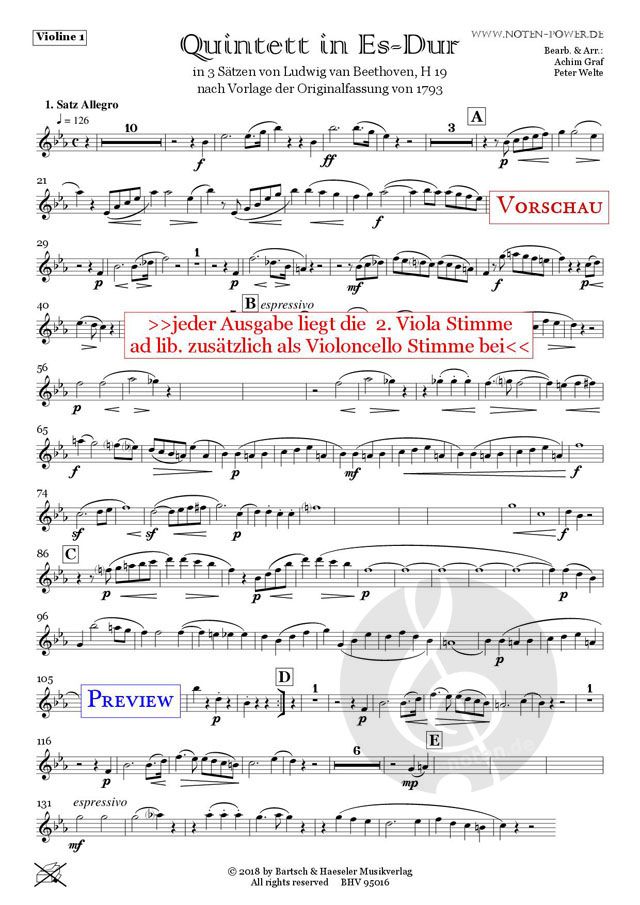
Violin 1+2, Viola 1+2, Violoncello (The 2nd viola part is also included ad lib. as violoncello part)
"Rarely will one find music of this kind which is so well tuned, so well understood, and which has achieved such a high degree of truth and perfection, especially in the carrying of the tone, as this one." This is how Boßler's Musikalische Korrespondenz (1791) in Speyer enthused about the Harmonie-Tafelmusik of the Cologne Elector Max Franz, for which the young Ludwig van Beethoven composed the most important of his works for wind instruments. Others, mostly of a marginal nature, were composed in his youthful years in Bonn for friends and acquaintances from the Electorate of Cologne. Only a few of these works later appeared under Beethoven's 137 printed operas; most of them are listed in the composer's catalog of works under "Works without opus number" (WoO).
1st Allegro, 2nd Adagio Maestoso, 3rd Minuetto Allegro
Contents: Director's Score and Parts
Violin 1+2, Viola 1+2, Violoncello (The 2nd viola part is also included ad lib. as violoncello part)
"Rarely will one find music of this kind which is so well tuned, so well understood, and which has achieved such a high degree of truth and perfection, especially in the carrying of the tone, as this one." This is how Boßler's Musikalische Korrespondenz (1791) in Speyer enthused about the Harmonie-Tafelmusik of the Cologne Elector Max Franz, for which the young Ludwig van Beethoven composed the most important of his works for wind instruments. Others, mostly of a marginal nature, were composed in his youthful years in Bonn for friends and acquaintances from the Electorate of Cologne. Only a few of these works later appeared under Beethoven's 137 printed operas; most of them are listed in the composer's catalog of works under "Works without opus number" (WoO).