
Erwin Schulhoff
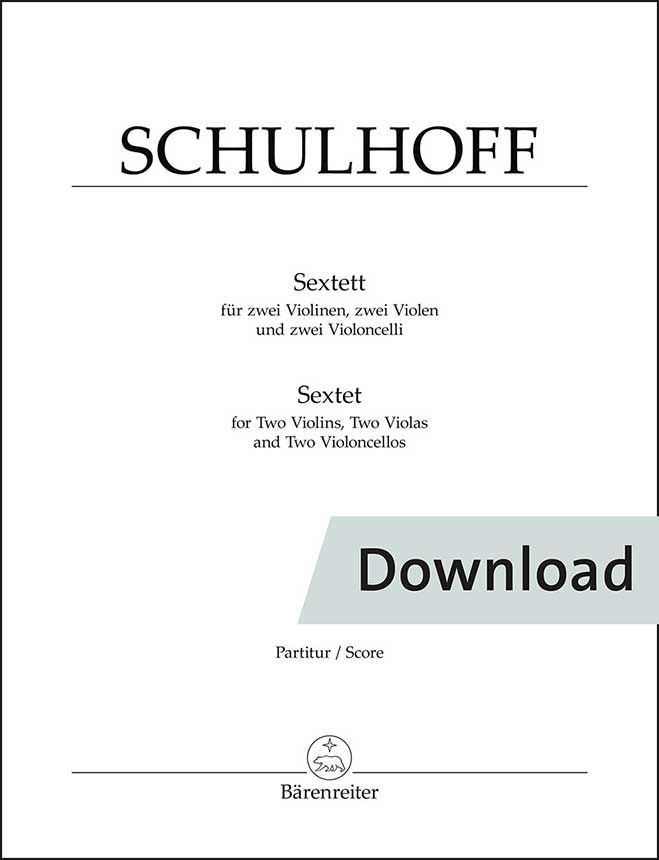
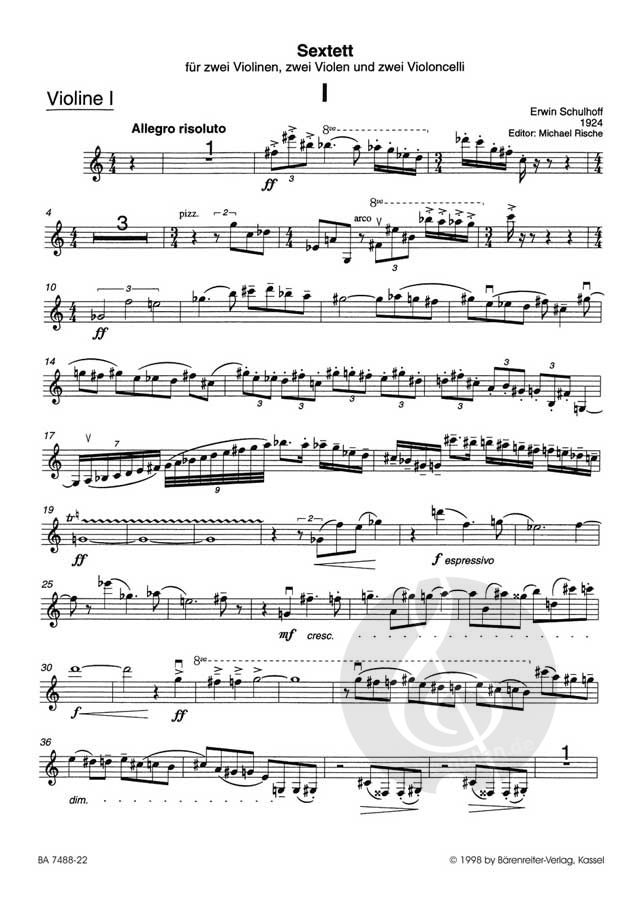
Sextet
for two violins, two violas and two cellos - 1924

Erwin Schulhoff
Sextet
for two violins, two violas and two cellos - 1924
- Instrumentation 2 Violins, 2 Violas and 2 Cellos
- Composer Erwin Schulhoff
- Editor Michael Rische
- Edition Score Download
- Publisher Bärenreiter Verlag
- Order no. BA7488-DL
 immediately available
Download immediately after ordering
incl. tax,
excl. shipping costs
Not available in all countries. Learn more

Description:
Schulhoff spent a total of four years working on the "Sextet for two violins, two violas and two cellos". While the first movement was already completed in Dresden on April 27, 1920, it took until April 30, 1924 for the other movements to be finalized in Prague.
None other than Paul Hindemith had arranged the premiere of the work with Schulhoff in Donaueschingen, which took place there on July 19, 1924. It was played by the Zika Quartet, Hindemith's brother Rudolf and himself. After this success, Schulhoff sent the manuscript to Universal-Edition in Vienna in order to have it printed, but on April 17, 1926 he asked for it to be revised. This revision never took place, and no further performances seem to have taken place during his lifetime.
In 1978, the first printed score of the sextet was published by Supraphon in Prague, albeit without the individual parts. Since the mid-1980s, the work has finally returned to the concert hall: a credit not least to Gidon Kremer, who was the first to campaign for its rehabilitation. In the meantime, several first-class ensembles have taken up the string sextet, which is reflected not only in concert life but also on the record market.
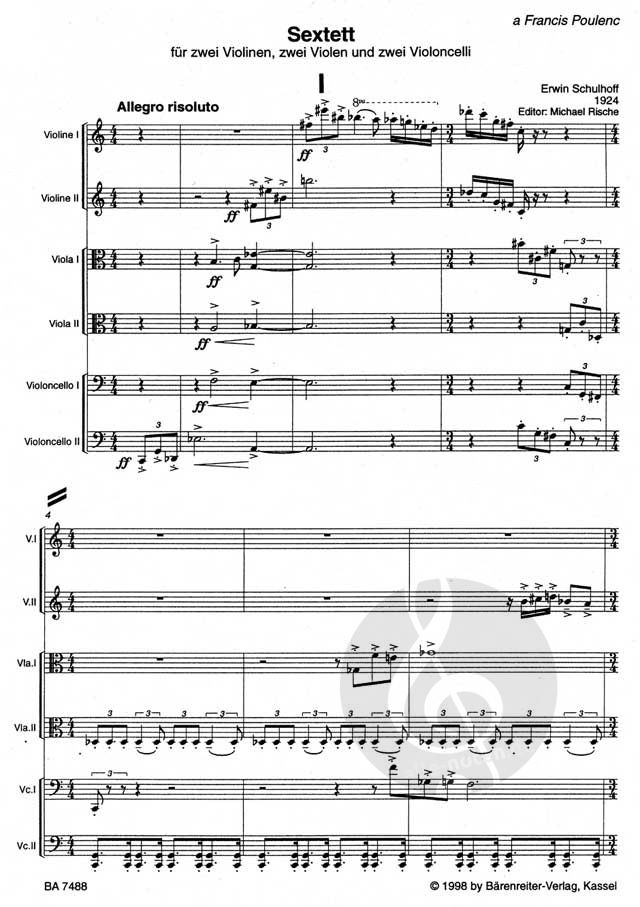
Schulhoff dedicated the sextet to Francis Poulenc. I am not aware of any personal contact between the two, but it is safe to assume that Schulhoff was familiar with the French composer's oeuvre; after all, he presented Poulenc together with Hindemith, Stravinsky, Casella and others in a short article in the magazine "Auftakt" in 1924.
The publication of Erwin Schulhoff's string sextet was more than overdue, as it undoubtedly belongs in the series of works by Brahms and Schoenberg due to its youthful élan and the associated courage for expressivity.
(Foreword by Michael Rische, October 24, 1997)
None other than Paul Hindemith had arranged the premiere of the work with Schulhoff in Donaueschingen, which took place there on July 19, 1924. It was played by the Zika Quartet, Hindemith's brother Rudolf and himself. After this success, Schulhoff sent the manuscript to Universal-Edition in Vienna in order to have it printed, but on April 17, 1926 he asked for it to be revised. This revision never took place, and no further performances seem to have taken place during his lifetime.
In 1978, the first printed score of the sextet was published by Supraphon in Prague, albeit without the individual parts. Since the mid-1980s, the work has finally returned to the concert hall: a credit not least to Gidon Kremer, who was the first to campaign for its rehabilitation. In the meantime, several first-class ensembles have taken up the string sextet, which is reflected not only in concert life but also on the record market.
Schulhoff dedicated the sextet to Francis Poulenc. I am not aware of any personal contact between the two, but it is safe to assume that Schulhoff was familiar with the French composer's oeuvre; after all, he presented Poulenc together with Hindemith, Stravinsky, Casella and others in a short article in the magazine "Auftakt" in 1924.
The publication of Erwin Schulhoff's string sextet was more than overdue, as it undoubtedly belongs in the series of works by Brahms and Schoenberg due to its youthful élan and the associated courage for expressivity.
(Foreword by Michael Rische, October 24, 1997)
-
Vorwort
-
Allegro risoluto
-
Tranquillo
-
Burlesca. Allegro molto con spirito
-
Molto adagio
-
Kritischer Bericht
Related products:
Here is how the download works:
1 Buy download sheet music
Purchase the download score from our online store
2 Order confirmation with download link
Immediately after completing your order, you will receive an order confirmation by email listing all items. You will find the download link next to each item. You can use this link to start the download right away. Please also check your spam folder if necessary.
Customers rated this product:
Manufacturer Information:
Bärenreiter-Verlag Karl Vötterle GmbH & Co. KG
Heinrich-Schütz-Allee 35-37
34131
Kassel
Deutschland
Other customers also bought:
- 2 Violins, 2 Violas and 2 Cellos
- Set of Parts (Urtext)
-
in stock
ships within 1-2 working days - Also available for download!
- Clarinet, Cello and Piano
- Score and Parts
-
in stock
ships within 1-2 working days - Also available for download!
- Violin, Cello and Piano
- Sheet Music
-
in stock
ships within 1-2 working days - Also available for download!

Hugo Wolf
- String Quartet
- Sheet Music
-
ships within 2-4 weeks

- Piano, Violin and Cello
- Sheet Music
- Bernhard Päuler
-
in stock
ships within 1-2 working days
Wolfgang Amadeus Mozart
for Piano, Clarinet (Violin) and Viola
- Clarinet, Viola and Piano
- Set of Parts (Urtext)
-
ships within 2-5 working days
- 2 Violins, 2 Violas and 2 Cellos
- Set of Parts
-
ships within 2-4 working days
- Also available for download!
Robert Schumann
for Piano and Clarinet (or Violin or Violoncello) op. 73 (version for Violoncello)
- Cello and Piano
- Sheet Music (Urtext)
- Ernst Herttrich
-
in stock
ships within 1-2 working days
Gioacchino Rossini
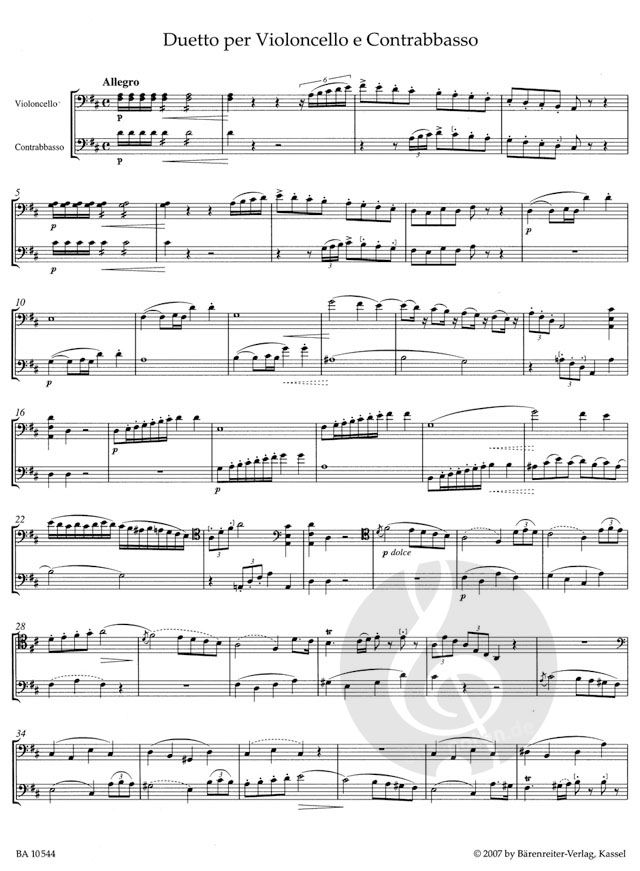
- String Duet (Cello and Double Bass)
- Score and Parts (Urtext)
-
ships within 2-4 working days
- Also available for download!



- 2 Violins, 2 Violas, 2 Cellos and Double Bass
- Set of Parts
- Rudolf Leopold
-
in stock
ships within 1-2 working days
- 7 Strings
- Study Score
- Rudolf Leopold
-
in stock
ships within 1-2 working days

Vincent d' Indy
for Trumpet in D or B flat, 2 Flutes & String Quartet (with string bass ad lib.)
- Trumpet, 2 Flutes, 2 Violins, Viola and Cello
- Sheet Music
-
in stock
ships within 1-2 working days