
Matthias Pintscher
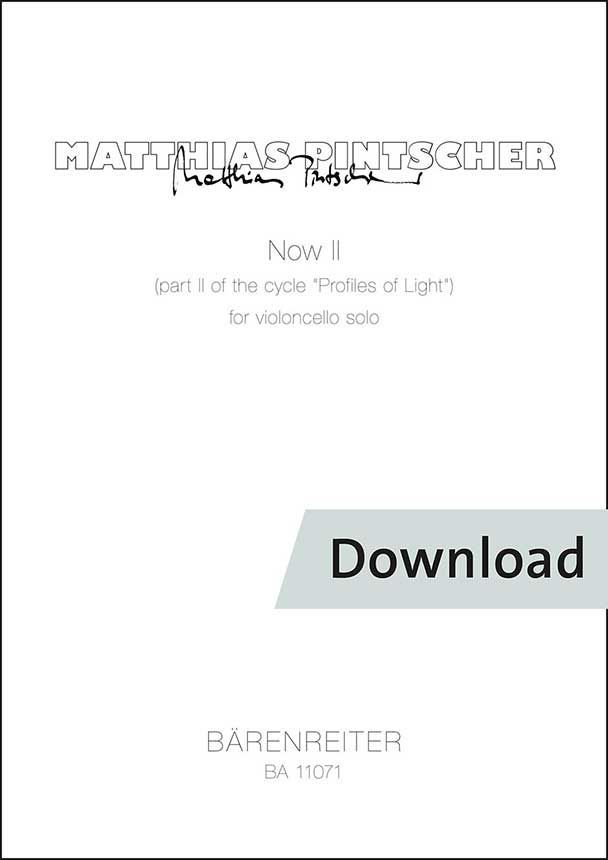
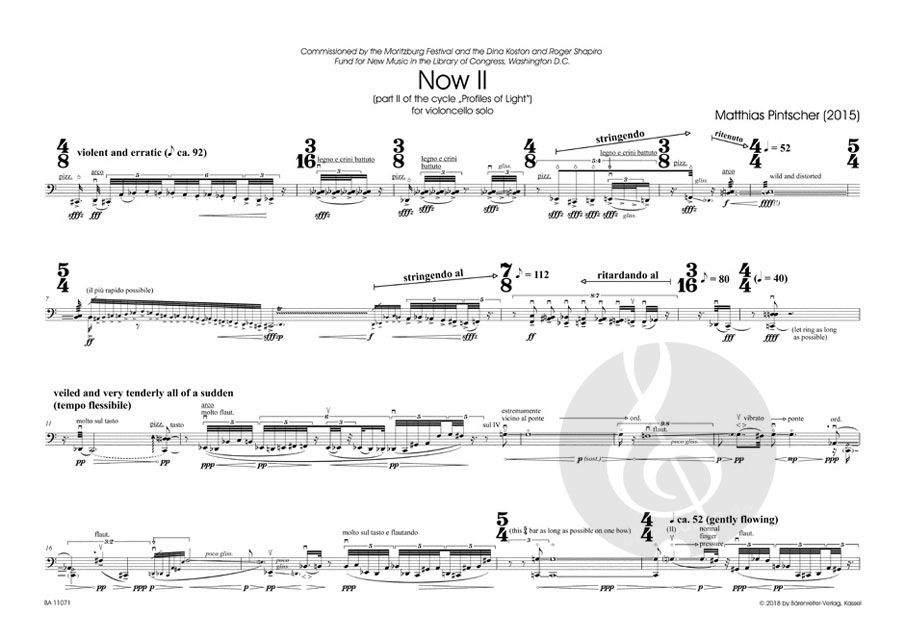
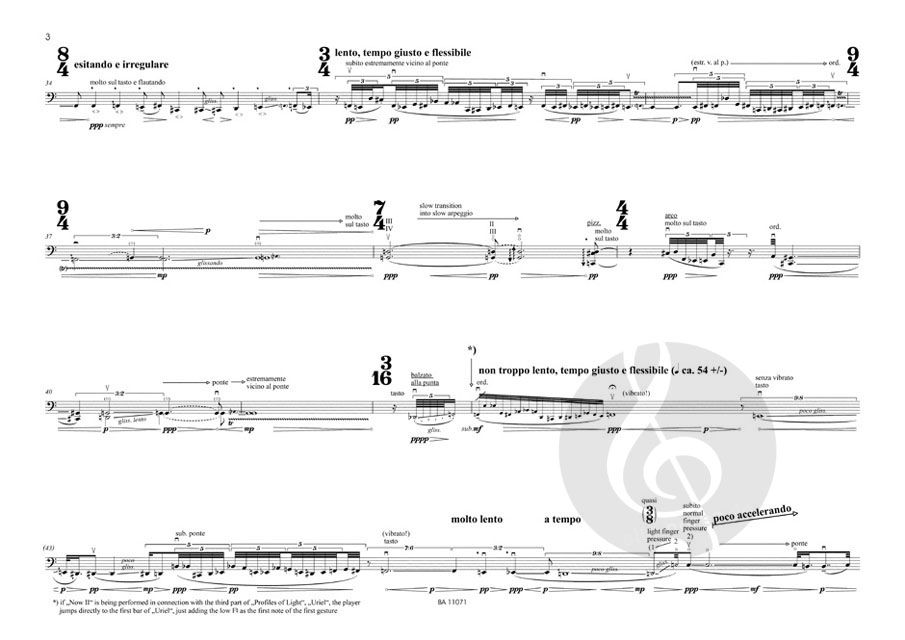
Now II for violoncello solo
part II of the cycle 'Profiles of Light'
Matthias Pintscher
Now II for violoncello solo
part II of the cycle 'Profiles of Light'
- Instrumentation Cello
- Composer Matthias Pintscher
- Edition Sheet Music Download
- Publisher Bärenreiter Verlag
- Order no. BA11071-DL
 immediately available
Download immediately after ordering
incl. tax,
excl. shipping costs
Not available in all countries. Learn more

Description:
Now II is the second part of a chamber music triptych entitled "Profiles of Light". The first part is composed for piano solo (Now I, BA 11073), the second part for violoncello solo, and in the final part (Uriel, BA 11013) the two instruments come together.
All three pieces are inspired by the abstract expressionist works of the American painter Barnett Newman. Newman's work has strongly influenced Matthias Pintscher's artistic understanding: what does it mean to engage with the essence of reduction and the most direct expression at the same time? In some of Newman's paintings there is an immensely intensely luminous light, but more in the manner of a specifically dark glow; something that can also be found in the music of the late Franz Schubert, where a comparable profundity and yearning retrospection shines through the surface of even the brightest keys.
It is a piece about resonances, about the inner and outer conditions of existence, about life itself: "I think the cello is a very suitable instrument for depicting these existential conditions."
All three pieces are inspired by the abstract expressionist works of the American painter Barnett Newman. Newman's work has strongly influenced Matthias Pintscher's artistic understanding: what does it mean to engage with the essence of reduction and the most direct expression at the same time? In some of Newman's paintings there is an immensely intensely luminous light, but more in the manner of a specifically dark glow; something that can also be found in the music of the late Franz Schubert, where a comparable profundity and yearning retrospection shines through the surface of even the brightest keys.
It is a piece about resonances, about the inner and outer conditions of existence, about life itself: "I think the cello is a very suitable instrument for depicting these existential conditions."