
Edward Mollenhauer
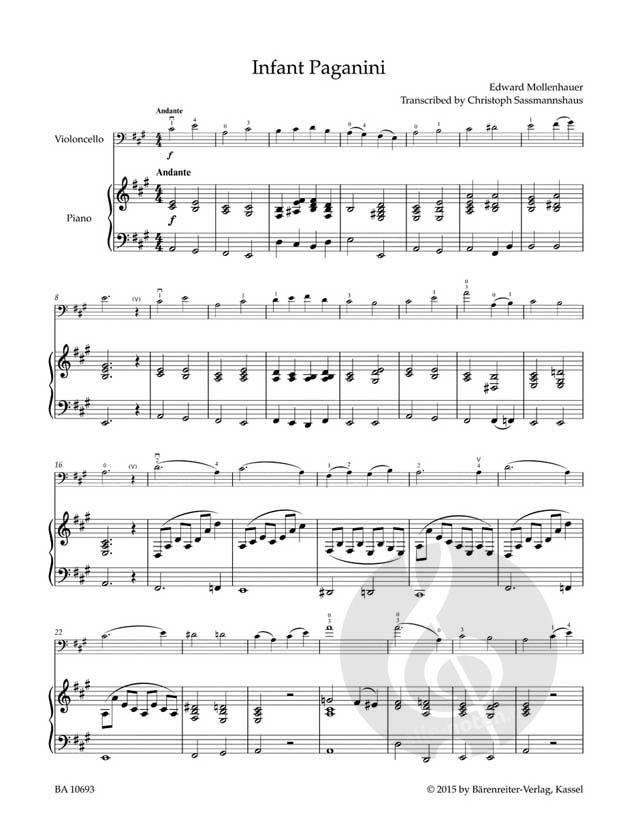
The Infant Paganini
Transcribed for Cello and Piano - Bärenreiter's Concert Pieces
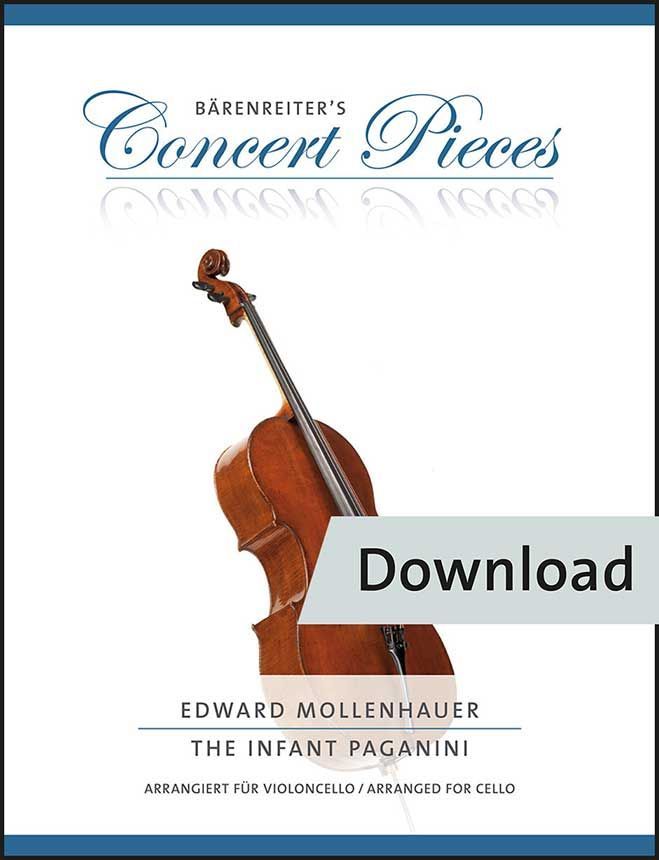
Edward Mollenhauer
The Infant Paganini
Transcribed for Cello and Piano - Bärenreiter's Concert Pieces
- Instrumentation Cello and Piano
- Composer Edward Mollenhauer
- Series Bärenreiter's Concert Pieces
- Editor Christoph Sassmannshaus
-
Difficulty Level
- Edition Piano reduction with part(s) Download
- Publisher Bärenreiter Verlag
- Order no. BA10693-DL
 immediately available
Download immediately after ordering
incl. tax,
excl. shipping costs
Not available in all countries. Learn more

Description:
The Erfurt-born composer Edward Mollenhauer (1827-1914) was a successful soloist and teacher in America. His best-known pieces for young violinists are The Boy Paganini and The Infant Paganini.
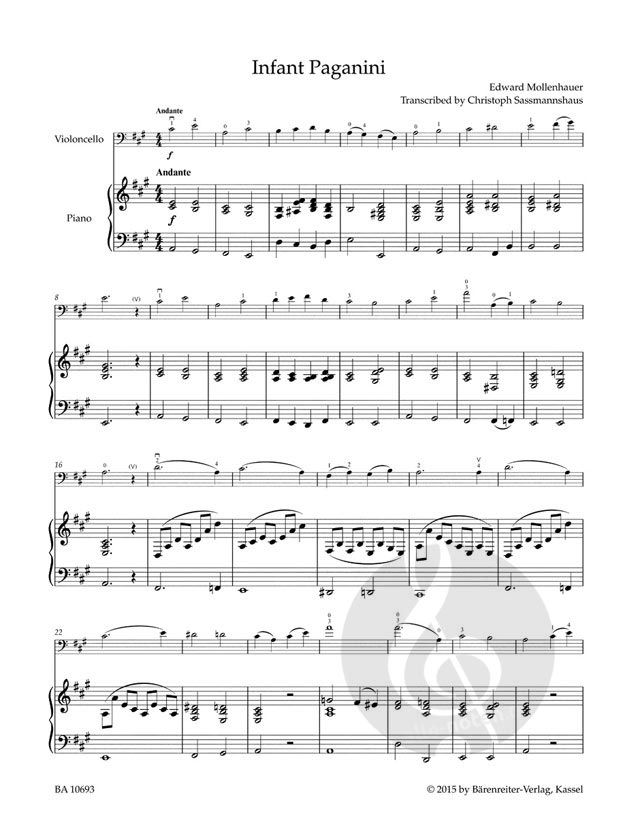
Both are published in the original edition for violin and piano as well as for the first time in a transcription for cello by Christoph Sassmannshaus.
The Fantasia The Infant Paganini for violin and piano (BA 10691) is a delightful prelude in first and third position and can be achieved by pupils at the level of the fourth volume of the Sassmannshaus Violin School. Flageolets and pizzicati are expected.
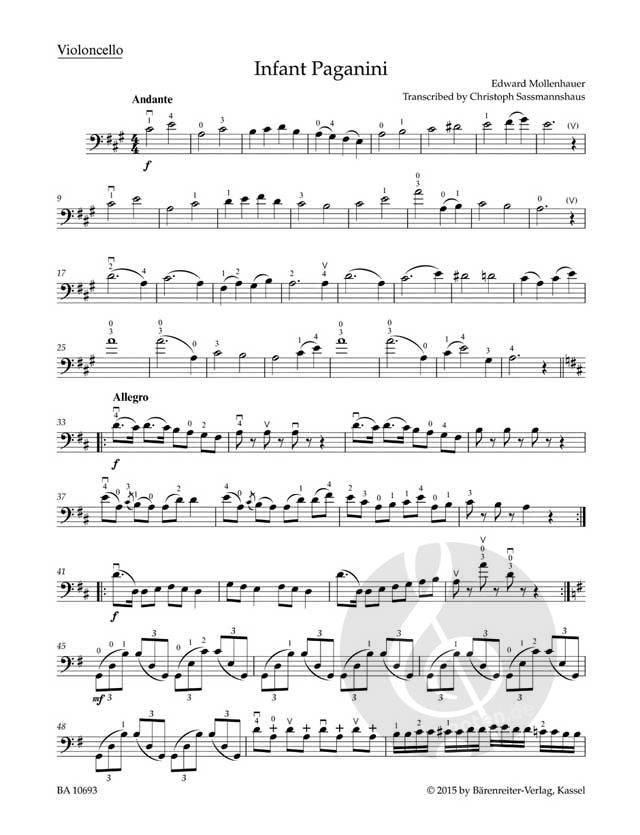
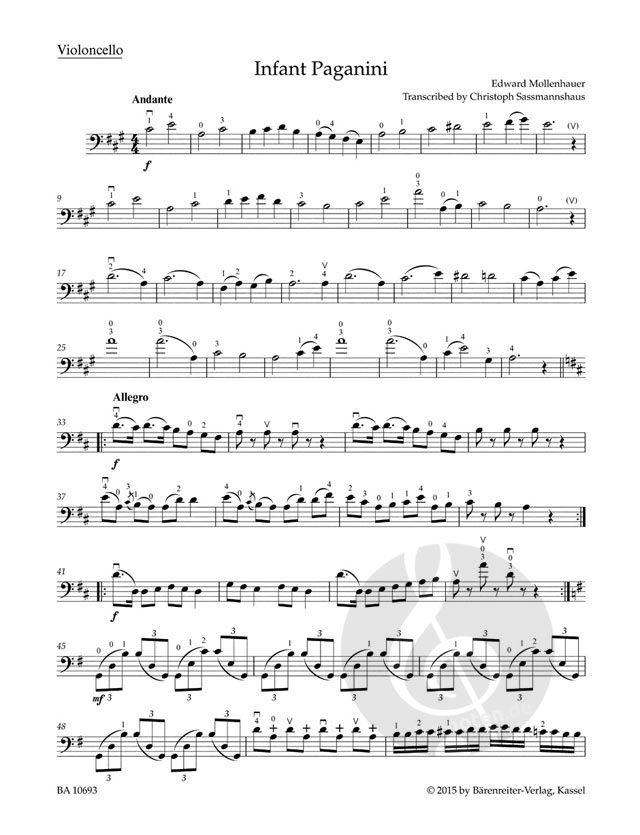
The Infant Paganini on the cello (BA 10693) is also a rewarding performance piece in the first to fourth positions, which can be mastered by pupils working with the fourth volume of the Early Beginning. As with the violin, the bowing techniques required are detaché, legato, spiccato and string changes with arpeggios. Flageolets and pizzicati are also expected.
The Fantasia The Boy Paganini for violin and piano (BA 10692), an impressive concert piece in the first to fifth positions, is more demanding. The two movements require time changes, harmonics and pizzicati.
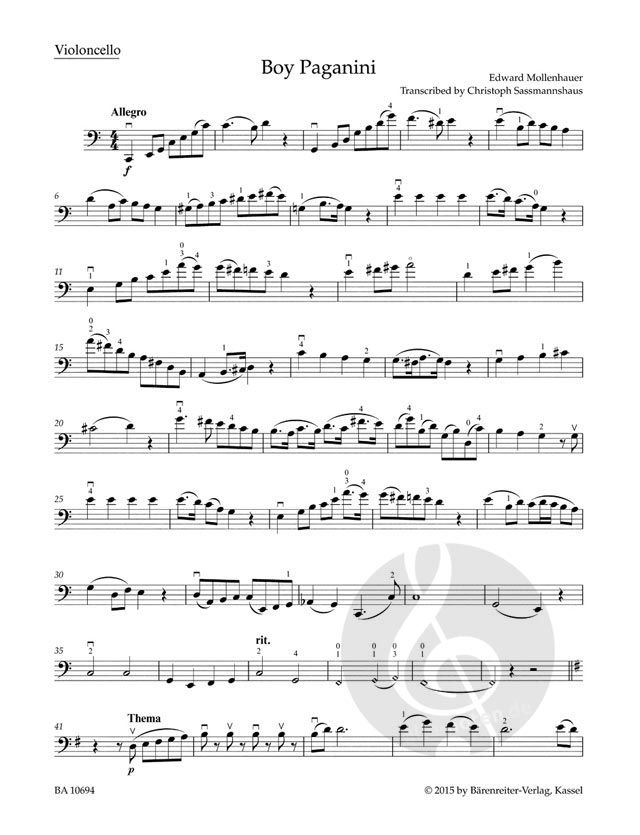
In the cello version (BA 10694), playing in the first to fourth positions is required. The pupil should have worked through the four volumes of Early Beginnings on the Cello almost completely. Further challenges are chords across all four strings and simple playing in octaves.
Both are published in the original edition for violin and piano as well as for the first time in a transcription for cello by Christoph Sassmannshaus.
The Fantasia The Infant Paganini for violin and piano (BA 10691) is a delightful prelude in first and third position and can be achieved by pupils at the level of the fourth volume of the Sassmannshaus Violin School. Flageolets and pizzicati are expected.
The Infant Paganini on the cello (BA 10693) is also a rewarding performance piece in the first to fourth positions, which can be mastered by pupils working with the fourth volume of the Early Beginning. As with the violin, the bowing techniques required are detaché, legato, spiccato and string changes with arpeggios. Flageolets and pizzicati are also expected.
The Fantasia The Boy Paganini for violin and piano (BA 10692), an impressive concert piece in the first to fifth positions, is more demanding. The two movements require time changes, harmonics and pizzicati.
In the cello version (BA 10694), playing in the first to fourth positions is required. The pupil should have worked through the four volumes of Early Beginnings on the Cello almost completely. Further challenges are chords across all four strings and simple playing in octaves.
Here is how the download works:
1 Buy download sheet music
Purchase the download score from our online store
2 Order confirmation with download link
Immediately after completing your order, you will receive an order confirmation by email listing all items. You will find the download link next to each item. You can use this link to start the download right away. Please also check your spam folder if necessary.
Customers rated this product:
Manufacturer Information:
Bärenreiter-Verlag Karl Vötterle GmbH & Co. KG
Heinrich-Schütz-Allee 35-37
34131
Kassel
Deutschland
Related products:
Edward Mollenhauer
Transcribed for Violoncello and Piano (Bärenreiter's Concert Pieces)
- Cello and Piano
- Piano reduction with part(s)
- Bärenreiter Verlag
-
-
in stock
ships within 1-2 working days - Also available for download!

- Cello and Piano
- Piano reduction with part(s) Download
- Bärenreiter Verlag
-
-
immediately available
Download immediately after ordering - Instant download
Other customers also bought:
Sebastian Lee
- Cello
- Sheet Music
-
in stock
ships within 1-2 working days - Also available for download!

Louis R. Feuillard
- Cello
- Sheet Music
-
in stock
ships within 1-2 working days
Justus Johann Friedrich Dotzauer
- Cello
- Sheet Music
-
in stock
ships within 1-2 working days
- Cello and Piano
- Piano reduction with part(s)
-
in stock
ships within 1-2 working days - Also available for download!

- Cello and Piano
- Piano reduction with part(s)
-
in stock
ships within 1-2 working days - Also available for download!