
Florentine Mulsant
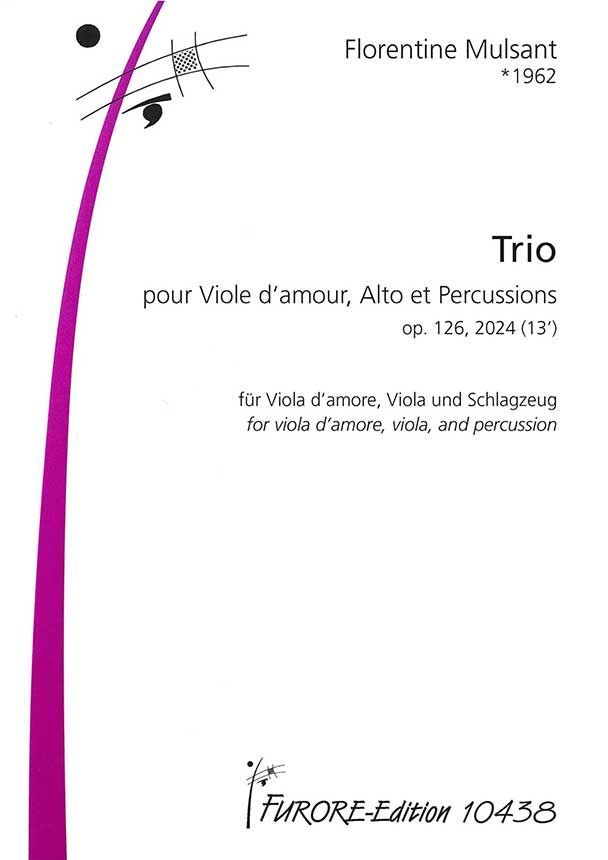
Trio op. 126
für Viola d'amore, Bratsche und Schlagzeug
Florentine Mulsant
Trio op. 126
für Viola d'amore, Bratsche und Schlagzeug
- Instrumentation Viola, Viola d'amore and Drums
- Composer Florentine Mulsant
- Edition Sheet Music
- Publisher Furore Verlag
- Order no. FUR10438
 ships within 4-8 working days
incl. tax,
excl. shipping costs
Not available in all countries. Learn more

Description:
Special attention was paid to the dialogue between the various instruments, with an emphasis on the melodic lines.
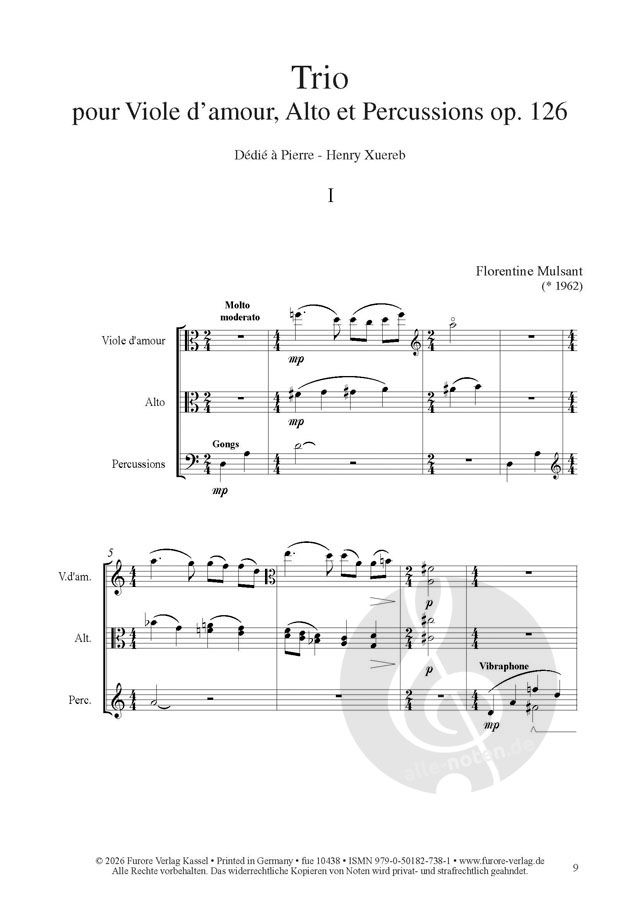
The Trio for Viola d'amore, Viola, and Percussion was composed in the winter of 2024. With a duration of 13 minutes, it is a commissioned work by Pierre-Henri Xuereb, to whom it is also dedicated, and consists of two movements. The first movement, lasting 8 minutes and 40 seconds, introduces a theme with a modal character. This is followed by six variations, with the fifth variation presenting an inversion of the theme in terms of instrumentation. The selected percussion instruments are resonant and gentle: gongs, crotales (finger cymbals), triangle, suspended cymbals, and vibraphone color the musical texture with great subtlety.
Special attention was paid to the dialogue between the various instruments, with an emphasis on the melodic lines. The second movement, lasting 4 minutes and 20 seconds, is cheerful and dynamic and follows the form of a rondo. It introduces a theme played pizzicato by both string instruments and accompanied by woodblocks. This is followed by two couplets and an instrumental cadenza for the two string instruments in measure 111. The percussion instruments chosen for this movement are light: The woodblocks are particularly prominent, as is the xylophone, which supports the theme and engages in a dialogue with the viola d'amore and the viola. The work concludes with a burst of powerful energy.
The Trio for Viola d'amore, Viola, and Percussion was composed in the winter of 2024. With a duration of 13 minutes, it is a commissioned work by Pierre-Henri Xuereb, to whom it is also dedicated, and consists of two movements. The first movement, lasting 8 minutes and 40 seconds, introduces a theme with a modal character. This is followed by six variations, with the fifth variation presenting an inversion of the theme in terms of instrumentation. The selected percussion instruments are resonant and gentle: gongs, crotales (finger cymbals), triangle, suspended cymbals, and vibraphone color the musical texture with great subtlety.
Special attention was paid to the dialogue between the various instruments, with an emphasis on the melodic lines. The second movement, lasting 4 minutes and 20 seconds, is cheerful and dynamic and follows the form of a rondo. It introduces a theme played pizzicato by both string instruments and accompanied by woodblocks. This is followed by two couplets and an instrumental cadenza for the two string instruments in measure 111. The percussion instruments chosen for this movement are light: The woodblocks are particularly prominent, as is the xylophone, which supports the theme and engages in a dialogue with the viola d'amore and the viola. The work concludes with a burst of powerful energy.