
Niccolò Paganini
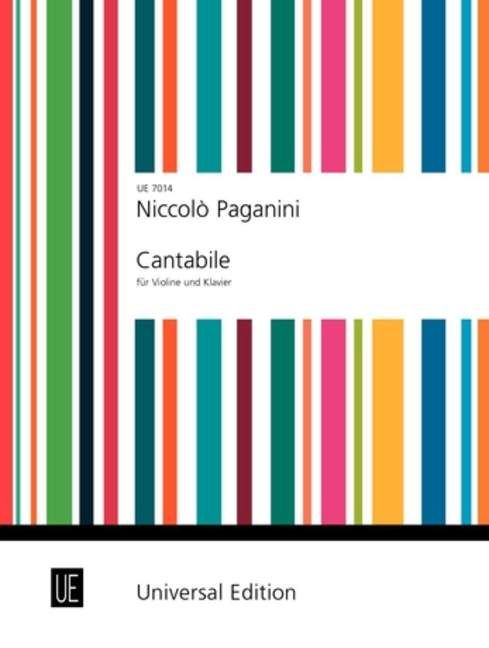
Cantabile D Major
for Violin and Piano
PDF
view
Niccolò Paganini
Cantabile D Major
for Violin and Piano
- Instrumentation Violin and Piano
- Composer Niccolò Paganini
- Editor Fritz Rothschild Georg Kinsky
- Editor Fritz Rothschild Georg Kinsky
-
Difficulty Level
- Edition Sheet Music
- Publisher Universal Edition
- Order no. UE7014
 in stock
ships within 1-2 working days
incl. tax,
excl. shipping costs
Not available in all countries. Learn more
Description:
In the comparatively few compositions written by Paganini primarily for his own diversion rather than for purposes of public performance, the composer generally appoints the accompanying part to the guitar which, as is well known, was the violinists
other favourite instrument, mastered by him with no lesser degree of skill than the violin. Among the vast number of manuscripts discovered after Paganini's death and now in the possession of Wilhelm Heyer's Museum of Musical Historics in Cologne (see Preface), there was found only one piece originally written for Violin and Piano. This was the Cantabile in D major, allegedly composed for a special occasion, and now published for the first time. It is a comparatively easy piece combining melodic charm with absolute fidelity to the form and, though thoroughly instrumental in character, still possesses the graceful line peculiar to the operatic cavatinas of its time. It awakens memories of Bellini and other composers of that period.
other favourite instrument, mastered by him with no lesser degree of skill than the violin. Among the vast number of manuscripts discovered after Paganini's death and now in the possession of Wilhelm Heyer's Museum of Musical Historics in Cologne (see Preface), there was found only one piece originally written for Violin and Piano. This was the Cantabile in D major, allegedly composed for a special occasion, and now published for the first time. It is a comparatively easy piece combining melodic charm with absolute fidelity to the form and, though thoroughly instrumental in character, still possesses the graceful line peculiar to the operatic cavatinas of its time. It awakens memories of Bellini and other composers of that period.
Customers rated this product:
Other customers also bought:
Arthur Seybold
A selection of the most valuable Studies for the Violin progressively arranged. Easy Studies in the first position
- Violin
- Sheet Music
-
in stock
ships within 1-2 working days
- Violin and Piano
- Piano reduction with part(s)
-
in stock
ships within 1-2 working days - Also available for download!
- Violin Duet
- Sheet Music
-
in stock
ships within 1-2 working days
A graded collection of favourite classical and romantic pieces
- Violin and Piano
- Sheet Music
- Arthur Seybold
-
in stock
ships within 1-2 working days
Antonio Vivaldi
- Violin and Piano
- Piano reduction with part(s)
-
in stock
ships within 1-2 working days - Also available for download!
- Music Accessories
- Wall Poster
-
ships within 4-8 working days
- Flute and Piano
- Piano reduction with part(s)
-
in stock
ships within 1-2 working days - Also available for download!
- Violin and Piano
- Sheet Music
-
in stock
ships within 1-2 working days - Also available for download!
Leopold Lichtenberg
- Violin and Piano
- Sheet Music
-
ships within 3-6 working days
Laure Choisy
- Violin and Piano
- Sheet Music
-
ships within 4-8 working days
- Violin and Piano
- Sheet Music
- Fritz Kreisler
-
in stock
ships within 1-2 working days - Also available for download!


- Violin and Piano
- Sheet Music
-
in stock
ships within 1-2 working days
- Violin and Piano
- Sheet Music
- Fritz Kreisler
-
in stock
ships within 1-2 working days - Also available for download!
- Violin and Piano
- Sheet Music
- Fritz Kreisler
-
in stock
ships within 1-2 working days - Also available for download!
- Violin and Piano
- Sheet Music
-
in stock
ships within 1-2 working days - Also available for download!