
Béla Bartók
Romanian Folk Dances, Sz. 56
(Rumänische Volkstanze)
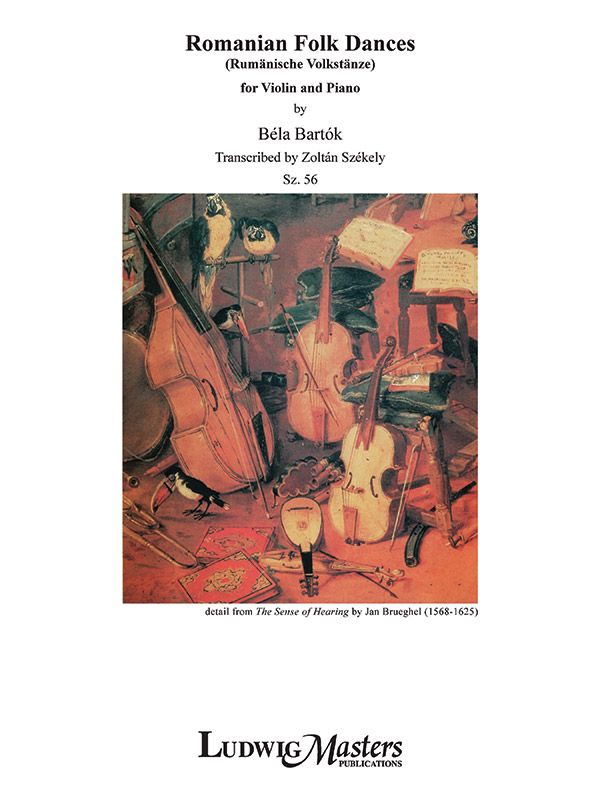
Béla Bartók
Romanian Folk Dances, Sz. 56
(Rumänische Volkstanze)
- Instrumentation Violin and Piano
- Composer Béla Bartók
- Series Master String Series - LudwigMasters
- Edition Sheet Music
- Publisher Ludwig Music Publishing Company
- Order no. LU60710007
 ships within 2-4 weeks

Description:
In the years preceding World War I, Hungarian composer, pianist, and ethnomusicologist Béla Bartók (1881-1945) took trips to the Transylvanian region to explore the musical traditions of the Romanian population. Following a two-year depression caused by the war, as well as some professional setbacks, he returned to composition. The Romanian Folk Dances, Sz. 56, emerged in 1915, bearing a strong influence from his experiences as an ethnomusicologist. They comprise 6 dances, all based on folk tunes that Bartók had recorded and transcribed. In 1917, he arranged a version for full orchestra. Hungarian violinist and composer Zoltán Székely (1903-2001) transcribed these six short movements for violin and piano in 1926, which are offered here in this reprint edition. Movements: 1. Joc cu bâta (Stick Dance), 2. Brâul (Sash Dance), 3. Topogó - Pê-loc (In One Spot), 4. Bucsumí tánc - Buciumeana (Dance from Bucsum), 5. Poarga româneasca (Romanian Polka), 6. Aprózó - Maruntel (Fast Dance).