
Heinrich Ignaz Franz Biber
Sonata für Violine - Ausgewählte Werke 3
Demo
listen
Heinrich Ignaz Franz Biber
Sonata für Violine - Ausgewählte Werke 3
- Instrumentation Violin and Continuo
- Composer Heinrich Ignaz Franz Biber
-
Difficulty Level
- Edition Score
- Publisher Strube Verlag
- Order no. STRUBE7509
 ships within 4-8 working days
incl. tax,
excl. shipping costs
Not available in all countries. Learn more
Description:
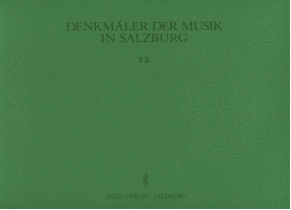
Sonata for violin and basso continuo (Minoritenkodex 726). Series: "Denkmäler der Musik in Salzburg", Volume 12, edited by Bernhard Moosbauer. The parts are included with the score.
In two partial editions, this volume contains the facsimile and its transcription as well as the performance material (continuo realization, violin part, bass part) of the Sonata in E (Chafe 108), contained in the Minorite Codex 726, which undoubtedly represents a pinnacle of virtuoso violin literature of the 17th century. Formally, two metrically less strictly bound, virtuoso-improvisatory sections can be recognized, which frame a series of variations. This series of variations makes the piece a witty and original contribution to the Baroque violin literature. The opening section is in the tradition of the prelude; the key is introduced and the sound space unfolds. The virtuoso orchestrates his performance in calm movement, only to suddenly surprise the listener with rushing scales and arpeggios in many different variations.
In two partial editions, this volume contains the facsimile and its transcription as well as the performance material (continuo realization, violin part, bass part) of the Sonata in E (Chafe 108), contained in the Minorite Codex 726, which undoubtedly represents a pinnacle of virtuoso violin literature of the 17th century. Formally, two metrically less strictly bound, virtuoso-improvisatory sections can be recognized, which frame a series of variations. This series of variations makes the piece a witty and original contribution to the Baroque violin literature. The opening section is in the tradition of the prelude; the key is introduced and the sound space unfolds. The virtuoso orchestrates his performance in calm movement, only to suddenly surprise the listener with rushing scales and arpeggios in many different variations.