
Bruno Mantovani
Amours d'Etienne Jodelle
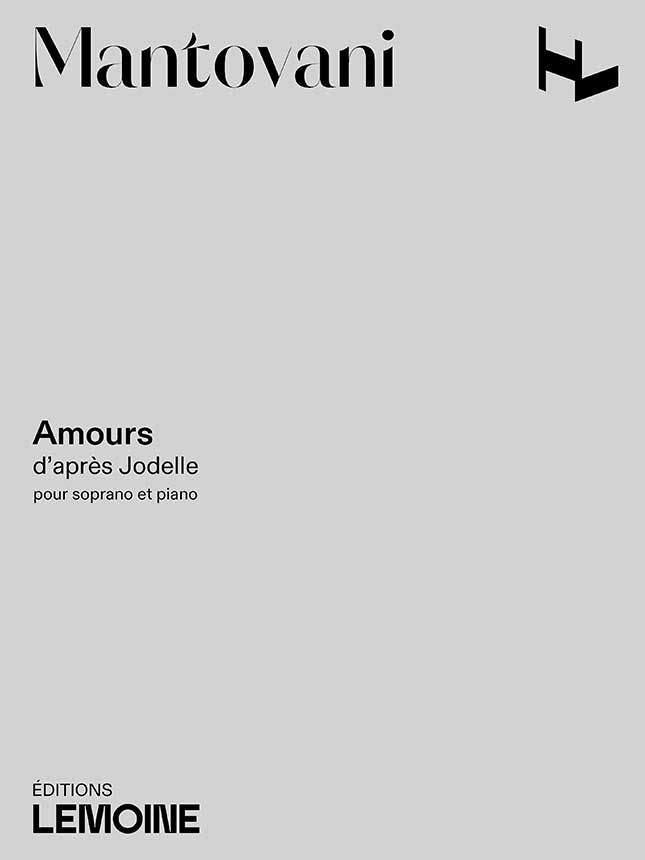
Bruno Mantovani
Amours d'Etienne Jodelle
- Instrumentation High Voice and Piano
- Composer Bruno Mantovani
- Edition Sheet Music
- Publisher Editions Henry Lemoine
- Order no. LEMO29520
 ships within 4-8 working days
incl. tax,
excl. shipping costs
Not available in all countries. Learn more

Description:
Bruno Mantovani is one of the most important French composers of our time. While he is a master of orchestral writing, chamber music and opera, he has yet to write a melody for voice and piano. With Amours, he chooses the intimate form of the cycle and the verses of the great Renaissance poet Etienne Jodelle. He talks to us about the secrets of his creative process. Amours is your first work for voice and piano. Why are you only now tackling the genre of French melody? I grew up and studied under the influence of Lied and melody. Working on a dramaturgy of the imaginary rather than of representation is something I hold dear and natural. As for the cyclical form, I'd already tackled it in pieces for voice and ensemble or choral works. So it was high time I came to the cycle of melodies for voice and piano - but nobody asked me to! Programmers often shy away from this repertoire. I'd like to pay tribute to Christophe Ghristi, director of the Théâtre du Capitole: he has always defended both the Lied and the mélodie, and contemporary creation. We wrote an opera together [1], and he is truly the inspiration behind Amours. He knew I had to write a cycle of melodies. We often talk about the special bond between a performer and a composer, but there's an essential artistic path between the composer and the commissioner, who can become a true co-creator.How do you fit into the rich history of French melody: Fauré, Debussy, Ravel? They've had a major influence on my career! Not only those you mention, but also Chausson, Reynaldo Hahn, Poulenc, Messiaen and even Boulez. But I always try to adopt the same attitude towards the monumental history of a musical genre: know the repertoire almost exhaustively, then submit to a duty of amnesia. Without this voluntary forgetfulness, there's no way out. For this cycle, you have chosen to set to music texts by Etienne Jodelle, the great Renaissance poet and playwright, a member of the Pléiade. Can you tell us about this choice? I spoke earlier of co-creation with the commissioner, and this choice was born of my exchange with Christophe Ghristi. I knew I didn't want contemporary poetry, I wanted to confront the formal constraints and also a certain historical distance. But I also needed very dynamic, lively poetry. Christophe sent me Jodelle's poems, and I said to myself: that's exactly what I need! There's an urgency in this poetry, an almost electric vitality in the way it speaks of love. But it's also incredibly modern. I chose rather concise poems, without excessive symmetry, and combined them to build a cycle, to find a trajectory - a trajectory of meaning, but also of the musical potential of each idea. It's a simple but time-tested equation: one poem = one idea. If you look at the greatest Lieder, this is always true. What is the trajectory of meaning in Amours? In this poetry, we are constantly between Eros and Thanatos, between love and death. The last poem of the cycle, "Des trois sortes d'aimer" [2], could be the synthesis of all this. In fact, I started with it, and proceeded backwards. Ultimately, the question explored by the cycle is simple and immense: what is love?...A word about your String Quartet n°5, which will also be a world premiere. Given the breadth of the genre's history, I imagine that the "duty of amnesia" you spoke of must be particularly prevalent in the composition? Yes, but this is my fifth quartet (actually, the seventh in chronological order). I've also composed several quintets, so I'd already explored the genre at length. Quartet n°5 is a confinement piece, and I wrote it simultaneously with n°7. Given the exceptional situation we were living in, I set myself a challenge, to see if I was capable of renewing myself: choose the genre that is the most charged in the history of music, the most sacralized by composers, the most saturated by contemporary creation, and I added an extra difficulty: write two quartets at the same time! In Quartet n°7, I sought out violent contrasts and juxtapositions of clashing ideas. In a way, it was the culmination of all my quartet writing. Conversely, in Quartet No. 5, I sought the opposite of what I am: a continuum in the writing. It's a canon for four instruments, a moving but continuous line, a perpetual fade, what the world of images calls morphing. The Quatuor Voce, which I adore, had asked me for a link to Ravel, because my Quatuor n°5 will be recorded with Ravel's Quartet, where this continuum is also central: a harmony in perpetual metamorphosis, in suspension. Why did you choose Schumann's Piano Quintet Op. 44 to complement your program? For a very personal reason: Schumann is one of my most important composers. He is often regarded as a ?or Romantic genius - in reality, he possesses a science of form, a rigor of writing that is absolutely astonishing. When it came to the Lied, of which he is an absolute master, I felt a particular affinity. Varduhi Yeritsyan will be magnificent, as will soprano Gabrielle Philiponet in Amours. Interview by Dorian AstorVivace ! n°11[1] Akhmatova, music by B. Mantovani and libretto by C. Ghristi, Opera de Paris, 2011[2] Of the three kinds of lovingOf the three kinds of loving the first expressedIn this is instinct, which can most moveMan towards man, while from a haughty dutyOur own life is less than another life loved.The other lesser, and stronger yet inflamed,Is the love that man to woman can have more. The third is ours, having such power From woman faith to woman animated.Que des deux hommes donc taillés ici, les noeuds Tant forts cèdent à nous! O love, this whole love be yet master.The very altar of death would make witness of this,Let the altar of Faith show. A jamais doncDiane en Anne, et Anne en Diane puisse être.Etienne Jodelle (1532-1573)