
Franz Schubert
Ave Maria Do Majeur
Voix Elevees
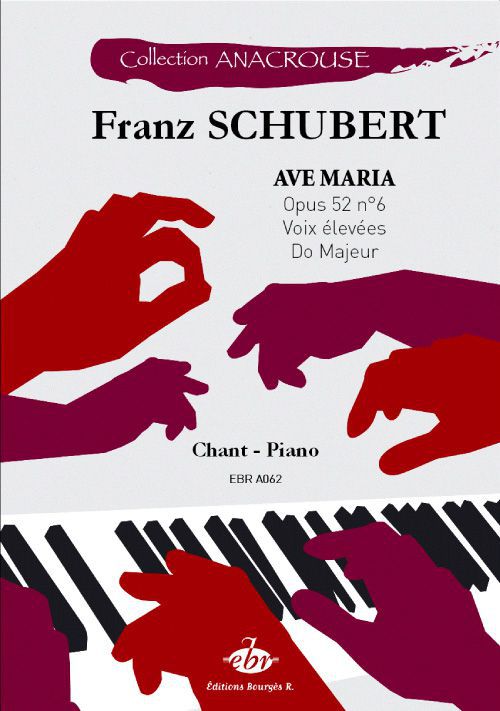
Franz Schubert
Ave Maria Do Majeur
Voix Elevees
- Instrumentation Piano and Voice
- Composer Franz Schubert
- Edition Sheet Music
- Publisher Editions Bourgès R.
- Order no. EBRA062
Description:
The ANACROUSE collection offers novice and experienced pianists alike a wide choice of classical works, from the Renaissance to the modern era.
We have set ourselves the goal of offering both "must-haves" from the classical repertoire and pieces by sometimes forgotten composers, all of undeniable pedagogical value. Each piece, sold individually, has been the subject of careful editorial work, both in terms of the musical text and its engraving, in order to guarantee musicians the conditions indispensable to the pleasures derived from frequent trade in these works.
The scores are offered in the form of traditional works (paper sheets), and also available by download.
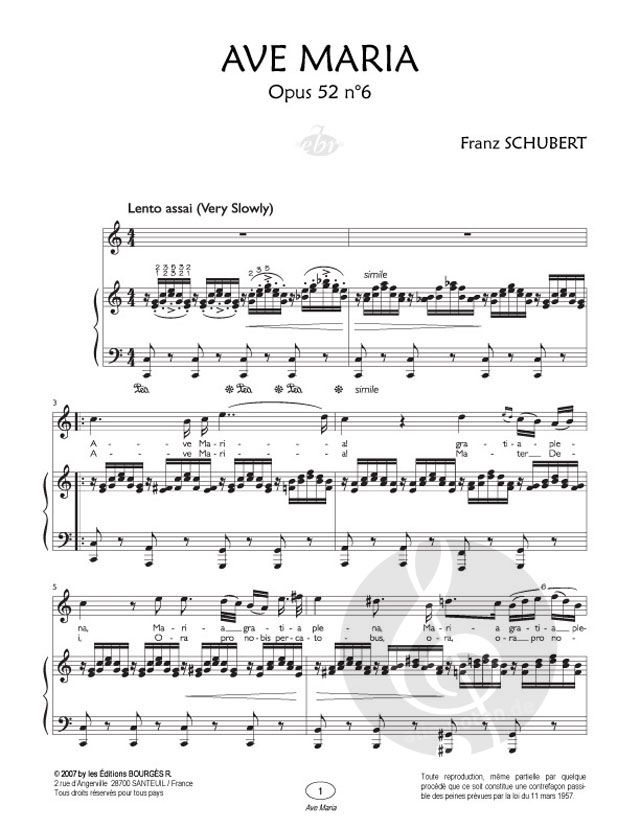
Franz Schubert composed the "Ave Maria" for voice and piano in 1825. It was published in 1826 as Opus 52 n°6, in Bb Major. At the time, he was a great admirer of Mary, the mother of Jesus. He set to music an excerpt from the poem "Madame du lac" by the English writer Walter Scott, which had been translated into German by Adam Storck. Schubert calls the "Ave Maria" his dritter Gesang, "Ellen's third song". The heroine of the poem, Ellen Douglas, prays to the Virgin in hiding. In one of his correspondences with his parents, he confesses to expressing in this song a hymn to the Blessed Virgin Mary. Walter Scott's original words include many references to the Latin "Ave Maria" prayer. Eventually, the Latin words adapted from the prayer is now the version most generally performed. The Ave Maria is part of the 19th-century Marian repertoire. Even today, this piece of music remains one of the most popular wedding ceremony accompaniments for lovers.
We have set ourselves the goal of offering both "must-haves" from the classical repertoire and pieces by sometimes forgotten composers, all of undeniable pedagogical value. Each piece, sold individually, has been the subject of careful editorial work, both in terms of the musical text and its engraving, in order to guarantee musicians the conditions indispensable to the pleasures derived from frequent trade in these works.
The scores are offered in the form of traditional works (paper sheets), and also available by download.
Franz Schubert composed the "Ave Maria" for voice and piano in 1825. It was published in 1826 as Opus 52 n°6, in Bb Major. At the time, he was a great admirer of Mary, the mother of Jesus. He set to music an excerpt from the poem "Madame du lac" by the English writer Walter Scott, which had been translated into German by Adam Storck. Schubert calls the "Ave Maria" his dritter Gesang, "Ellen's third song". The heroine of the poem, Ellen Douglas, prays to the Virgin in hiding. In one of his correspondences with his parents, he confesses to expressing in this song a hymn to the Blessed Virgin Mary. Walter Scott's original words include many references to the Latin "Ave Maria" prayer. Eventually, the Latin words adapted from the prayer is now the version most generally performed. The Ave Maria is part of the 19th-century Marian repertoire. Even today, this piece of music remains one of the most popular wedding ceremony accompaniments for lovers.
Customers rated this product:
Manufacturer Information:
Editions Bourgès R.
17 Rue de Clichy
75009
Paris
Frankreich
Other customers also bought:
- Medium Voice
- Score
-
 in stock
ships within 1-2 working days


- Violin
- Sheet Music Download
-
immediately available
Download immediately after ordering