
Claudio Monteverdi
Lamento d'Arianna
for (mezzo-)soprano and B.C.
NEW
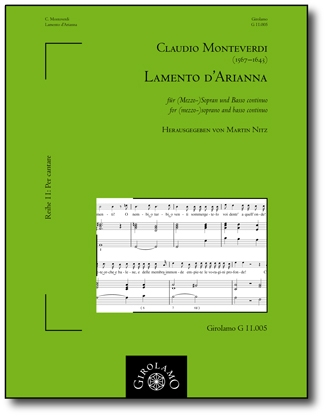
PDF
view
Claudio Monteverdi
Lamento d'Arianna
for (mezzo-)soprano and B.C.
- Instrumentation Soprano and basso continuo
- Optional Instrumentation Mezzo-soprano and basso continuo
- Composer Claudio Monteverdi
- Editor Martin Nitz
- Edition Score and Parts
- Publisher Girolamo Musikverlag
- Order no. GIRO11-005
 ships within 1-2 working days
incl. tax,
excl. shipping costs
Not available in all countries. Learn more

Description:
for (mezzo-)soprano and basso continuo
Edited by Martin Nitz
Thorough bass realization by Martin Nitz
Claudio Monteverdi's opera *Arianna* premiered in 1608. The plot is based on the Greek legend of the hero Theseus, who, with the help of the Cretan princess Ariadne (Italian: Arianna), defeats the monster Minotaur and wins her love. On their journey back to Athens together, however, Theseus callously abandons his beloved on the island of Naxos.
Ariadne's lament, the *Lamento d'Arianna*, represented the climax of the opera for the composer—"La più essential parte dell'opera," as Monteverdi wrote in a letter dated March 20, 1620.
Unfortunately, only this lament has survived from the music of the opera *Arianna*; it was initially circulated in handwritten copies and published by Monteverdi (along with two other compositions) in 1623. This print served as the basis for the present edition.
The original manuscript contains only a few "bar lines," which serve merely as a guide. The editor's additions and modifications to the bar lines are adapted to the rhythm of the Italian language and provide a clearer overview of this recitative-style composition.
The figured bass notation is very simple. It is intended as a harmonic framework to serve as a basis for the various continuo instruments that might be used (harpsichord, chest organ, theorbo, or lute). The figured bass numbers added by the editor in parentheses should be regarded as non-binding suggestions.
It should come as no surprise that Monteverdi did not incorporate the harmonic "results" of his five-voice madrigal version—which appeared in 1614, nine years before the Lamento was republished—into this later edition: The five-part version required a more distinct harmonic and rhythmic profile than the original version, in which the recitative-like delivery of the solo voice could only be supported by long-held bass notes.
The German translation of the Italian text was provided by Martina Schänzle in collaboration with the editor. Both would like to thank Dr. Maria Grazia Kölling of Hamburg for her additional advice and assistance.
Hamburg, March 1998, Martin Nitz
Edited by Martin Nitz
Thorough bass realization by Martin Nitz
Claudio Monteverdi's opera *Arianna* premiered in 1608. The plot is based on the Greek legend of the hero Theseus, who, with the help of the Cretan princess Ariadne (Italian: Arianna), defeats the monster Minotaur and wins her love. On their journey back to Athens together, however, Theseus callously abandons his beloved on the island of Naxos.
Ariadne's lament, the *Lamento d'Arianna*, represented the climax of the opera for the composer—"La più essential parte dell'opera," as Monteverdi wrote in a letter dated March 20, 1620.
Unfortunately, only this lament has survived from the music of the opera *Arianna*; it was initially circulated in handwritten copies and published by Monteverdi (along with two other compositions) in 1623. This print served as the basis for the present edition.
The original manuscript contains only a few "bar lines," which serve merely as a guide. The editor's additions and modifications to the bar lines are adapted to the rhythm of the Italian language and provide a clearer overview of this recitative-style composition.
The figured bass notation is very simple. It is intended as a harmonic framework to serve as a basis for the various continuo instruments that might be used (harpsichord, chest organ, theorbo, or lute). The figured bass numbers added by the editor in parentheses should be regarded as non-binding suggestions.
It should come as no surprise that Monteverdi did not incorporate the harmonic "results" of his five-voice madrigal version—which appeared in 1614, nine years before the Lamento was republished—into this later edition: The five-part version required a more distinct harmonic and rhythmic profile than the original version, in which the recitative-like delivery of the solo voice could only be supported by long-held bass notes.
The German translation of the Italian text was provided by Martina Schänzle in collaboration with the editor. Both would like to thank Dr. Maria Grazia Kölling of Hamburg for her additional advice and assistance.
Hamburg, March 1998, Martin Nitz