
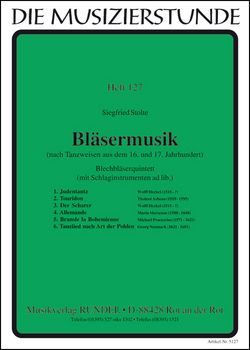
Siegfried Stolte
Wind music after dance tunes from the 16th-17th century
Ensemble Time 127
PDF
view
Siegfried Stolte
Wind music after dance tunes from the 16th-17th century
Ensemble Time 127
- Instrumentation 5 Brass Instruments
- Optional Instrumentation 5 Brass Instruments and Percussion
- Composer Siegfried Stolte
- Series Die Musizierstunde
-
Difficulty Level
- Edition Score and Parts
- Publisher Musikverlag Rundel
- Order no. MVSR5127
 ships within 2-5 working days
incl. tax,
excl. shipping costs
Not available in all countries. Learn more

Description:
1st voice in Bb
2nd voice in Bb
3rd voice in Eb/F
4th voice in C/Bb
5th voice in C/Bb
percussion instrument ad. lib.
The collection of Franz Magnus Böhme (1827 - 1898), who collected about 16,000 folk songs and dances in the 19th century under great privations, offered me a rich treasure trove. From this almost unmanageable abundance, I have chosen six melodies for my 'Wind Music' as models and tried, on the one hand, to take into account stylistic elements of this time, but also to add contrapuntal and harmonic 'ingredients', which - I hope - will please the taste of the musicians and listeners. A special 'spice' would be the percussion (2 players), which fits well in the acoustic color and can underline the liveliness of these dances.
For chamber music performances the wind quintet (with or without percussion) is of course ideal, but also a wind choir in not too large instrumentation can achieve the intended effect.
In the hope that serious musicians will have fun with wind music and can please listeners with it, I wish all participants good success.
Siegfried Stolte
2nd voice in Bb
3rd voice in Eb/F
4th voice in C/Bb
5th voice in C/Bb
percussion instrument ad. lib.
The collection of Franz Magnus Böhme (1827 - 1898), who collected about 16,000 folk songs and dances in the 19th century under great privations, offered me a rich treasure trove. From this almost unmanageable abundance, I have chosen six melodies for my 'Wind Music' as models and tried, on the one hand, to take into account stylistic elements of this time, but also to add contrapuntal and harmonic 'ingredients', which - I hope - will please the taste of the musicians and listeners. A special 'spice' would be the percussion (2 players), which fits well in the acoustic color and can underline the liveliness of these dances.
For chamber music performances the wind quintet (with or without percussion) is of course ideal, but also a wind choir in not too large instrumentation can achieve the intended effect.
In the hope that serious musicians will have fun with wind music and can please listeners with it, I wish all participants good success.
Siegfried Stolte