
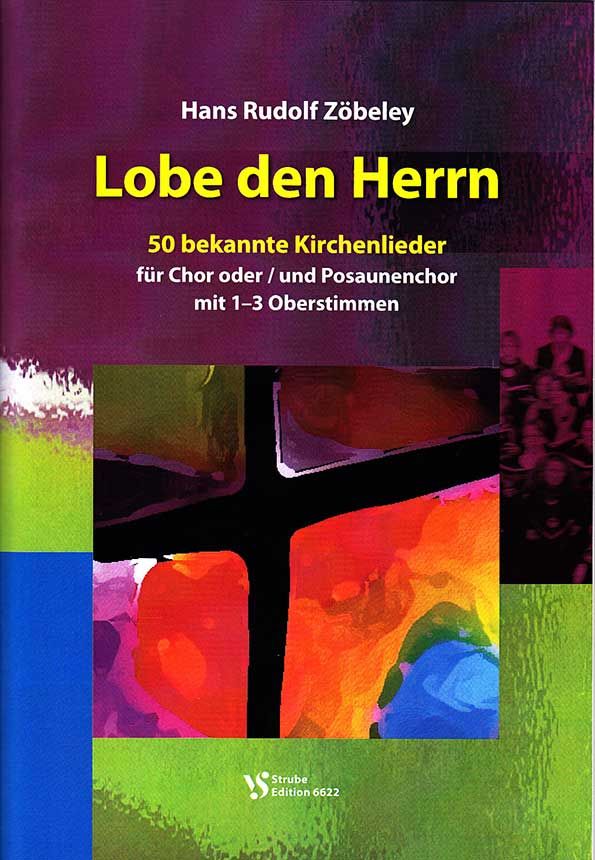
Hans Rudolf Zöbeley
Lobe den Herrn
50 bekannte Kirchenlieder für Chor oder/und Posaunenchor mit 1-3 Oberstimmen
PDF
1
view
PDF
2
view
Hans Rudolf Zöbeley
Lobe den Herrn
50 bekannte Kirchenlieder für Chor oder/und Posaunenchor mit 1-3 Oberstimmen
- Instrumentation Choir and Brass Ensemble
- Optional Instrumentation Brass Ensemble
- Composer Hans Rudolf Zöbeley
- Editor Michael Grill
- Edition Instrumental Part: Bb Instrument
- Publisher Strube Verlag
- Order no. STRUBE662201B
 ships within 4-8 working days
incl. tax,
excl. shipping costs
Not available in all countries. Learn more

Description:
With this edition of sheet music, we congratulate the Munich Motet Choir on its 50th birthday!
The selection of these movements by Hans Rudolf Zöbeley may complete the picture of his extensive work at Munich's St. Matthäuskirche. Away from the bright spotlight of the Philharmonie, they were composed almost every week in the basement office on Nussbaumstraße as the quiet but constant work of a cantor. Every Friday lunchtime, the sermon arrived in the cantor's office in written form, and now the songs and liturgy could be selected and arranged. On Friday evenings, the wind ensemble rehearsed, a trombone choir with instruments ranging from narrowly scaled to double bass trombone. This meant that Hans Rudolf Zöbeley usually only had a few hours to turn the melodies of the hymns into movements that could be used by the wind players to accompany the congregation on the coming Sunday, sometimes festively with upper voice(s), often also for the choir.
Zöbeley was far from adapting stylistically to the spirit of the times in these movements. Neither imitations of Bach or Reger were his thing, nor did he attempt compositions in the style of popular church music. Thus he remained true to himself in his sometimes somewhat harsh modality for decades, unperturbed by opinions and discussions about this (including with the editor!). But with the distance from day-to-day business, the great experience that is reflected in these sentences can also be recognized. Hans Rudolf Zöbeley's masterly handling of his orchestral ensembles can be felt in every chord. We therefore gratefully recommend this selection to a wider public.
In terms of their purpose, these movements are equally suitable for trombone choir or mixed vocal choir. As the first verse of the hymn is usually sung by the congregation, we usually only print a selection of the text from the second verse onwards. It should be noted that some hymns are a tone lower than in the EG. Obvious spelling mistakes have been tacitly corrected, and where several versions differ from one another, the better one in my opinion has been selected. We offer alternatives for very high upper parts. The original is also printed in the upper part edition.