
Giovanni Gabrieli
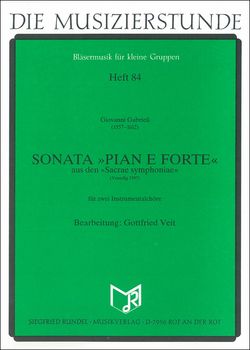
Sonata piano e forte
Ensemble Time
PDF
view
Giovanni Gabrieli
Sonata piano e forte
Ensemble Time
- Instrumentation 8 Brass Instruments
- Composer Giovanni Gabrieli
- Editor Gottfried Veit
- Series Die Musizierstunde
-
Difficulty Level
- Edition Score and Parts
- Publisher Musikverlag Rundel
- Order no. MVSR5084
 ships within 2-5 working days
incl. tax,
excl. shipping costs
Not available in all countries. Learn more

Description:
The famous St. Mark's chapel master Giovanni Gabrieli, once called 'the Titian of music', was certainly one of the greatest color tone artists known to music history. He wrote for the interior of the gold-radiated St. Mark's Cathedral of Venice a sonorous music, in which up to twenty-two voices sound simultaneously.
One of the most significant examples of his composition is a double-choir work of eight voices, which -in the original- is dominated by the sound of trombones. It owes its extraordinary effect (as the name suggests) to the dynamic interplay between 'loud and soft', which on top of that creates a fascinating echo effect.
The two instrumental choirs, which should be placed as far away from each other as possible, have the effect that the room in which the performance takes place is stimulated to 'play along'.
The present edition has been arranged in such a way that a highly variable instrumentation is possible. However, this work will sound most characteristic when the 1st choir is scored with two trumpets and trombones each and the 2nd choir with two horns, tenor horn and baritone. In order to achieve a welcome increase in sound, especially in larger rooms, two tuba players can be added to the two instrumental choirs. There is also no objection to a choral instrumentation of the two groups. The only thing to keep in mind here is that the timbres of the two instrumental choirs should contrast as well as possible.
Gottfried Veit
This edition contains the following parts:
1st chorus:
1st voice in Bb (trumpet)
2nd voice in Bb (trumpet)
3rd voice in C and Bb (trombone)
4th voice in C and Bb (trombone). Voice in C and Bb (trombone)
4th voice in C and Bb (bass ad. lib.)
2nd choir
1st voice in F and Eb (horn)
1st voice in Bb (tenor horn)
2nd voice in Bb (tenor horn). Voice in F and Eb (horn)
2. voice in Bb (tenor horn)
3. voice in C and Bb (baritone)
4. voice in C and Bb (baritone)
4. voice in C and Eb (bass ad. lib.)
One of the most significant examples of his composition is a double-choir work of eight voices, which -in the original- is dominated by the sound of trombones. It owes its extraordinary effect (as the name suggests) to the dynamic interplay between 'loud and soft', which on top of that creates a fascinating echo effect.
The two instrumental choirs, which should be placed as far away from each other as possible, have the effect that the room in which the performance takes place is stimulated to 'play along'.
The present edition has been arranged in such a way that a highly variable instrumentation is possible. However, this work will sound most characteristic when the 1st choir is scored with two trumpets and trombones each and the 2nd choir with two horns, tenor horn and baritone. In order to achieve a welcome increase in sound, especially in larger rooms, two tuba players can be added to the two instrumental choirs. There is also no objection to a choral instrumentation of the two groups. The only thing to keep in mind here is that the timbres of the two instrumental choirs should contrast as well as possible.
Gottfried Veit
This edition contains the following parts:
1st chorus:
1st voice in Bb (trumpet)
2nd voice in Bb (trumpet)
3rd voice in C and Bb (trombone)
4th voice in C and Bb (trombone). Voice in C and Bb (trombone)
4th voice in C and Bb (bass ad. lib.)
2nd choir
1st voice in F and Eb (horn)
1st voice in Bb (tenor horn)
2nd voice in Bb (tenor horn). Voice in F and Eb (horn)
2. voice in Bb (tenor horn)
3. voice in C and Bb (baritone)
4. voice in C and Bb (baritone)
4. voice in C and Eb (bass ad. lib.)