
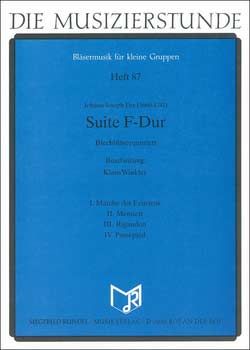
Johann Joseph Fux
Suite F major
Ensemble Time 87
PDF
view
Johann Joseph Fux
Suite F major
Ensemble Time 87
- Instrumentation 5 Brass Instruments
- Composer Johann Joseph Fux
- Editor Klaus Winkler
- Series Die Musizierstunde
-
Difficulty Level
- Edition Score and Parts
- Publisher Musikverlag Rundel
- Order no. MVSR5087
 ships within 2-5 working days
incl. tax,
excl. shipping costs
Not available in all countries. Learn more

Description:
1st voice in Bb
2nd voice in Bb
3rd voice n Eb/F
3rd voice in C/Bb
4th voice in C/Bb
5th voice in Eb
5. Voice in C/Bb
Johann Joseph Fux (1660 - 1741), known as a music theorist and Kapellmeister of three emperors in Vienna, created an extensive oeuvre: a large number of church music works (masses, requiems, vespers, psalms, etc.), oratorios, operas and instrumental music, of which only a small part appeared in print.
His collection 'Concento musico-instrumentalis', dedicated to Emperor Joseph I, appeared in print in Nuremberg in 1701; the volume contains 7 partitas (orchestral suites), each with a fluctuating number of individual movements, scored for strings, oboes, bassoon, and occasionally flauto and clarino.
In order to make J.J. Fux's instrumental works accessible to a wider public, individual movements were assembled into 'suites'. In the selection, attention was paid to the possibility of cyclic performance. Other considerations were that the melodic formations should have as high an affinity as possible to wind music and that the keys of the individual movements should be identical or related. The movement, originally conceived for four voices, was transferred to five brass instruments in order not to burden the individual wind player too much. Occasionally, a fifth voice was added, corresponding to the figured bass and adapted motivically. The original voice leading remained untouched, in individual cases it was necessary to notate a few notes octave-shifted. The pieces were transposed lower to make them playable for wind instruments. The instrumentation can be 2 trumpets and three trombones, but also horn, trombone and tuba. In addition to a solo instrumentation, a choral instrumentation is also conceivable, in which case a bass tuba can be added in octaves in the tutti passages. The original notation does not contain any rules for articulation; here, too, this has been dispensed with in order not to restrict the performing musicians. The few original dynamic additions, on the other hand, have been adopted.
May the pieces serve to make Fux's compositional work, unfortunately often forgotten, known in a new form and to recall it again.
Dierdorf, May 1986 Dr. Klaus Winkler
Source information:
Ouverture V, Marche des Ecurieus (5th movement; C major);
Sinfonia II, Minuet (4th movement; B flat major);
Ouverture IV, Rigaudon and Trio Bourrée (2nd movement; G dorian);
Sinfonia II, Passepied (5th movement; B flat major).
2nd voice in Bb
3rd voice n Eb/F
3rd voice in C/Bb
4th voice in C/Bb
5th voice in Eb
5. Voice in C/Bb
Johann Joseph Fux (1660 - 1741), known as a music theorist and Kapellmeister of three emperors in Vienna, created an extensive oeuvre: a large number of church music works (masses, requiems, vespers, psalms, etc.), oratorios, operas and instrumental music, of which only a small part appeared in print.
His collection 'Concento musico-instrumentalis', dedicated to Emperor Joseph I, appeared in print in Nuremberg in 1701; the volume contains 7 partitas (orchestral suites), each with a fluctuating number of individual movements, scored for strings, oboes, bassoon, and occasionally flauto and clarino.
In order to make J.J. Fux's instrumental works accessible to a wider public, individual movements were assembled into 'suites'. In the selection, attention was paid to the possibility of cyclic performance. Other considerations were that the melodic formations should have as high an affinity as possible to wind music and that the keys of the individual movements should be identical or related. The movement, originally conceived for four voices, was transferred to five brass instruments in order not to burden the individual wind player too much. Occasionally, a fifth voice was added, corresponding to the figured bass and adapted motivically. The original voice leading remained untouched, in individual cases it was necessary to notate a few notes octave-shifted. The pieces were transposed lower to make them playable for wind instruments. The instrumentation can be 2 trumpets and three trombones, but also horn, trombone and tuba. In addition to a solo instrumentation, a choral instrumentation is also conceivable, in which case a bass tuba can be added in octaves in the tutti passages. The original notation does not contain any rules for articulation; here, too, this has been dispensed with in order not to restrict the performing musicians. The few original dynamic additions, on the other hand, have been adopted.
May the pieces serve to make Fux's compositional work, unfortunately often forgotten, known in a new form and to recall it again.
Dierdorf, May 1986 Dr. Klaus Winkler
Source information:
Ouverture V, Marche des Ecurieus (5th movement; C major);
Sinfonia II, Minuet (4th movement; B flat major);
Ouverture IV, Rigaudon and Trio Bourrée (2nd movement; G dorian);
Sinfonia II, Passepied (5th movement; B flat major).