
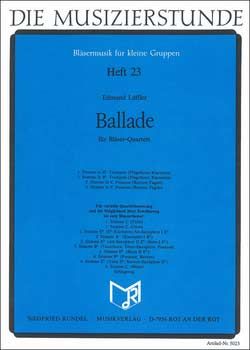
Edmund Löffler
Ballad
Ensemble Time 23
PDF
view
Edmund Löffler
Ballad
Ensemble Time 23
- Instrumentation 4 Wind Instruments
- Composer Edmund Löffler
- Series Die Musizierstunde
-
Difficulty Level
- Edition Score and Parts
- Publisher Musikverlag Rundel
- Order no. MVSR5023
 ships within 2-5 working days
incl. tax,
excl. shipping costs
Not available in all countries. Learn more

Description:
The musical form of the ballad - vocal and instrumental - developed from the medieval dance song and reached its peak in the 19th century. Typical features of the ballad are narrative and dramatic elements, but one also finds passages of a lyrical and cheerful nature.
The ballad for 4 winds by Edmund Löffler begins with a serious and yearning sounding theme, which after its development leads to a fast, dramatically moving movement. This is followed as a contrast by a solemnly designed manner.
Then the colors become brighter. A lilting melody in 2/4 time forms the transition to a cheerful and dance-like melody in 6/8 time. And now the inversion of a previous motif in a faster tempo and with increased dynamics brings the ballad to a close.
This edition contains the following parts:
1st voice C (flute)
1st voice C (oboe)
1st voice Eb (Eb clarinet/alto saxophone I Eb)
1st voice in Bb trumpet (flugelhorn/clarinet)
2nd voice in Bb trumpet (flugelhorn/clarinet)
2nd voice in Bb trumpet (flugelhorn/clarinet). Voice Eb (Clarinet I Eb)
2. Voice Eb (Alto Saxophone II Eb/Horn I Eb)
3. Voice in C Trombone (Baritone/Bassoon)
3. Voice Bb (Tenor Horn, Tenor Saxophone, Trombone)
3. Voice Eb (horn II Eb)
4th voice in C trombone (baritone/bassoon)
4th voice Bb (trombone, baritone)
4th voice Eb (tuba Eb/baritone saxophone Eb)
4th voice C (basses)
Percussion
The ballad for 4 winds by Edmund Löffler begins with a serious and yearning sounding theme, which after its development leads to a fast, dramatically moving movement. This is followed as a contrast by a solemnly designed manner.
Then the colors become brighter. A lilting melody in 2/4 time forms the transition to a cheerful and dance-like melody in 6/8 time. And now the inversion of a previous motif in a faster tempo and with increased dynamics brings the ballad to a close.
This edition contains the following parts:
1st voice C (flute)
1st voice C (oboe)
1st voice Eb (Eb clarinet/alto saxophone I Eb)
1st voice in Bb trumpet (flugelhorn/clarinet)
2nd voice in Bb trumpet (flugelhorn/clarinet)
2nd voice in Bb trumpet (flugelhorn/clarinet). Voice Eb (Clarinet I Eb)
2. Voice Eb (Alto Saxophone II Eb/Horn I Eb)
3. Voice in C Trombone (Baritone/Bassoon)
3. Voice Bb (Tenor Horn, Tenor Saxophone, Trombone)
3. Voice Eb (horn II Eb)
4th voice in C trombone (baritone/bassoon)
4th voice Bb (trombone, baritone)
4th voice Eb (tuba Eb/baritone saxophone Eb)
4th voice C (basses)
Percussion
Customers rated this product:
Manufacturer Information:
Musikverlag Rundel
Untere Gewendhalde 27
88430
Rot an der Rot
Deutschland
Other customers also bought:
Procol Harum
- 2 Trumpets, Horn, Trombone and Tuba
- Score and Parts
- Jan van Kraeydonck
-
in stock
ships within 1-2 working days