
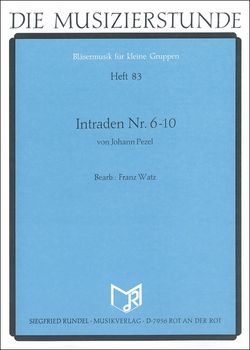
Johann Pezel
Intrades No. 6-10
Ensemble Time
PDF
view
Johann Pezel
Intrades No. 6-10
Ensemble Time
- Instrumentation 5 Wind Instruments
- Composer Johann Pezel
- Editor Franz Watz
- Series Die Musizierstunde
-
Difficulty Level
- Edition Score and Parts
- Publisher Musikverlag Rundel
- Order no. MVSR5083
 ships within 2-5 working days
incl. tax,
excl. shipping costs
Not available in all countries. Learn more

Description:
JOHANN CHRISTOPH PEZEL (1639 - 1694), also known in professional circles as Bässel, Betzel, Bezeld, Petzel, Petzold, Pezelius, was active in Leipzig and Bautzen. His job included 'blowing off' the hours at the town hall tower. He also had the right to play music at festive occasions of all kinds. It can be assumed that Pezel composed a large part of his music for such occasions.
The ten intradas of the present edition, issue no. 47 and issue no. 83, were taken from 'Fünfstimmige Blasende Musik', which consists of 76 pieces for 2 tines and 3 trombones in the first print of 1685 in Frankfurt/Main.
Our concern is to make this music, which has somewhat fallen into oblivion, accessible to today's wind players and listeners. Thus the various instrumentation possibilities are to be understood. Starting from quintet (as well as the original version) these pieces are playable. However, the individual parts can be chorused according to the instrumentation list in order to appeal to a large number of performers. Pedagogically, any formation that has a roughly balanced distribution of voices is acceptable. Without brass, however, this music will lose its impact.
The 1st clarinet in B-flat should be used only when the flute or the clarinet in E-flat is involved, since this voice is usually above the 1st original voice. Likewise, the percussion should only be used with choral instrumentation.
The tempo is determined by the character of the respective piece, whereby a dragging or overhasty time measure does not serve the performance. Ornaments common during the composer's lifetime are not included and should also be used sparingly. Under the supervision of the teacher, however, trills, mordents and trills can contribute to an increase in the joy of music-making and to the completion of a performance in keeping with the style. Furthermore, a discreet ritardando is appropriate at the end of each piece.
The dynamics indicated do not originate from the composer. However, this music lives from the contrast between piano and forte, from the terrace or step dynamics. The crescendo should therefore only confirm the exception.
This edition contains the following parts:
Comprehensive set of parts for wind orchestra
1st part in C (flute)
1st part in C (oboe)
1st clarinet in Bb (supplementary part)
1st part in Eb
Cornet in Eb
1. Voice in Bb
2nd voice in Eb
2nd voice in Bb
3rd voice in Bb (low)
3rd voice in Bb (high)
3rd voice in Eb/F
3rd voice in C (trombone)
4th voice in Bb
4th voice in C
5th voice in Eb
5th voice in Bb
5th voice in C (basses)
Percussion ad. lib.
Timbals
The ten intradas of the present edition, issue no. 47 and issue no. 83, were taken from 'Fünfstimmige Blasende Musik', which consists of 76 pieces for 2 tines and 3 trombones in the first print of 1685 in Frankfurt/Main.
Our concern is to make this music, which has somewhat fallen into oblivion, accessible to today's wind players and listeners. Thus the various instrumentation possibilities are to be understood. Starting from quintet (as well as the original version) these pieces are playable. However, the individual parts can be chorused according to the instrumentation list in order to appeal to a large number of performers. Pedagogically, any formation that has a roughly balanced distribution of voices is acceptable. Without brass, however, this music will lose its impact.
The 1st clarinet in B-flat should be used only when the flute or the clarinet in E-flat is involved, since this voice is usually above the 1st original voice. Likewise, the percussion should only be used with choral instrumentation.
The tempo is determined by the character of the respective piece, whereby a dragging or overhasty time measure does not serve the performance. Ornaments common during the composer's lifetime are not included and should also be used sparingly. Under the supervision of the teacher, however, trills, mordents and trills can contribute to an increase in the joy of music-making and to the completion of a performance in keeping with the style. Furthermore, a discreet ritardando is appropriate at the end of each piece.
The dynamics indicated do not originate from the composer. However, this music lives from the contrast between piano and forte, from the terrace or step dynamics. The crescendo should therefore only confirm the exception.
This edition contains the following parts:
Comprehensive set of parts for wind orchestra
1st part in C (flute)
1st part in C (oboe)
1st clarinet in Bb (supplementary part)
1st part in Eb
Cornet in Eb
1. Voice in Bb
2nd voice in Eb
2nd voice in Bb
3rd voice in Bb (low)
3rd voice in Bb (high)
3rd voice in Eb/F
3rd voice in C (trombone)
4th voice in Bb
4th voice in C
5th voice in Eb
5th voice in Bb
5th voice in C (basses)
Percussion ad. lib.
Timbals