
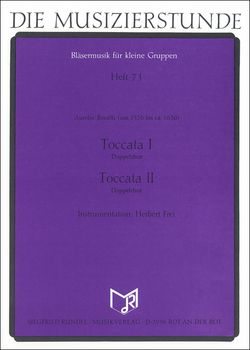
Toccata I-Toccata II
Ensemble Time 73
PDF
view
Toccata I-Toccata II
Ensemble Time 73
- Instrumentation 8 Wind Instruments
- Optional Instrumentation 4 Wind Instruments and Organ
- Editor Herbert Frei
- Series Die Musizierstunde
-
Difficulty Level
- Edition Director's Score and Parts
- Publisher Musikverlag Rundel
- Order no. MVSR5073
 ships within 2-5 working days
incl. tax,
excl. shipping costs
Not available in all countries. Learn more

Description:
2nd chorus can also be played by an organ
CHORUS 1
1st voice in C (flute/oboe)
1st voice in Eb (clarinet in Eb/cornet in Eb)
1st voice in Bb (1st clarinet)
1st voice in Bb (cornet/flugelhorn/trumpet)
2. Voice in Bb (8va clarinet)
2. Voice in Bb (cornet/flugelhorn/trumpet)
2. Voice in Eb (alto saxophone/horn)
3. Voice in Eb (alto saxophone/horn)
3. Voice in Bb (tenor sax./tenor horn/trombone)
3. Voice in C (trombone)
4. Voice in Eb (baritone sax./bass in Eb)
4th voice in Bb (baritone/trombone/bass in Bb)
4th voice in C (baritone/trombone/basses)
CHOIR II
1st voice in Bb (trumpet)
2nd voice in Bb (trumpet)
2nd voice in Eb (horn)
3rd voice in Bb (trombone)
3. Voice in Eb (horn)
3rd voice in C (trombone)
4th voice in Bb (trombone)
4th voice in Eb (bass in Eb)
4th voice in C (trombone/bass)
Aurelio Bonelli (c. 1570 to c. 1630)
Aurelio Bonelli was born in Bologna in 1570. He served as organist in several churches in his native city and painted pictures. Around 1600 he moved to Milan and obtained the position of organist at San Michele in Bosco and a few years later at San Giovanni in Monte. Bonelli continued to be active as a painter and may have died in Milan around 1630.
His compositional output is not very large, comprising mainly 8 ricercari and 8 canzoni, some masses and motets, and the 2 toccatas for eight voices here.
The toccatas can be scored in a wide variety of ways, the simplest scoring being a wind quartet with organ, in which case the voices of the 2nd choir are not scored. The organist plays the 2nd chorus from the playing score.
Other possibilities: Woodwind quartet/brass quartet or wide scaled brass quartet/narrow scaled brass quartet, etc.
Smaller instrumentations are preferable to lushly scored groupings. The high clarinet parts are to be used only in the last case.
Originally these toccatas were written, according to the time, without bar division. The counting unit was the half note. For reasons of simplification and manageability for amateur musicians, today's common time signatures were chosen in the present arrangements.
CHORUS 1
1st voice in C (flute/oboe)
1st voice in Eb (clarinet in Eb/cornet in Eb)
1st voice in Bb (1st clarinet)
1st voice in Bb (cornet/flugelhorn/trumpet)
2. Voice in Bb (8va clarinet)
2. Voice in Bb (cornet/flugelhorn/trumpet)
2. Voice in Eb (alto saxophone/horn)
3. Voice in Eb (alto saxophone/horn)
3. Voice in Bb (tenor sax./tenor horn/trombone)
3. Voice in C (trombone)
4. Voice in Eb (baritone sax./bass in Eb)
4th voice in Bb (baritone/trombone/bass in Bb)
4th voice in C (baritone/trombone/basses)
CHOIR II
1st voice in Bb (trumpet)
2nd voice in Bb (trumpet)
2nd voice in Eb (horn)
3rd voice in Bb (trombone)
3. Voice in Eb (horn)
3rd voice in C (trombone)
4th voice in Bb (trombone)
4th voice in Eb (bass in Eb)
4th voice in C (trombone/bass)
Aurelio Bonelli (c. 1570 to c. 1630)
Aurelio Bonelli was born in Bologna in 1570. He served as organist in several churches in his native city and painted pictures. Around 1600 he moved to Milan and obtained the position of organist at San Michele in Bosco and a few years later at San Giovanni in Monte. Bonelli continued to be active as a painter and may have died in Milan around 1630.
His compositional output is not very large, comprising mainly 8 ricercari and 8 canzoni, some masses and motets, and the 2 toccatas for eight voices here.
The toccatas can be scored in a wide variety of ways, the simplest scoring being a wind quartet with organ, in which case the voices of the 2nd choir are not scored. The organist plays the 2nd chorus from the playing score.
Other possibilities: Woodwind quartet/brass quartet or wide scaled brass quartet/narrow scaled brass quartet, etc.
Smaller instrumentations are preferable to lushly scored groupings. The high clarinet parts are to be used only in the last case.
Originally these toccatas were written, according to the time, without bar division. The counting unit was the half note. For reasons of simplification and manageability for amateur musicians, today's common time signatures were chosen in the present arrangements.