
François-René Gebauer
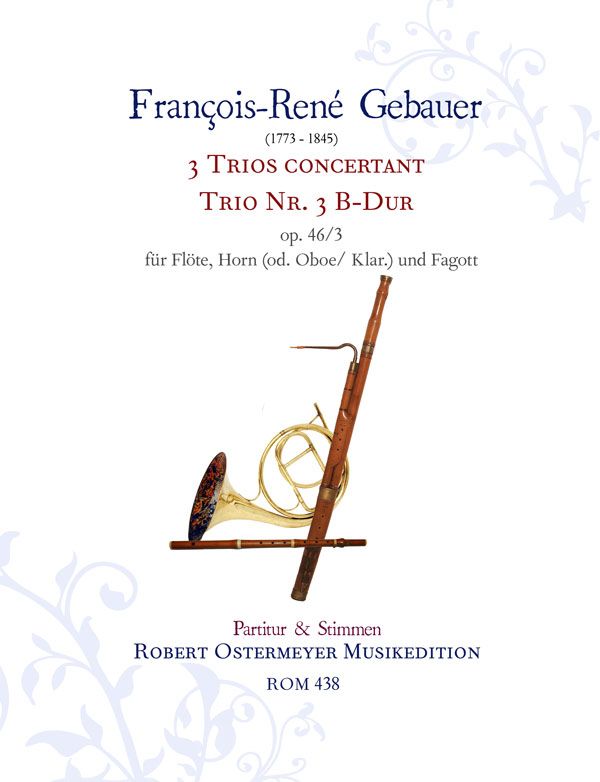
Trio in B flat major op. 46/3
for flute, horn (or oboe/clarinet) and bassoon
Video
view
François-René Gebauer
Trio in B flat major op. 46/3
for flute, horn (or oboe/clarinet) and bassoon
- Instrumentation Flute, Horn and Bassoon
- Optional Instrumentation Flute, Oboe and Bassoon
- Composer François-René Gebauer
- Edition Score and Parts
- Publisher Robert Ostermeyer Musikedition
- Order no. ROM438
 ships within 2-4 working days
incl. tax,
excl. shipping costs
Not available in all countries. Learn more

Description:
François René Gebauer (1773 - 1845)
(* 15. 3. 1773 in Versailles, † 28. 7. 1845 in Paris) was the son of a German military musician. He was trained musically by his brother Michel-Joseph (oboe) and François Devienne (bassoon). At the age of 15, he joined the Garde suisse in Versailles as a bassoonist and soon followed his brother to Paris, where he was a member of the Musique de la garde nationale de Paris. In 1795 he became professor of bassoon at the Conservatoire de Paris, where he remained until 1802 and then from 1824 to 1838. Around 1800 he became bassoonist at the Grande Opera. Gebauer's compositional output includes 13 bassoon concertos, 8 symphonies and numerous chamber works with and for wind instruments.
Trio op.46/3 for flute, horn (or clarinet or oboe) and bassoon
The present trio no. 3 is from Gebauer's Trois Trios concertant op.46 for flute, horn and bassoon was first printed by the Paris publishing house of Paté with the plate number 2088. On the print Gebauer describes himself as "Chevalier de la Légion d'honneur, Artiste de la Chapelle de Roi, et 1er Basson de l'academie Royale de Musique".
The trios were dedicated to "Monsieurs Bonjours freres"
As an alternative for the horn part, Gebauer arranged a part for oboe or clarinet. As a clarinet in C has to be used for this, an additional clarinet part in B flat has been edited in this new edition.
(* 15. 3. 1773 in Versailles, † 28. 7. 1845 in Paris) was the son of a German military musician. He was trained musically by his brother Michel-Joseph (oboe) and François Devienne (bassoon). At the age of 15, he joined the Garde suisse in Versailles as a bassoonist and soon followed his brother to Paris, where he was a member of the Musique de la garde nationale de Paris. In 1795 he became professor of bassoon at the Conservatoire de Paris, where he remained until 1802 and then from 1824 to 1838. Around 1800 he became bassoonist at the Grande Opera. Gebauer's compositional output includes 13 bassoon concertos, 8 symphonies and numerous chamber works with and for wind instruments.
Trio op.46/3 for flute, horn (or clarinet or oboe) and bassoon
The present trio no. 3 is from Gebauer's Trois Trios concertant op.46 for flute, horn and bassoon was first printed by the Paris publishing house of Paté with the plate number 2088. On the print Gebauer describes himself as "Chevalier de la Légion d'honneur, Artiste de la Chapelle de Roi, et 1er Basson de l'academie Royale de Musique".
The trios were dedicated to "Monsieurs Bonjours freres"
As an alternative for the horn part, Gebauer arranged a part for oboe or clarinet. As a clarinet in C has to be used for this, an additional clarinet part in B flat has been edited in this new edition.
Customers rated this product:
Manufacturer Information:
Robert Ostermeyer
Giselherstraße 21
85053
Ingolstadt
Deutschland
Other customers also bought:
- Oboe, Clarinet, Horn and Bassoon
- Score and Parts
- Fritz Krüger
-
ships within 3-6 working days
- Score and Parts
-
in stock
ships within 1-2 working days
Robert Nicolas-Charles Bochsa
für Flöte, Oboe (oder Klarinette in C), Horn und Fagott
- Score and Parts
-
ships within 3-6 working days
François-René Gebauer
für Flöte, Klarinette oder Oboe, Horn und Fagott (1800) (Partitur und Stimmen)
- Score and Parts
-
ships within 3-6 working days
- 2 Flutes and 2 Horns
- Score and Parts
-
ships within 4-8 working days
Frederico Fiorillo
für Flöte oder Oboe, Horn, Violine, Viola und Basso - Partitur und Stimmen
- Score and Parts
-
ships within 3-6 working days
Johann Friedrich Edelmann
- Harpsichord
- Sheet Music
-
in stock
ships within 1-2 working days
Giovanni Punto (Johann (Jan) Wenzel (Vaclav) Stich)
Partitur und Stimmen
- Score and Parts
-
ships within 3-6 working days

Henri Joseph Rigel
- Harpsichord
- Sheet Music
-
ships within 2-4 weeks
Filippo Ruge
per Flauto Traversiere, Violino ed Corno da Caccia (Flöte, Violine und Horn)
- Flute, Violin and Horn
- Score and Parts
-
in stock
ships within 1-2 working days
- Score and Parts
-
ships within 3-6 working days
- Score and Parts
-
in stock
ships within 1-2 working days
Jacques Christoph Michel Widerkehr
für Flöte, Horn und Fagott - Partitur und Stimmen
- Flute, Horn and Bassoon
- Score and Parts
-
ships within 3-6 working days

Carl Stamitz
- Oboe, Horn, Viola and Cello
- Set of Parts
- Bernhard Päuler
-
ships within 4-8 working days
Henri Joseph Rigel
- Harpsichord
- Sheet Music
-
ships within 2-4 weeks