
Bruno Mantovani
Mit Ausdruck
Bruno Mantovani
Mit Ausdruck
- Instrumentation Bass Clarinet
- Composer Bruno Mantovani
- Edition Sheet Music
- Publisher Editions Henry Lemoine
- Order no. LEMO29818
 ships within 4-8 working days
incl. tax,
excl. shipping costs
Not available in all countries. Learn more

Description:
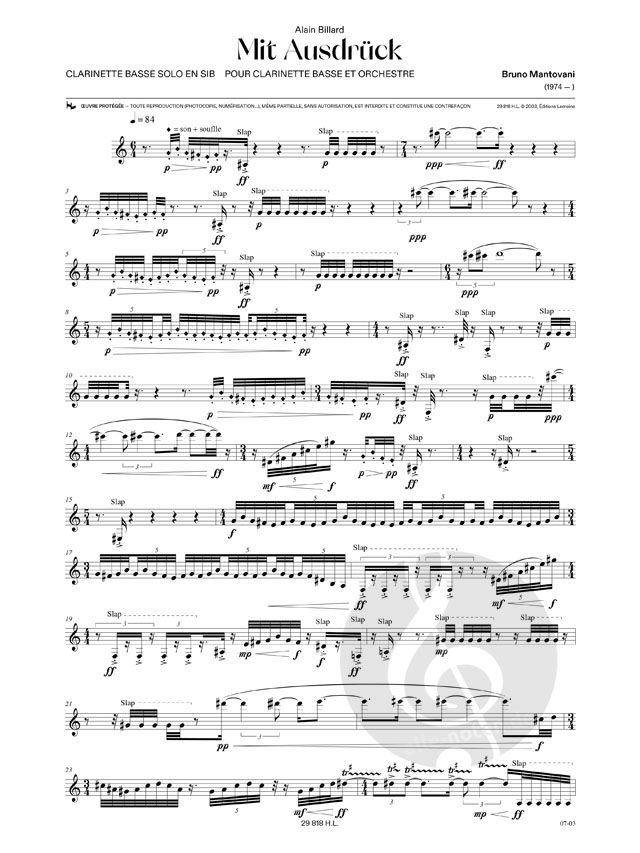
Even more than the magnificent melodic lines of rare inventiveness, it's the pianistic accompaniment formulas ("pattern" in English, or "formel" in German) that fascinate me in Schubert's Lieder. Often the bearers of meaning and conductors of dramaturgy, these repetitive elements whose gradual transformations build the form are much more than a simple case surrounding the vocal part, but contain the very essence of the musical substance. When Jonathan Nott, Artistic Director of the Bamberg Symphony Orchestra, asked me to write a tribute to Schubert, I immediately accepted the challenge with enthusiasm, and chose to draw my inspiration from the musical material of several of the composer's lieder. As such, it is not a question of variations or paraphrases, but rather of an abstract development of the material borrowed from Schubert. Moreover, the formation chosen (Mit ausdruck is a concerto for bass clarinet and full orchestra), which is unique in the history of music, enabled me to write in a logic of proliferation, an idea stated by the soloist finding multiple echoes or counterpoints in the orchestra.Gretchen am Spinnrade: Schubert's obsessive cell is presented here by the soloist, interspersed with formulas stated in "slap" (a percussive mode of clarinet playing), or microtonal chromatisms echoing the beginning of the melody. Erlkönig: the progression on the obsessive motif in the previous section leads to an orchestral tutti based on the three motivic elements present in the original lied. Die Forelle and Der Tod un das Mädchen: although in literary terms the two Lieder have nothing to do with each other (!!!!), I decided to superimpose them on each other.), I decided to superimpose the aquatic gestures of the first piece, multiplied in the orchestra, onto the regular ostinato of the second.In der Ferne: I retained from this lied only the general profile of the introductory formula: two distant chords (octaves in the original) which give rise to a filling in the middle register. Nacht und Traüme: here, the original tremolo is accelerated, but the effect of suspending time breaks the logic of organic development that has been omnipresent since the beginning of the work.Suleika I: here, the motif of the original lied is accelerated and, above all, presented in much higher dynamics. Der Wanderer: the piece ends with a sense of calm, the regularity of the accompaniment formula allowing the soloist to move into a lyrical register.Mit audruck draws all its musical substance from various Schubert Lieder, but the meaning of the piece seems quite different from the model. Indeed, the musical elements here are pretexts for development, and make no reference whatsoever to the original literary intent. Commissioned by the Bamberg Symphony Orchestra, which premiered the work on October 8, 2003, conducted by Jonathan Nott, Mit ausdruck is dedicated to my friend, clarinettist Alain Billard.Bruno MantovaniRecording1 CD Tudor, 7132, Schubert DialogWidmann: Lied für Orchestrer - Rihm: Erscheinung - Mantovani: Mit Ausdruck - Schnebel: Schubert-PhantasieBamberger Symphoniker, Alain Billard (bass clarinet), Jonathan Nott (conductor)