
Johannes Brahms
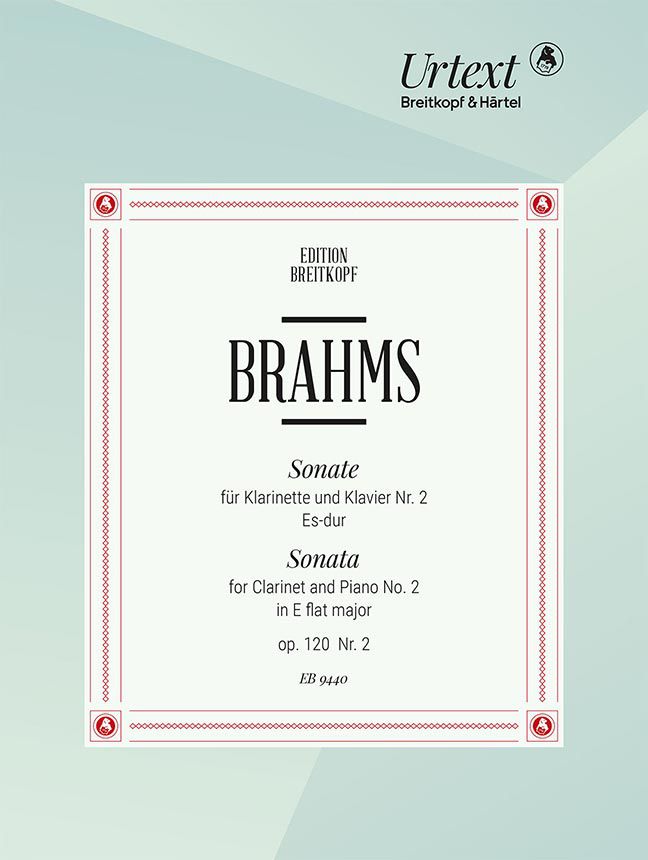
Sonata No. 2 in E flat major op. 120/2
for Clarinet and Piano
PDF
view
Johannes Brahms
Sonata No. 2 in E flat major op. 120/2
for Clarinet and Piano
- Instrumentation Clarinet and Piano
- Composer Johannes Brahms
- Editor Hans Gál
- Edition Piano Score and Part(s) (Urtext)
- Publisher Breitkopf & Härtel
- Order no. EB9440
 in stock
ships within 1-2 working days
incl. tax,
excl. shipping costs
Not available in all countries. Learn more

Description:
The two sonatas of Johannes Brahms's op. 120 are widely hailed as crowning points of the repertoire for clarinet and piano. Moreover, in the version for viola and piano arranged by Brahms himself, they rank among the most frequently played viola works of the 19th century. They far surpass in compositional substance the relatively few original sonatas written for these instrumentations during the same period.
Of the two fellow works, the Sonata No. 2 in E flat major is the more accessible. Diverging from the classical-romantic tradition, Brahms used the key of E flat major here not to express the heroic or monumental, but to obtain lyrical, chiefly restrained characterizations. The serenade-like beauty of the principal theme, which opens the sonata, has always been particularly admired. In his review of the world premiere, the renowned Viennese music critic Eduard Hanslick, a friend of Brahms's, raves with the words 'it was as if it had fallen from the Heavens.' The closing set of variations also follows with gentle gracefulness this lyrical character. However, the middle movement, with its tempestuous outer sections in E flat minor and the hymnic trio in B major provides a passionate and serious contrast, which allows the flanking idyll to unfold its beauties all the more insistently.
Of the two fellow works, the Sonata No. 2 in E flat major is the more accessible. Diverging from the classical-romantic tradition, Brahms used the key of E flat major here not to express the heroic or monumental, but to obtain lyrical, chiefly restrained characterizations. The serenade-like beauty of the principal theme, which opens the sonata, has always been particularly admired. In his review of the world premiere, the renowned Viennese music critic Eduard Hanslick, a friend of Brahms's, raves with the words 'it was as if it had fallen from the Heavens.' The closing set of variations also follows with gentle gracefulness this lyrical character. However, the middle movement, with its tempestuous outer sections in E flat minor and the hymnic trio in B major provides a passionate and serious contrast, which allows the flanking idyll to unfold its beauties all the more insistently.
-
1. Allegro amabile
-
2. Allegro appassionato
-
3. Andante con moto - Allegro
Customers rated this product:
Manufacturer Information:
Breitkopf & Härtel KG
Walkmühlstraße 52
65195
Wiesbaden
Deutschland
Other customers also bought:
Clarinet/High Clarinet/Bass Clarinet
- Clarinet
- Sheet Music
-
in stock
ships within 1-2 working days

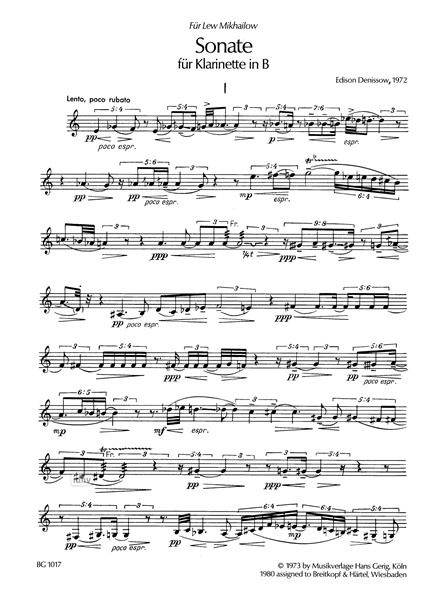
Edison Wassiljewitsch Denisow
- Clarinet
- Sheet Music
-
in stock
ships within 1-2 working days