
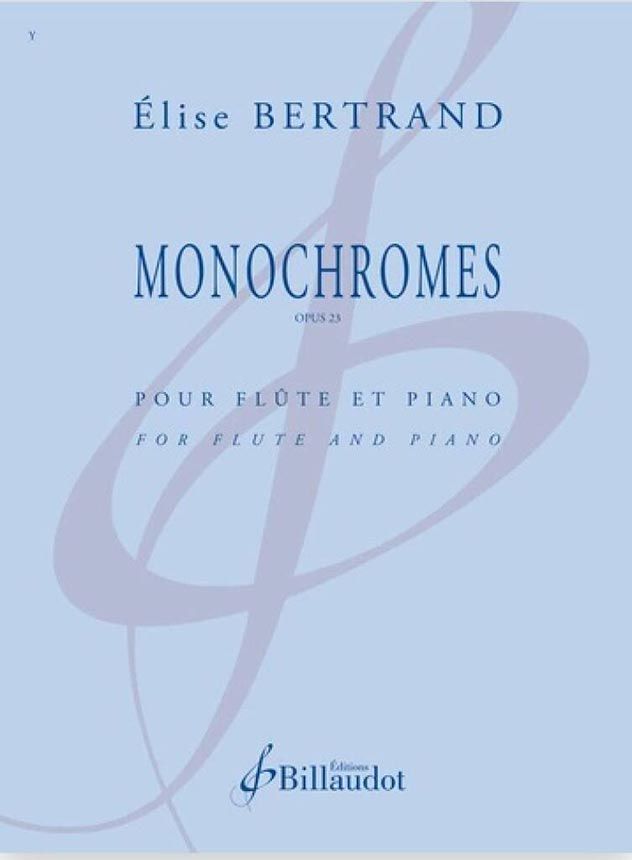
Élise Bertrand
Monochromes op. 23
for flute and piano
PDF
view
Élise Bertrand
Monochromes op. 23
for flute and piano
- Instrumentation Flute and Piano
- Composer Élise Bertrand
-
Difficulty Level
- Edition Piano Score and Part(s)
- Publisher Gerard Billaudot
- Order no. BILL10597
 in stock
ships within 1-2 working days
incl. tax,
excl. shipping costs
Not available in all countries. Learn more

Description:
Monochromes comes from the composer's interest in colour, which has been associated with light since childhood. Light becomes musical light.
It is the different sensations that the colours evoke in her that she wanted to transpose into three varied colours-atmospheres, imagining each movement haloed by a light and a texture of its own.
The first, lyrical, Monochrome, reveals the forms of an imaginary and sonorous landscape as the rhythm evolves. The contours of the melody, resembling shapes or objects, are articulated more and more precisely, shaping themselves from quarter notes to sixteenth notes in a gradual ascent before descending to half notes. Could it be the color white?
That's what the second Monochrome suggests, hazy and atmospheric. The effects of wind, ultrasound, loss of the notion of time, widening of the ambitus, evoke the colour pearl grey.
Contrasting in tempo, character and ardour, the last Monochrome is the accumulation of the textures of the other two movements, the explosion of a multitude of colours, creating the illusion of a single multiple colour, like an iridescent kaleidoscope.
It is the different sensations that the colours evoke in her that she wanted to transpose into three varied colours-atmospheres, imagining each movement haloed by a light and a texture of its own.
The first, lyrical, Monochrome, reveals the forms of an imaginary and sonorous landscape as the rhythm evolves. The contours of the melody, resembling shapes or objects, are articulated more and more precisely, shaping themselves from quarter notes to sixteenth notes in a gradual ascent before descending to half notes. Could it be the color white?
That's what the second Monochrome suggests, hazy and atmospheric. The effects of wind, ultrasound, loss of the notion of time, widening of the ambitus, evoke the colour pearl grey.
Contrasting in tempo, character and ardour, the last Monochrome is the accumulation of the textures of the other two movements, the explosion of a multitude of colours, creating the illusion of a single multiple colour, like an iridescent kaleidoscope.