
Tina Ternes
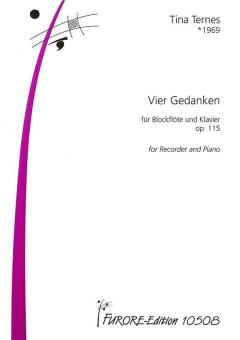
4 Gedanken op. 115
für Blockflöte und Klavier
NEW
Tina Ternes
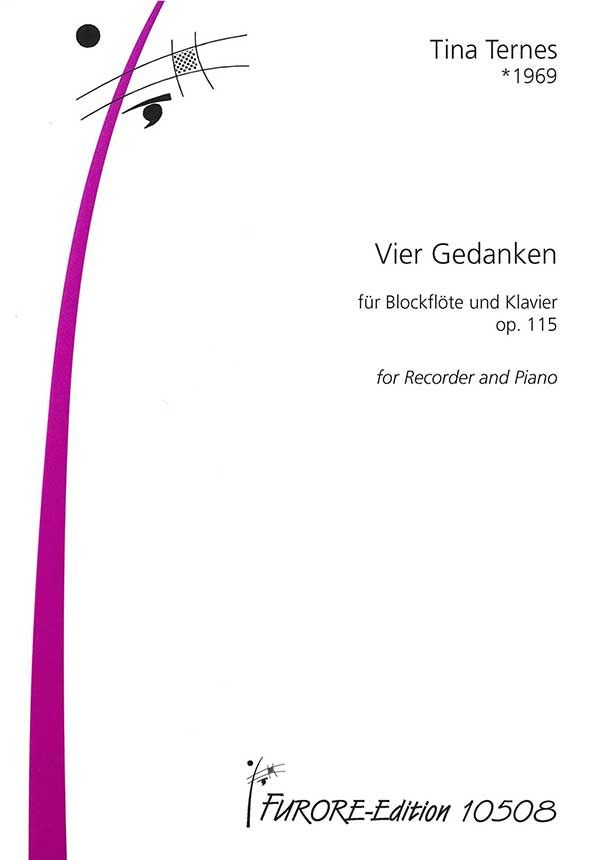
4 Gedanken op. 115
für Blockflöte und Klavier
- Instrumentation Recorder and Piano
- Composer Tina Ternes
- Edition Score and Parts
- Publisher Furore Verlag
- Order no. FUR10508
 ships within 4-8 working days
incl. tax,
excl. shipping costs
Not available in all countries. Learn more

Description:
In her "Four Thoughts" for recorder and piano, Tina Ternes unfolds a small musical world of ideas in which different moods and inner images are interwoven. The four movements—"Melancholy," "Consolation," "Dream Dance," and "Promenade"—trace a path from contemplation through confidence and playful reverie to a cheerful, lively scene.
World premiere in 2026 by Ute Schleich (recorders) and Brigitte Becker (piano) at the "100 Years of GEDOK" anniversary concert in Heidelberg
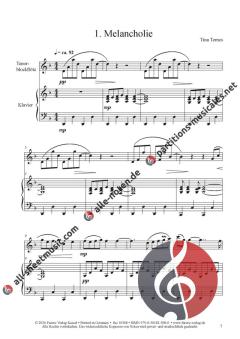
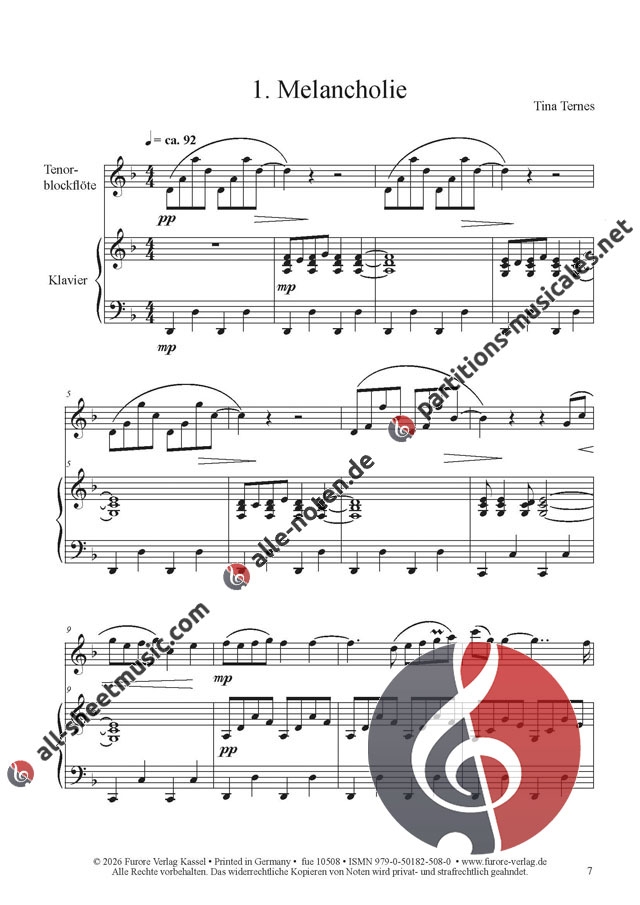
1. Melancholy
(tenor recorder)
The basic idea here was thoughts that circle around something, examining a matter from different angles, yet not necessarily arriving at a solution. Therefore, variations rather than contrasts play a role here, even though the middle section—initially cadenza-like, then rhythmic—stands out from the framing A section. The melodic material is distributed quite evenly between the piano and recorder; the overall mood is calm and melancholic.
2. Comfort
(bass recorder)
The piece works with two themes: an opening six-measure motif and a main theme spanning 20 measures. The short middle section emphasizes the harmony. Both themes return, though the main theme appears as a variation that begins in A major on the piano and is taken up by the flute, which carries the melodic lead in this piece. The aim here is to convey a sense of inner peace and serenity.
3. Dream Dance
(alto recorder)
Thoughts that jump back and forth and cannot really be grasped—cheerful, simple, and playful—are meant to be brought to life here. Formally, the piece is a rondo with a four-measure theme that is heard alternately on the flute and the piano and forms the ritornello. It remains in E major, while the two couplets explore other keys.
4. Promenade
(soprano recorder)
Here, the thoughts go for a walk, so to speak. The first section plays melodically with the church modes Lydian, Dorian, and Mixolydian, and is intended to represent the promenade—that is, the walk—rhythmically through the quarter notes with upbeat notes in the piano. The two middle sections (bars 18–48 and 49–65) stand in stark contrast to this. They correspond to two places that one visits during this mental stroll and contemplates at leisure before setting off on the return journey.
World premiere in 2026 by Ute Schleich (recorders) and Brigitte Becker (piano) at the "100 Years of GEDOK" anniversary concert in Heidelberg
1. Melancholy
(tenor recorder)
The basic idea here was thoughts that circle around something, examining a matter from different angles, yet not necessarily arriving at a solution. Therefore, variations rather than contrasts play a role here, even though the middle section—initially cadenza-like, then rhythmic—stands out from the framing A section. The melodic material is distributed quite evenly between the piano and recorder; the overall mood is calm and melancholic.
2. Comfort
(bass recorder)
The piece works with two themes: an opening six-measure motif and a main theme spanning 20 measures. The short middle section emphasizes the harmony. Both themes return, though the main theme appears as a variation that begins in A major on the piano and is taken up by the flute, which carries the melodic lead in this piece. The aim here is to convey a sense of inner peace and serenity.
3. Dream Dance
(alto recorder)
Thoughts that jump back and forth and cannot really be grasped—cheerful, simple, and playful—are meant to be brought to life here. Formally, the piece is a rondo with a four-measure theme that is heard alternately on the flute and the piano and forms the ritornello. It remains in E major, while the two couplets explore other keys.
4. Promenade
(soprano recorder)
Here, the thoughts go for a walk, so to speak. The first section plays melodically with the church modes Lydian, Dorian, and Mixolydian, and is intended to represent the promenade—that is, the walk—rhythmically through the quarter notes with upbeat notes in the piano. The two middle sections (bars 18–48 and 49–65) stand in stark contrast to this. They correspond to two places that one visits during this mental stroll and contemplates at leisure before setting off on the return journey.