
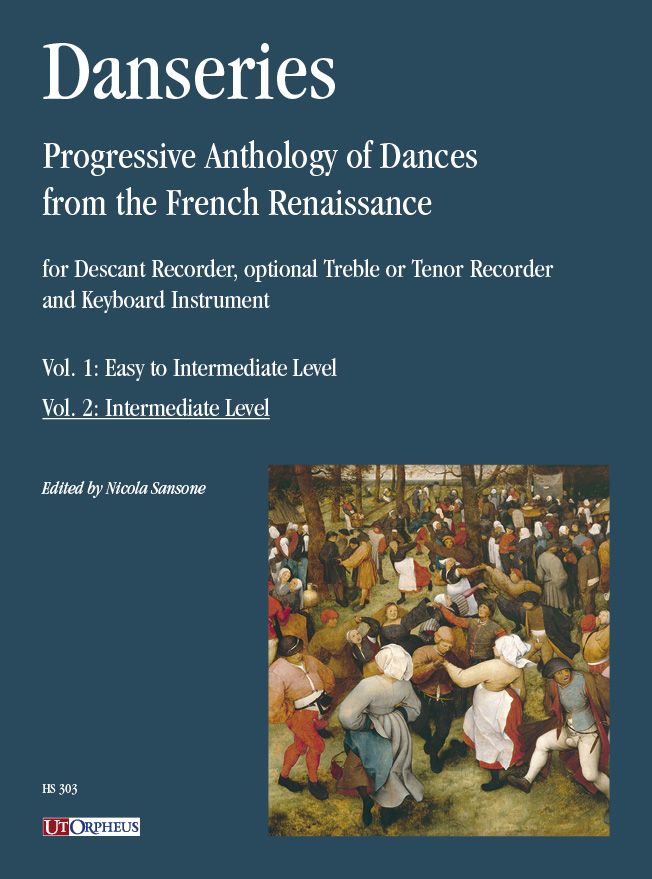
Danseries 2
Progressive Anthology of dances from the French Renaissance for descant recorder optional alto- or tenor recorder and keyboard instrument
PDF
view
Danseries 2
Progressive Anthology of dances from the French Renaissance for descant recorder optional alto- or tenor recorder and keyboard instrument
- Instrumentation Descant Recorder and Piano
- Optional Instrumentation Alto Recorder and Piano
- Editor Nicola Sansone
-
Difficulty Level
- Edition Piano Score and Part(s)
- Publisher UT Orpheus Edizioni
- Order no. ORPH-HS303
 in stock
ships within 1-2 working days
incl. tax,
excl. shipping costs
Not available in all countries. Learn more

Description:
This two-volume anthology has been designed on the living experience of teaching as material for early and intermediate soprano recorder players. The progressive order allows an approach to ensemble music starting from the use of only the notes of the left hand and proceeds in parallel with the acquisition of the new positions until the chromatic extension of an octave and a sixth is reached.
The repertoire used consists exclusively of dance music from the French and Flemish areas contained in various collections published between 1530 and 1583 by different authors and curators. This choice was dictated by numerous and different factors: the extremely clear and symmetrical metrical and formal schemes typical of the Renaissance dance form, with due and useful exceptions, help to understand the concept of musical phrase; the use of codified and recurring rhythmic formulas allows the rhythmic division to be perfected; Harmony based mostly on fundamental degrees helps to form an experience of listening, intonation and understanding of the main harmonic functions. No less significant are other elements: a variety in the length of the pieces, from a few measures to a few dozen, favors the development of concentration and attention with the same technical difficulties; but above all the vastness of the repertoire, more than 500 compositions, allows you to choose and order the pieces with an idea of technical and musical progressivity comparable to that of a method.
The edition is made in such a way that the pieces can be performed, all for four voices except for a few five, in different formations, the most essential of which is in reduced form for three voices of soprano, tenor and bass, the latter two entrusted respectively to the right and left hand of the keyboardist. Since the recorders play at the upper octave, the tenor part is also transposed in the same way to make the sound of the three upper voices homogeneous, while the bass retains the original texture. It is also possible to expand the group to play the four voices in full with the addition of an alto or tenor flute that plays the alto part, available in the separate part, and two additional instruments, tenor and bass flutes or others, to play the respective lines alone or in doubling at the keyboard.
The repertoire used consists exclusively of dance music from the French and Flemish areas contained in various collections published between 1530 and 1583 by different authors and curators. This choice was dictated by numerous and different factors: the extremely clear and symmetrical metrical and formal schemes typical of the Renaissance dance form, with due and useful exceptions, help to understand the concept of musical phrase; the use of codified and recurring rhythmic formulas allows the rhythmic division to be perfected; Harmony based mostly on fundamental degrees helps to form an experience of listening, intonation and understanding of the main harmonic functions. No less significant are other elements: a variety in the length of the pieces, from a few measures to a few dozen, favors the development of concentration and attention with the same technical difficulties; but above all the vastness of the repertoire, more than 500 compositions, allows you to choose and order the pieces with an idea of technical and musical progressivity comparable to that of a method.
The edition is made in such a way that the pieces can be performed, all for four voices except for a few five, in different formations, the most essential of which is in reduced form for three voices of soprano, tenor and bass, the latter two entrusted respectively to the right and left hand of the keyboardist. Since the recorders play at the upper octave, the tenor part is also transposed in the same way to make the sound of the three upper voices homogeneous, while the bass retains the original texture. It is also possible to expand the group to play the four voices in full with the addition of an alto or tenor flute that plays the alto part, available in the separate part, and two additional instruments, tenor and bass flutes or others, to play the respective lines alone or in doubling at the keyboard.
Customers rated this product:
Manufacturer Information:
Ut Orpheus Edizioni S.r.l.
Via Marsala 31/E
40126
Bologna
Italien
Other customers also bought:
Johann Joseph Fux
- Recorder Quartet
- Sheet Music
- Klaus Winkler
-
ships within 2-4 weeks
- 2 Alto Recorders and Continuo
- Score and Parts
-
ships within 2-5 working days
- Also available for download!

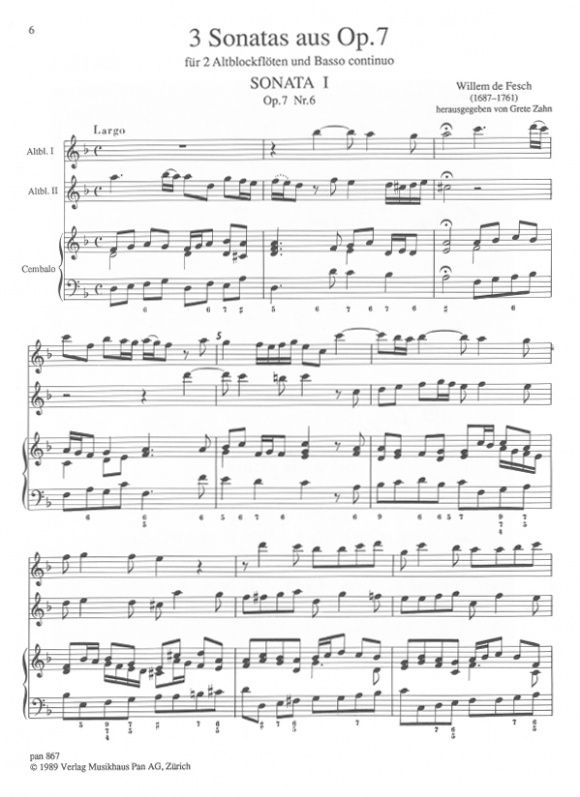
- 2 Alto Recorders and Continuo
- Score and Parts
-
ships within 3-6 working days
- Recorder Quartet
- Sheet Music
- Ehrenfried Reichelt
-
in stock
ships within 1-2 working days
Robert Valentine
- 2 Alto Recorders and Continuo
- Instrumental Part: Cello
-
ships within 2-5 working days