
Adrien Ledoux
Beat!
for tenor saxophone and 3 baritone saxophones
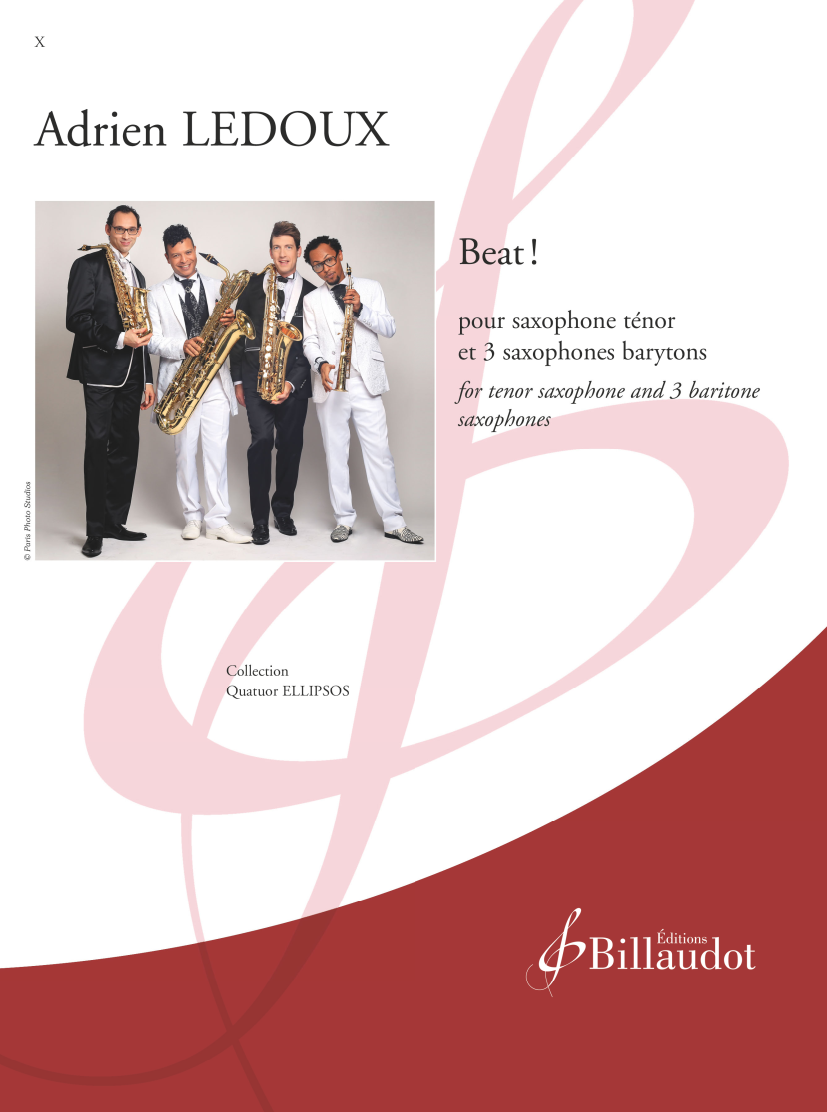
Video
view
PDF
view
Adrien Ledoux
Beat!
for tenor saxophone and 3 baritone saxophones
- Instrumentation 4 Saxophones (TBBB)
- Composer Adrien Ledoux
-
Difficulty Level
- Edition Score and Parts
- Publisher Gerard Billaudot
- Order no. BILL10470
 ships within 4-8 working days
incl. tax,
excl. shipping costs
Not available in all countries. Learn more

Description:
Beat! is a quartet in three movements for improvising tenor saxophone solo and three baritone saxophones.
This surprising work is built around the pulse (the framework) and improvisation (freedom) on the tenor saxophone. These two elements are used through three characteristic approaches to the saxophone: contemporary, classical and jazz-bossa.
Beat !a work in three movements for an improvising tenor saxophone solo and three baritone saxophones, aims to make heard or suggest an ever-present pulse, through different aesthetics.
The first movement begins with the three baritones spatialised on stage, the tenor hidden backstage or in the audience. It is only at the end of the first movement that the tenor begins improvising for a free period, leading into the second movement. During this improvisation, the baritone saxophones can freely restart the pulse.
The theme of the second movement can be freely played, ornamented and interpreted in the manner of a standard by the tenor saxophonist.
The third movement begins with a modern introduction reminiscent of the contemporary aesthetic of the first movement, then moves towards a generous bossa nova and closes after an improvisation putting the soloist (tenor) in the spotlight one last time.
This surprising work is built around the pulse (the framework) and improvisation (freedom) on the tenor saxophone. These two elements are used through three characteristic approaches to the saxophone: contemporary, classical and jazz-bossa.
Beat !a work in three movements for an improvising tenor saxophone solo and three baritone saxophones, aims to make heard or suggest an ever-present pulse, through different aesthetics.
The first movement begins with the three baritones spatialised on stage, the tenor hidden backstage or in the audience. It is only at the end of the first movement that the tenor begins improvising for a free period, leading into the second movement. During this improvisation, the baritone saxophones can freely restart the pulse.
The theme of the second movement can be freely played, ornamented and interpreted in the manner of a standard by the tenor saxophonist.
The third movement begins with a modern introduction reminiscent of the contemporary aesthetic of the first movement, then moves towards a generous bossa nova and closes after an improvisation putting the soloist (tenor) in the spotlight one last time.