
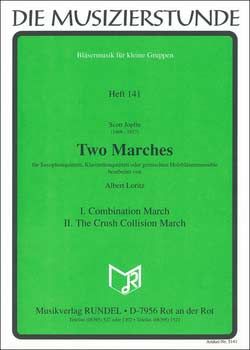
Scott Joplin
2 Marches
Ensemble Time 141
PDF
view
Scott Joplin
2 Marches
Ensemble Time 141
- Instrumentation Saxophone Quartet
- Optional Instrumentation Clarinet Quartet
- Composer Scott Joplin
- Editor Albert Loritz
- Series Die Musizierstunde
-
Difficulty Level
- Edition Score and Parts
- Publisher Musikverlag Rundel
- Order no. MVSR5141
 ships within 2-5 working days
incl. tax,
excl. shipping costs
Not available in all countries. Learn more

Description:
Score (notation for saxophone quintet)
Soprano sax. in Bb (1st clarinet)
1st alto sax. in Eb
2nd alto sax. in Eb
Tenor sax. in Bb
Baritone sax. in Eb
Flute (ad.lib.)
Oboe (Flute II) (ad.libl)
2nd clarinet in Bb
3. Clarinet in Bb
Alto Clarinet in Eb
Bass Clarinet in Bb
Bassoon
Scott Joplin, born in 1868 in Texarkan, the 'King of Ragtime Writers', had become abruptly famous in 1899 when his 'Maple Leaf Rag' appeared in print. In the early years of the 20th century he wrote a large number of ragtimes, which brought him fame and also some prosperity. The last years of his life Joplin turned increasingly to larger musical forms. He could not get over the failure of his opera 'Treemonisha' (1915), and in 1917 he died in Manhattan State Hospital in New York.
The complete edition of Joplin's piano works includes a wealth of ragtimes as well as some marches and waltzes. Although these pieces were invented and written as 'salon pieces' for piano, evidence shows that they were arranged early on for all sorts of instrumentation, including marching band. (Incidentally, Joplin played second cornet in the Queen City Concert Band in Sedalia in 1894!)
On the arrangement:
Joplin's piano setting is largely determined by a fixed musical division of roles: right hand = melody, left hand = preludes and postludes. Again and again, however, passages appear which are reminiscent of an orchestral distribution and give the impression that one is dealing with a kind of piano reduction of a (wind) orchestral piece.
In the present arrangement, Joplin's piano movement was transferred to the individual instruments of the quintet movement in such a way that a mesh of independent voices was created. The melody fell alternately to the first and second voices, but occasionally wanders into lower regions. The dumb proposal/accompaniment figures typical of the piano movement were dissolved into secondary melodies and accompaniment figures more attractive for wind instruments in such a way that a lively, musical movement was created, which at some points one can also hear an inner smirk and a slight hint of ironic detachment on the part of the arranger. Many a repetition got a contrapuntal 'encore'...
Both marches were set a whole tone lower compared to the original.
The 'CRUSH COLLISION MARCH' contains some elements of 'program music'. The melancholy beginning is interesting, certainly a consequence of the train accident described later. From bar 77 on, it becomes quite concrete. Joplin placed the following explanatory texts under his notes:
â-º Measure 77 'The noise of the trains while running at the rate of sixty miles per hour'
â-º Measure 79 'Whistling for the crossing'
â-º Measure 81 'Noise of the trains'
â-º Measure 83 'Whistle before the collision'
â-º Measure 84 'The Collision'
Our two Joplin marches can be played in solo or choral quintet setting.
Possible instrumentation:
1st voice soprano saxophone, 1st clarinet
2nd voice 1st alto saxophone, 2nd clarinet
3rd voice 2nd alto saxophone, 3rd clarinet
4. Voice tenor saxophone, alto clarinet
5th voice baritone saxophone, bass clarinet, bassoon
In addition to the pure saxophone or clarinet quintet, well mixed ensembles are also conceivable. For example, a very good sounding combination would be (1) three clarinets in unison, (2) alto saxophone, (3) two or three clarinets in unison, (4) tenor saxophone, (5) bassoon and bass clarinet.
If the quintet parts are balanced and strong enough, flute(s) and oboe(s) can be added as additional timbre. The additional voices provided for this purpose are not identical to the first quintet voice; the voice 'Oboe (Flute II)' can only be occupied when a high flute voice is also occupied.
Soprano sax. in Bb (1st clarinet)
1st alto sax. in Eb
2nd alto sax. in Eb
Tenor sax. in Bb
Baritone sax. in Eb
Flute (ad.lib.)
Oboe (Flute II) (ad.libl)
2nd clarinet in Bb
3. Clarinet in Bb
Alto Clarinet in Eb
Bass Clarinet in Bb
Bassoon
Scott Joplin, born in 1868 in Texarkan, the 'King of Ragtime Writers', had become abruptly famous in 1899 when his 'Maple Leaf Rag' appeared in print. In the early years of the 20th century he wrote a large number of ragtimes, which brought him fame and also some prosperity. The last years of his life Joplin turned increasingly to larger musical forms. He could not get over the failure of his opera 'Treemonisha' (1915), and in 1917 he died in Manhattan State Hospital in New York.
The complete edition of Joplin's piano works includes a wealth of ragtimes as well as some marches and waltzes. Although these pieces were invented and written as 'salon pieces' for piano, evidence shows that they were arranged early on for all sorts of instrumentation, including marching band. (Incidentally, Joplin played second cornet in the Queen City Concert Band in Sedalia in 1894!)
On the arrangement:
Joplin's piano setting is largely determined by a fixed musical division of roles: right hand = melody, left hand = preludes and postludes. Again and again, however, passages appear which are reminiscent of an orchestral distribution and give the impression that one is dealing with a kind of piano reduction of a (wind) orchestral piece.
In the present arrangement, Joplin's piano movement was transferred to the individual instruments of the quintet movement in such a way that a mesh of independent voices was created. The melody fell alternately to the first and second voices, but occasionally wanders into lower regions. The dumb proposal/accompaniment figures typical of the piano movement were dissolved into secondary melodies and accompaniment figures more attractive for wind instruments in such a way that a lively, musical movement was created, which at some points one can also hear an inner smirk and a slight hint of ironic detachment on the part of the arranger. Many a repetition got a contrapuntal 'encore'...
Both marches were set a whole tone lower compared to the original.
The 'CRUSH COLLISION MARCH' contains some elements of 'program music'. The melancholy beginning is interesting, certainly a consequence of the train accident described later. From bar 77 on, it becomes quite concrete. Joplin placed the following explanatory texts under his notes:
â-º Measure 77 'The noise of the trains while running at the rate of sixty miles per hour'
â-º Measure 79 'Whistling for the crossing'
â-º Measure 81 'Noise of the trains'
â-º Measure 83 'Whistle before the collision'
â-º Measure 84 'The Collision'
Our two Joplin marches can be played in solo or choral quintet setting.
Possible instrumentation:
1st voice soprano saxophone, 1st clarinet
2nd voice 1st alto saxophone, 2nd clarinet
3rd voice 2nd alto saxophone, 3rd clarinet
4. Voice tenor saxophone, alto clarinet
5th voice baritone saxophone, bass clarinet, bassoon
In addition to the pure saxophone or clarinet quintet, well mixed ensembles are also conceivable. For example, a very good sounding combination would be (1) three clarinets in unison, (2) alto saxophone, (3) two or three clarinets in unison, (4) tenor saxophone, (5) bassoon and bass clarinet.
If the quintet parts are balanced and strong enough, flute(s) and oboe(s) can be added as additional timbre. The additional voices provided for this purpose are not identical to the first quintet voice; the voice 'Oboe (Flute II)' can only be occupied when a high flute voice is also occupied.